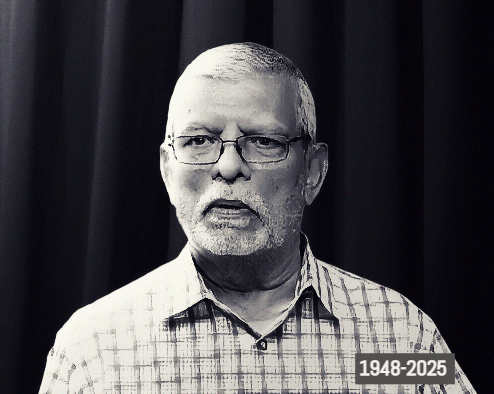
Mahdi Ahmed

Scripting waves of imagination from the sunny side of the Maldives.

Posts tagged ‘writing’

THE EVE I WAIT FOR EVERY YEAR

My Dearest Love,

Every year, on the eve of your birthday, I find myself here again—fingers on keys, heart refusing to sit still. It’s my favorite ritual, the one thing I never want to outgrow. You often ask me what I really want to do in life. Well, here’s the shocking truth: this. Writing you these letters. Everything else—screenplays, awards, even Everest—can politely wait their turn. Because all of them shrink next to you—you, the most beautiful contradiction I know.

You can silence a room with a single glance, then melt into tears over a stray cat licking a fish bone. Steel wrapped in silk—that’s you. And that mix—strength and softness—has a way of spilling into everything, even laughter, which you’ve turned into the rarest currency of our home.

Your dance moves, your one-liners, the way you make even silence ridiculous—if trophies were given for making me laugh, we’d have to rent a storage unit. Even Tuffin and his wife Hirafus would protest the unfairness. But if laughter is your gift, patience is your superpower—you’ve carried more than your share.

You put up with Kokko’s teenage thunderstorms, my YouTube binges, and my gold-medal snoring during the very movies you lovingly picked. But beyond the funny stuff lie the heavier flaws—the times I wasn’t present, the moments I should have listened, the lapses I wish I could take back. And still, you meet it all with a grace that doesn’t just humble me—it reminds me every day how deeply grateful I am to have you.

And that same quiet grace doesn’t just stay at home—it follows you into your CC days. Nerves before, brilliance after. The world sees strength; I see the heart it takes to show up, again and again.

And when you bring that same strength home, it turns into something else entirely—as a mother, you’re a force. Kokko is basically your twin with a teenage remix. Terrifying? Yes. A blessing? Absolutely. And somehow, on top of that, you still find space for your artistry—it’s magic.

You make your iPhone photography look like fine art and you even charm bougainvillea into blooming just by talking to them. If plants could vote, you’d be president by now. And your creativity doesn’t stop there—it spills into the kitchen too.

Your cooking? If nations wanted peace, they’d serve your chicken rice. Honestly, sometimes I wish I could have surprised you with it, especially last month when you lost your taste. But perhaps it’s better I didn’t—my version would’ve been memorable for all the wrong reasons—one spoon of that would’ve started a war.

But beyond the kitchen, there’s something even more powerful—your presence. People admire you not just for what you say but for the way you make them believe. Not by force, but simply by being you. That’s rare. And it’s exactly why you’ve been my muse from the very beginning.

The whole reason I returned to screenwriting was secretly trying to impress you. Even now, one remark from you can rewrite an entire film. At premieres, I walk proud—not because of the applause, but because you are beside me. And yes, you always steal the red carpet. I wouldn’t trade that theft for anything.

Through storms and sunshine, you’ve been my anchor, my muse, my Jessica, my SV, my gossip partner, my joy, my love. You’re not just the love of my life—you’re the life in my love.

So today, laugh, dance, and if a tear slips through, let it remind you of how completely, foolishly, and hopelessly I have always belonged to you.

Happy Birthday, my love. May your glow forever outshine every candle, every star, every dream I could never quite reach—but always wished I could place in your hands.

Your hopelessly devoted and sometimes hopelessly foolish husband.

HUSSAIN MUNAWWARU: CRAFTING THE UNSEEN SILENCE OF KAN’BULO

My creative journey with Hussain Munawwaru spans well over a decade. From the brutal realism of Sazaa to the devastating truths of Dhilakani, and more recently the uncomfortable introspection of Kamanaa, our collaborations have always been rooted in a shared commitment to confronting uncomfortable realities through cinema. With Kan’bulo, our fourth project together, Munawwaru’s direction once again proves why he remains one of the most fearless filmmakers working in Dhivehi cinema today.

Kan’bulo began in the wake of Kamanaa’s success — fresh after its theatrical run. Munawwaru handed me a digital copy of Yuktha, the 2009 National Award-winning long story, itself inspired by true events. I finished reading it in a single breathless sitting.

At its core, it was a harrowing account of suffering through the eyes of a 9-year-old. But Munawwaru, in his wisdom and restraint as a responsible storyteller, proposed a crucial shift: the protagonist’s age should be increased to 16 or 17. His reasoning was both artistic and ethical. While Kan’bulo still demands courage from its audience, asking them to endure the discomfort of confronting realities often left unspoken, portraying such trauma through the innocence of a 9-year-old would veer too close to the unbearable for our already conservative audience.

That decision speaks volumes about Munawwaru’s maturity as a filmmaker. He doesn’t flinch from darkness, but he understands the weight of responsibility — knowing when to push, and when to protect. He understands that cinema isn’t just about shock; it’s about resonance. It’s about asking the audience to walk the line with you without turning away in numbness.

What Munawwaru achieves with Kan’bulo is perhaps his most restrained, yet most quietly brutal work to date. Where Kamanaa confronted violence with raw, graphic immediacy, Kan’bulo lingers in the silences. His direction here is defined not by how loudly a scene can speak, but by how deeply it can wound without words. This film doesn’t move on dramatic cues or conventional pacing — it breathes in long pauses, in glances, in the weight of what’s left unsaid. Munawwaru lets the camera observe, unblinking, without interference. In doing so, he allows the audience no escape. They must sit with the discomfort. They must feel the slow erosion of the human spirit unfold.

Technically, Munawwaru continues to refine his visual language — muted palettes, claustrophobic framing, and stillness used as both tension and release. His collaboration with Fai on sound and Inthi on music furthers this precision. But equally vital to shaping the fractured emotional rhythm of Kan’bulo is the meticulous work of Abdulla Muaz, whose editing serves as the narrative’s silent architect. Nothing is there by accident. Every moment feels curated to serve the psychological architecture of the film.

As a screenwriter, I trust few directors to carry the weight of my scripts with the same reverence for subtext and emotional integrity as Munawwaru. He reads beyond dialogue. He listens for what isn’t spoken. He understands that trauma doesn’t always scream; sometimes, it barely whispers. And it’s in that silence where Munawwaru does his most harrowing work.

Kan’bulo is not Kamanaa. It’s a different film with a different pulse. But like every film we’ve created together, it is guided by Munawwaru’s unwavering belief that the stories we tell matter only if they remain true — no matter how difficult they are to watch.

Kan’bulo is set to be released on 31 August 2025.

MADULU MOHAMED WAHEED: THE LAST VERSE OF A GUARDIAN

This morning—April 14, 2025—the final chapter of a remarkable book closed.

My dear friend, Madulu Mohamed Waheed, passed away at the age of 77, while seeking treatment for his illness.

He was no ordinary man—he was a living manuscript.

A towering volume in the library of Maldivian literature and journalism.

His words did more than fill pages—they stirred thought, preserved culture, and gave breath to Dhivehi language.

He was not merely a writer. He was the binding that held our language together.

In 2019, he was awarded the National Award of Honor—a bookmark in a career richly underlined by purpose.

As Special Envoy of the Dhivehi Academy, he wrote till the ink ran dry.

His dedication? Unmatched. His margin notes? Timeless.

But there’s a personal grief scribbled in the margins of my heart.

He used to call some mornings and say, “Free for breakfast?”

It was never just about eating—it was about the chapters we were both writing.

About the drafts, the rewrites, the plots half-formed in our minds.

He’d help me find the right phrase, the perfect form, the word that unlocked a scene.

And when he published something new, he placed a copy in my hands.

Weeks before illness stole his final sentences, he said to me: “Let’s meet for another breakfast soon.”

We never turned that page.

And after my father passed, I found myself in one of those breakfasts—lost.

I spilled my sorrow on the table like ink.

He didn’t edit my grief.

He told me stories— verses about my father I had never read.

He reminded me that no one truly disappears from the book of life, as long as someone remembers their chapter.

Today, I feel the same ache.

Another book I cherished has closed.

But some books never really end.

They sit on our shelves—dog-eared, beloved, often revisited.

Rest now, my dearest friend.

The nation mourns.

I mourn.

And somewhere, in the silence between sentences— your voice will still turn the page.

Thank you for every word.

Rest in peace.

REKHACHITRAM: A CINEMATIC LOVE LETTER WRAPPED IN A MURDER MYSTERY

In Rekhachithram, director Jofin T. Chacko invites us on a journey that goes beyond time, blending mystery with a deep-seated love for Malayalam cinema’s illustrious past. The film intricately weaves a narrative that not only keeps the audience on the edge of their seats but also tugs at the nostalgic strings of those who cherish the golden age of Malayalam films.

The story centers around Vivek Gopinath, portrayed by Asif Ali, a police officer seeking redemption after a suspension. His assignment to investigate a 40-year-old murder case leads him to the enigmatic Rekha, played by Anaswara Rajan, an aspiring actress from the 1980s. The plot masterfully intertwines the investigation with the production of the real-life 1985 film Kathodu Kathoram, directed by Bharathan and starring Mammootty. This clever narrative choice creates an alternate history that feels both authentic and mesmerizing.

Chacko’s direction shines as he seamlessly transitions between the past and present, capturing the essence of the 1980s Malayalam film industry. The meticulous recreation of film sets, the depiction of industry stalwarts, and the subtle nods to iconic moments evoke a profound sense of nostalgia. The film doesn’t merely rely on these elements for sentimental value; they are integral to the storyline, enriching the viewing experience.

Asif Ali delivers a nuanced performance as Vivek, embodying the character’s determination and vulnerability. Anaswara Rajan’s portrayal of Rekha is both poignant and compelling, capturing the aspirations and challenges of an actress in that era. The supporting cast, including Manoj K. Jayan as Vincent and Zarin Shihab as young Pushpa, contribute significantly to the film’s depth and authenticity.

The film’s technical aspects are commendable. Appu Prabhakar’s cinematography beautifully captures the contrasting eras, while Mujeeb Majeed’s music subtly enhances the narrative without overshadowing it.

Rekhachithram is more than just a murder mystery; it’s a heartfelt tribute to Malayalam cinema’s rich heritage. It celebrates the art form, the artists, and the timeless stories that have shaped the industry. For cinephiles and casual viewers alike, this film offers a captivating blend of suspense and nostalgia, reminding us of the enduring magic of cinema.

Highly recommended.

P.S. The use of AI technology to recreate Mammootty’s appearance from the 1985 film is both innovative and respectful, adding a layer of realism that fans will appreciate.

KAMANAA: Unveiling the Haunting Reality of Domestic Violence

It all began one early morning on 04th June 2023 at Olympus Cafe. As usual, I sat with director Hussain Munawar, affectionately known as Kudafoolhu in the film fraternity, for our morning coffee. With his characteristic enthusiasm, he told me he had a story to share—a true one narrated by his wife, Rish, who got it from the source.

When he finished recounting the series of incidents, my coffee had gone cold, untouched except for one sip. Like the coffee, I felt a chill. Lately, stories with violence have been hard to stomach, and this one, about domestic violence, hit particularly hard. Munawar wanted it to be a spiritual sequel to his debut film “Sazaa,” which also dealt with violence against women and was our first collaboration in 2011. He promised to get an audio recording of the interview with the victim, and I agreed to start the detailed outlining once I received it. Little did I know this story would haunt me for the rest of the day.

The dramatic weight of the story put my brain into overdrive. That evening, on my way to Vilimale’ from Male’, I began crafting the screenplay on the ferry using my trusty Samsung S22 Ultra. By the time I reached Vilimale’, I had a rough outline. Later that evening, sprawled on the sitting room floor, I built up the backstory for all the separate acts of violence inflicted by a husband on his mild-mannered wife. I developed the characters, including the minor ones, and outlined the violent incidents leading up to the climax, staying true to the real story while reimagining it for the screen.

Days turned into weeks and weeks into months. I kept reminding Hussain about the interviews, but due to the subject’s sensitivity, Rish was still unable to record them. Meanwhile, casting had begun. Hussain locked down Mariyam Azza, the most sought-after actress, for the victimized wife and was negotiating with Yoosuf Shafeeu, the most decorated actor, for the violent husband role. He also scouted for an equally renowned actress to play the other woman. Despite some casting setbacks, he eventually onboarded the most up and coming actress, Aminath Rashfa, for the latter role. Veteran actor Mohamed Rasheed and promising actress Natasha Jaleel, along with Mohamed Manik, were assembled for the cast. I tweaked the characters and scenes to better fit the actors’ strengths, making my outline even more engaging.

Still waiting for the interviews, Hussain eventually informed me that he had set a date to begin production. He urged me to start writing. Luckily, I had the rough outline ready. I revised the outline in a day, removing repetitive violence and adding fresh, brutal scenes. Voila, the outline was complete and looked good.

With three weeks to write the screenplay, I divided my time, spending two hours in the morning and two in the evening. By the end of the final week, I had a draft ready and immediately sent it to Hussain for feedback. He shared it with the cast, and I received valuable input, particularly from Rish, who suggested additional scenes leading up to critical violent incidents and some character name changes.

The meeting with Yoosuf Shafeeu was a pivotal moment. When he approved the unrestricted interaction with the other woman, I couldn’t help but grin, my heart racing like a bullet train. I finished the final draft that night, adding intense violence and refining the interactions.

After a journey that began with a chilling tale over coffee, Hussain finally gave me the final title of the screenplay: ‘Kamanaa,’ a loving term in Dhivehi used to address a wife. What started as a daunting task had transformed into a powerful screenplay, getting ready to be brought to life on the big screen.

Kamanaa is set to release on 27th August 2024.

MAHARAJA: A Masterclass in Suspense and Emotions

Tamil film “Maharaja” (2024), masterfully penned and directed by Nithilan Saminathan, has mesmerized both audiences and critics. The film’s clever screenplay and multifaceted elements contribute significantly to its impact.

The narrative begins with a simple burglary, but the plot takes an intriguing turn when the protagonist, a mild mannered barber named Maharaja, portrayed brilliantly by Vijay Sethupathi, claims that his stolen “Lakshmi” is missing. This ambiguity hooks viewers instantly, leaving the audience to ponder whether Maharaja speaks of a literal valuable object or something more profound. Saminathan masterfully sustains this mystery, engaging viewers actively with the storyline.

The film’s non-linear narrative structure oscillates between the present, where Maharaja is on his quest to find his beloved “Lakshmi” and flashbacks that unveil his past. This dual approach not only builds suspense by leaving questions unanswered but also provides a deeper insight into Maharaja’s motivations. As his past unfolds, the audience witnesses the events that molded him and the emotional core driving his actions. This non-linear storytelling, though challenging at first, ultimately is rewarding as all narrative threads converge seamlessly.

While “Maharaja” fits within the thriller genre, Saminathan skillfully avoids a purely dark and gritty tone. The script injects humor through Maharaja’s interactions with a quirky police officer and several other oddball characters, providing comic relief without undermining the film’s seriousness. Additionally, the script explores Maharaja’s vulnerability, his love for his family, and the devastation wrought by the loss of his “Lakshmi.” This emotional depth adds weight to his actions, rendering him a more relatable protagonist.

The screenplay maintains suspense with well-placed twists and turns. Just as the audience thinks they have the plot figured out, the film surprises with a new revelation. These twists are not mere shocks; they naturally arise from the plot and character development. The climax, in particular, is lauded for its emotional resonance and the way it ties together all narrative elements.

Saminathan excels in using the power of suggestion and incorporating motifs and symbols throughout the film. Maharaja’s grief and rage are often conveyed through subtle expressions and actions rather than overt exposition. This technique allows viewers to connect with the character emotionally and engage actively with the story. This approach not only strengthens the film’s emotional impact but also fosters audience participation.

Initially, the missing “Lakshmi” serves as a McGuffin, a plot-driving object with no intrinsic value to the story. However, as the narrative progresses, “Lakshmi” evolves into a critical element tied to Maharaja’s past and motivation. It rises above the role of a simple McGuffin and becomes a Chekhov’s Gun. Similarly, other seemingly minor details introduced early in the film pay off later, foreshadowing future plot developments and solidifying the film’s tightly woven script.

The film features powerful performances by the lead cast, particularly Vijay Sethupathi, Anurag Kashyap as Selvam, the main antagonist, and the supporting actors. Sethupathi delivers a career-best performance, balancing vulnerability and intensity with finesse.

In summary, “Maharaja” (2024) stands as a masterclass in clever and engaging storytelling. It takes a familiar plot and elevates it through its unique structure, well-developed characters, and masterful use of suspense, humor, and emotional depth. The film exemplifies how filmmakers can employ various narrative techniques to craft a truly gripping cinematic experience.

Highly recommended.

P.S. The scene where Nallasivan re-enacts the robbery in Maharaja’s presence, along with the investigating police, and demonstrates how he strangled Maharaja reminded me of a powerful composition style Steven Spielberg used in his classic, The Color Purple, when Albert, engrossed in his newspaper, sees Cecile for the first time. Pure cinema magic.