Yesterday, I visited EMBER, the photography exhibition by GMB Akash at Gallery 350.
There were many powerful images.
But one photograph refused to leave me.
A young woman. Looking straight into the camera.
Crying.
No dramatic setting. No elaborate composition. Just her face, her eyes, and a tear travelling slowly down her cheek.
I don’t know her story.
I don’t know what happened before that photograph was taken. I don’t know whether those tears came from grief, fear, exhaustion, anger or helplessness.
And perhaps that is why it affected me so deeply.
The photograph does not explain her pain.
It simply asks you to look at it.
Really look.
There is something uncomfortable about meeting the eyes of someone who is crying. In real life, we often look away. A photograph gives us no such escape. That moment remains there, frozen, waiting for us.
And as I stood before her, I started thinking about all the people we pass every day carrying tears we never see.
People who smile.
People who work.
People who say, I’m fine.
Maybe her face connected with me because there was no performance in it. No attempt to appear strong.
Only vulnerability.
And yet, somehow, enormous dignity.
The exhibition describes an ember as something that remains glowing after the flames have died down.
Looking at her, I understood the title.
Sometimes resilience is not standing tall.
Sometimes it is simply remaining.
Still breathing.
Still looking back at the world.
Still glowing.
I left Gallery yesterday.
But that photograph did not stay behind.
Even now, I can see her face.
And perhaps that is what a truly powerful photograph does.
You look at it for a few seconds.
Then, somehow,
it follows you home.
GMB Akash’s EMBER is on view at Gallery 350 until 15 October 2026.
YouTube kept throwing loose scenes at me. Reacher enters a room. Reacher studies a man. Reacher warns him. The man makes the unfortunate decision not to listen. Then Reacher corrects the misunderstanding with the efficiency of someone closing an open cupboard.
No nonsense. No speech about what he intends to do.
He simply does it.
Every clip gave me a strange rush of blood. I rooted for him without knowing the full story or sometimes even the name of the man whose arm was about to discover a new angle.
Yet I never felt the urge to begin the series.
Then, about a month ago, I gave Season 1 a chance.
Believe you me, that was it.
I binge-watched Seasons 1, 2 and 3. By Season 4, I was waiting every week for the next episode until I finally watched the finale last week.
I am still rooting for him.
I think I always will.
Lee Child introduced Jack Reacher in the 1997 novel Killing Floor: a former United States Army military police major with no home, no car and almost no possessions. He travels from place to place, finds trouble and becomes the worst possible tourist for the people responsible.
Tom Cruise first played him in two films. When the television series arrived in 2022, Alan Ritchson brought Reacher much closer to the enormous figure described in the books. Each season adapts a different Lee Child novel, changing the place, mystery and supporting characters while preserving Reacher’s code.
The audience found him quickly. The four seasons currently average 95 per cent from critics on Rotten Tomatoes.
Clearly, Reacher is popular.
The more interesting question is why.
At first glance, Reacher appears to be a male fantasy assembled in a laboratory.
He is huge. He can fight, shoot and read a crime scene. He remembers facts no ordinary person would bother remembering. He owns almost nothing and carries no luggage—only a toothbrush.
But what makes him compelling is not his strength. It is the moral discipline governing that strength.
Reacher does not look for weak people to dominate. He notices the people being dominated. Bullies reveal themselves through the way they treat a waiter, corner someone frightened, misuse authority or assume money has made them untouchable.
He studies injustice the way another man studies a menu.
Then he orders.
There is something deeply satisfying about a character who sees clearly through the fog of real life. Institutions hesitate. Powerful people hide behind procedure. Victims are doubted. Everyone is told to wait while injustice continues working overtime.
Reacher does not wait.
As drama, he fulfils a private human wish: that someone incorruptible will arrive, understand what happened and stand beside the person nobody else will protect.
He is not simply a man who fights criminals.
He is certainty entering a world full of excuses.
The action attracts us, but the writing keeps us watching.
Reacher’s body is used as misdirection. Criminals see his size and assume violence is his only language. Sometimes we do too. Yet he usually defeats people in his head before defeating them with his hands.
He notices shoes, posture, accents, distances and inconsistencies. His military past gives him procedure. His life as a drifter gives him perspective. Because he is always an outsider, he sees the habits a town has stopped questioning.
His greatest physical feature is his size. His greatest dramatic feature is attention.
“Details matter” is not just his principle. It is a screenwriting lesson. Stories rarely become truthful through big speeches. They become truthful through the cup left untouched, the shoe that is too clean or the silence held one second longer than expected.
Reacher reads those details. When he finally acts, the action feels earned because we have watched the thought behind it.
He is also very funny.
The clever part is that he never behaves as though he is.
Most characters signal a joke. Their voice changes. Their face asks us to laugh. Reacher delivers sarcasm with the seriousness of a man reading military coordinates.
He does not perform wit. He reports it.
When someone threatens him, Reacher calmly explains why the threat will fail. When a foolish man mistakes restraint for fear, he responds as if correcting bad arithmetic. His words become warning, observation and punchline at the same time.
Alan Ritchson understands the music of those lines. There is no wink and no request for applause. We laugh because the line is sharp. We lean forward because the man receiving it has not realised it may be his final warning.
In weaker action writing, heroes joke during danger to show they are not afraid. Reacher’s wit tells us he has already measured the danger and found it disappointing.
For someone who owns almost nothing, Reacher carries a great deal.
He forms bonds, protects people and occasionally allows himself tenderness.
Then he leaves.
That is the wound at the centre of the character.
Reacher believes in people, but not in staying. His freedom is genuine, yet it has a price. He can walk away from possessions because possessions cannot mourn him. Walking away from people is harder, even when his face refuses to admit it.
The series wisely avoids forcing him into emotional speeches. Reacher is most moving when his feelings escape through action.
Which brings me to the final scene of Season 4.
After all the bloodshed, Reacher boards a subway train carrying a Philly cheesesteak. An unhoused elderly woman sits nearby.
He gives her half.
That is all.
No speech. No announcement that a good man is doing a good thing.
He notices someone who has less, and he gives.
I had watched him survive violence, uncover conspiracies and make dangerous men regret waking up that morning. Yet it was half a sandwich that brought tears to my eyes.
Because that small action explains him better than any fight scene.
Reacher does not fight injustice because he enjoys hurting people. He hurts certain people because he cannot look away when the helpless are being hurt. The fists are not the character. They are his tools.
The character is the man who notices the old woman.
As a screenwriter, I loved the restraint. The season begins on a subway with Reacher noticing a woman in danger and being unable to save her. It ends on a train with him noticing another woman and quietly helping her. The first moment pulls him into violence. The last returns him to compassion.
That is not merely a touching ending.
That is visual closure.
Perhaps those YouTube clips pulled me in because they offered justice without delay. A bad man behaved badly, Reacher warned him, and consequence arrived before the clip ended.
Real life is rarely edited that well.
But the blood rush was only the invitation. What kept me watching was Reacher’s mind, dry humour, moral clarity and the quiet sadness of a man who will fight for anyone but refuses to ask anyone to stay for him.
I came for the punches.
I stayed for the man.
Season 5 is already in production. Wherever Reacher steps off next, trouble will probably be waiting.
And I will be by his side.
Although, for obvious reasons, I will stand slightly behind him.
On this special day, I am here in the home you created.
Everything is where it should be—the furniture, the bougainvilleas, the warm lights and, of course, the unnecessarily necessary 85-inch television.
Everything except you.
The apartment carries your presence in every corner. Strangely, that only makes your absence feel greater. The rooms are quieter. The lights seem a little less warm. Home is still here, but the person who makes it feel alive is somewhere among the mountains—fast asleep with a headache after spending the entire day smelling, studying and taking far too many “little” sips of tea.
Every year, on this day, I try to find a new way to write about you. After all these years, this should have become easier.
It has not.
Perhaps that is because you cannot be neatly described in a few beautiful paragraphs. Just when I think I understand one side of you, another begins to reveal itself—quietly, through the little signs you may think have gone unnoticed. But after loving you this long, I have learned to read between the lines: the determined woman at work, the mother at home, the homemaker who gave our apartment its soul, and the gardener who gives every plant the attention usually reserved for a favourite child.
I am not saying the plants rank above me.
I am simply saying they are watered more regularly.
This year, more than anything, I have watched you build.
At work, years of effort finally found the recognition they deserved. Others may notice only what changed on paper. I see the early mornings, the responsibilities that followed you home and the quiet determination that carried you there.
When the news came, I was not surprised.
I was simply proud.
Then, in February, we moved into our new apartment.
I say “our apartment,” but since this is a special letter—and therefore a legally binding historical document—let us record the facts accurately.
You chose the colours.
You shaped the design.
You imagined the kitchen.
You selected the furniture.
You decided how every room should look, feel and function.
My contribution to this great architectural undertaking was one clear, bold and unwavering creative vision:
An 85-inch television.
Some men ask for a reading corner. Some ask for a home office.
I asked for something visible from neighbouring islands.
Even that exists because of you. Thank you for getting it for me despite knowing exactly what would happen. You installed a private cinema in our living room and gave its most loyal customer unlimited access.
But today, even eighty-five inches do not seem large enough to fill the space you have left behind.
Because it is everything around that enormous screen that makes this apartment feel like home.
That is your work.
You notice details the rest of us would happily walk past for years—the flowers on the kitchen island, the arrangement beside the accent chair, the way every lamp changes the mood of a room. In daylight, the flowers seem to belong to the sun. At night, beneath the warm lights, they become softer, calmer and almost cinematic.
You have worked out the lighting better than many film crews. No expensive equipment. No assistants. No retakes. Just flowers, lamps and the quiet confidence of a woman who already knows she is right.
You did not merely decorate an apartment. You gave empty rooms warmth, character and belonging. What began as walls, measurements, furniture catalogues and questions to which there was apparently only one correct answer has become a haven.
Your haven.
And then there is the balcony.
Under your care, it has become a garden above the city. Your bougainvilleas receive excellent accommodation, daily inspections and highly personalised care.
Frankly, they have a better management package than most resorts.
There is something about the bougainvillea that always makes me think of you. It withstands heat, wind and difficult weather, yet responds by producing colour. It does not wait for perfect conditions before it blooms.
Neither do you.
At work, you turn responsibility into achievement.
At home, you turn empty space into belonging.
On the balcony, you turn concrete into a garden.
And in my life, you turn ordinary days into something worth remembering.
People notice the finished results: the recognition, the beautiful apartment, the flowers and the blooming plants. I notice the care behind them—the thought, effort and persistence. I see the part of you that remains in every detail.
Today, I hope you pause long enough to see what I see.
Look at how far you have come. Look at the place you earned through years of effort. Look at the beautiful home you created. Look at the life growing on your balcony.
None of it happened by accident.
It carries your fingerprints.
And so does my life.
I hope your present location is kind to you. May those distant heights hold you gently, the crisp air brings a smile, and every lovely sight return a little of the joy you have created for everyone else.
May this year bring you more rest, more laughter and more reasons to feel proud of yourself. May your bougainvilleas continue to bloom, and may you occasionally forgive the man staring at the enormous television for not hearing what you said the first three times.
In my defence, eighty-five inches require intense concentration.
Sometimes it begins much earlier—when a strong body becomes weak, when pain replaces conversation, when the people gathered around a hospital bed begin searching one another’s faces for hope.
You grieve while the person is still breathing.
Then you feel guilty for grieving too soon.
So you hope.
On the chilly morning of 5 August 2022, I stood outside a resuscitation room where doctors were trying to bring my father back.
The door was ajar. Through the narrow opening, I could see only his feet. Every electric shock made them bounce from the bed before they fell still again.
I could not see his face.
I could not hold his hand.
I could only watch his feet move and convince myself that movement meant life.
With every shock, hope returned.
With every silence, it broke again.
My father died that morning. But grief kept that small opening in the door from ever closing inside me. A part of me remains in that corridor, still waiting for the next shock to work.
People say time heals. I am not sure it does. Time simply teaches us how to walk while carrying what cannot be healed.
Four years, one month and one day later, on 6 September 2026, grief found me outside another hospital room.
This time, my maternal uncle was inside the oncology ward. The door was closed, but through its glass pane I could see the cardiac monitor.
The number was 61.
He had fought an aggressive cancer bravely. We watched the disease take from him little by little. His strength. His comfort. His days.
It was painful to see him suffer. It was equally painful to look at the people who loved him and see their helplessness. Everyone wanted to take away some part of his pain, but love could do nothing except remain beside him and suffer too.
Still, we hoped.
That is what love does when it has nothing else left to offer.
From behind the glass, I watched the number fluctuate. As long as there was a number, he was still with us. As long as his heart beat, even weakly, there was room for a miracle.
At around 3:02 p.m., the number reached zero.
An alarm sounded.
And it was over.
I stared at the monitor, waiting for the zero to change. I wanted one more heartbeat—not a lifetime, not even another day. Just one beat to tell us that he had not left yet.
But zero remained zero.
In that moment, I did not lose only my uncle.
I lost my father again.
The alarm from the oncology ward became the silence outside the resuscitation room. The green zero became my father’s feet falling still. Four years disappeared, and grief joined both moments together as though they had happened on the same day.
That is the cruelty of grief.
Every new loss wakes the old ones.
It does not replace one sorrow with another. It gathers them. It places them side by side and makes the heart carry all of them at once.
One death I witnessed through an ajar door.
The other through the glass pane of a closed one.
In both moments, I was close enough to see life leaving someone I loved, yet too far away to stop it.
Perhaps grief is made from such small, unbearable details.
A pair of feet.
A green number.
An alarm.
A silence.
And the terrible realization that someone who had always existed in your world is suddenly no longer in it.
Life continues after that. Doors open. Corridors empty. People return home.
But grief comes home with us.
It sits quietly in the places they once occupied. It hides inside old photographs, familiar voices and ordinary memories. Some days it remains silent. On other days, a number on a screen is enough to bring everything back.
Until their final seconds, I hoped for both of them.
Perhaps the deepest sorrow is that a part of me still does.
May Allah forgive my maternal uncle and my father, shower them with His infinite mercy, fill their graves with light, and grant them eternal peace in Jannah.
I had the privilege of attending a private screening of the much-anticipated Dhivehi film Dhevi, ahead of its official release on 26 September.
After watching it, I could not simply wait for the release, write a conventional review and move on.
Because this is more than a review.
This is what I felt while watching it.
To begin with, Dhevi has one of the tensest openings I have seen in a Dhivehi film—and, strangely enough, it is introduced by a hen and her chicks.
I will not reveal what happens.
Let us just say that filmmakers have spent years using dark corridors, abandoned houses and creaking doors to frighten audiences. Dhevi begins by proving that even a perfectly innocent hen can carry us towards dread.
The opening hooked me from left, right and centre.
Anatomically impossible, perhaps—but that is how firmly it held me.
From that moment, the film makes its intentions clear. It is not here merely to make us jump. It wants to build a world, place us inside it and slowly remove every feeling of safety.
At its heart, Dhevi tells the story of twin sisters whose lives are overtaken by something far more sinister than one can imagine.
What begins with unease gradually tightens into a chain of terrifying events, each one drawing the sisters deeper into something they cannot easily escape. The horror continues to rise until the story arrives at a rousing and emotionally charged conclusion.
That is all I will say about the plot.
This is a film best experienced without someone walking ahead of you with a torch and warning you about what may be waiting in the darkness.
Superstar Mariyam Azza plays the twin sisters, Maahi and Maashi, while also serving as a producer for the first time.
Either responsibility would have been demanding enough. Azza chose both—apparently because sleeping peacefully is overrated.
I could not take my eyes off her.
That was true not only because of the physical demands of playing two roles, but because of the complete command she has over both characters. Through her body language, expressions, voice, movement and emotional rhythm, she creates two distinctly different women.
She does not merely change her clothes or appearance and expect the audience to complete the illusion. She changes her entire presence.
Even when the sisters occupy the same frame, we never feel as though we are watching an actress performing opposite herself. We believe that two separate individuals are sharing that space.
Physically, Azza is astonishing. Every movement appears carefully designed for the character she is playing. As an actress, she is equally remarkable. Her eyes carry fear, confusion, pain and strength—sometimes before a single word is spoken.
I watched her in awe.
These performances are miles apart from those in her recent blockbusters. There is no attempt to repeat what has worked for her before. She enters a darker and emotionally heavier space, then gives us two extraordinary performances in the same film.
As a first-time producer, Azza has also chosen an unusually ambitious project. Dhevi does not feel like a safe production created merely to carry her name. It feels like the work of someone prepared to challenge herself, her team and even the technical boundaries of Dhivehi cinema.
Mariyam Azza is not merely impressive in Dhevi.
She is extraordinary.
The supporting cast gives the film the strength it needs.
Sharaf Abdulla, Ismail Rasheed, Mohamed Manik, Ahmed Saeed and Rishmy Rameez deliver convincing performances, grounding the supernatural events in recognisable human emotions. Newcomer Hamdhaan also makes a confident impression, holding his own among experienced actors.
Then there is the late Ahmed Nimal.
He appears in a cameo in what would become his final film role.
Seeing him on the screen was bittersweet. There was happiness in witnessing him perform once more, but also sadness in knowing that this would be the last time a new performance of his would greet us from the screen.
For a moment, the horror gives way to remembrance.
Written by upcoming writer Shahudha Mahmood and director Sandy, the screenplay carefully establishes its atmosphere before allowing the horror to take control.
The writing understands that suspense comes from waiting—from sensing that something is approaching without knowing when, how or from where it will arrive.
Rather than treating the unfolding events as a convenient machine for producing frightening scenes, the writers build a human story around the people trapped inside it. That emotional foundation gives the horror its weight.
The screenplay steadily raises the tension and carries the story towards its powerful conclusion without revealing its hand too early.
Abdulla Muaz (Bhaai) and Rishmy Rameez’s crisp editing gives the narrative a well-balanced pace. The film knows when to let a moment breathe and when to tighten its grip. Horror can become exhausting when every scene screams for attention. Bhaai and Rishmy allow the quieter moments enough space, making the frightening ones strike even harder.
The workmanship applied throughout the film is outstanding. Combined with Samaah Ibrahim’s cinematography, the spaces become part of the horror. Light, shadow, colour and composition work together to make ordinary surroundings feel uncertain. Even silence begins to look suspicious.
Amid the mounting dread, I enjoyed the welcome breather offered by a modern rendition of legendary singer Naifaru Dhohokko’s Funhaa Loabi, performed by Anji with infectious energy and effortless moves.
It is difficult to believe that Dhevi is Sandy’s first film as a director. He directs it as though he has been calling the shots for years.
His confidence lies in his control. Performances, production design, cinematography, editing and visual effects all belong to the same cinematic world.
Of course, no director creates such an ambitious film alone. Sandy received wholehearted support from his team—particularly Bhaai and the visual-effects artists, whose technical brilliance helped him attempt things rarely seen in Maldivian cinema.
And now we come to the technical highlight of Dhevi: its visual effects.
Created by Bhaai, Vishal Zaky and Shamwyl Shareef, the visual effects contain moments that will genuinely leave audiences wondering how they were achieved.
The seamless presentation of Azza’s dual role is something I cannot recall seeing attempted with this level of complexity and polish in Maldivian cinema.
The sisters do not merely stand on opposite sides of a conveniently divided frame. They exist within the same physical world. They move through shared spaces, react to each other and interact with such precision that the technical construction becomes invisible.
And that invisibility is the achievement.
Creating a convincing dual performance requires far more than placing two images together. The eye-lines must match. The timing must be exact. Lighting, perspective, movement, shadows and physical distance must remain believable. Above all, the emotional performance on one side must feel alive to the performance on the other.
If even one element fails, we see the trick.
In Dhevi, we see the sisters.
Some effects proudly announce themselves, giving the film moments of visual scale and spectacle. Others work quietly beneath the surface, supporting scenes without asking the audience to admire the machinery behind them. Both kinds are handled with remarkable confidence.
The effects are not included merely to show us what the team can do. They serve the story, strengthen the horror and make Azza’s two performances possible.
That distinction matters.
Visual effects are most powerful when they stop feeling like visual effects. At several points, I found myself forgetting that the woman standing opposite Azza was also Azza.
My mind knew it.
My eyes refused to believe it.
The greatest compliment I can give the visual-effects team is that, after a while, I stopped searching for the trick.
I simply watched the sisters.
And one has to see this film to believe what this team has achieved.
Dhevi is not merely a successful horror film. It is evidence of what Dhivehi cinema can accomplish when ambition is supported by skill, patience and people willing to move beyond familiar limits.
It gives Mariyam Azza two extraordinary performances in one film. It announces Sandy as a director who already appears fully in command of his craft. It gives Shahudha Mahmood another strong step forward as a writer. It also gives us one final glimpse of the late Ahmed Nimal—an unexpected and bittersweet gift.
I walked into that private screening expecting to watch a much-anticipated Dhivehi horror film.
I walked out feeling immensely proud of the entire team behind Dhevi for bringing our cinema to a level of technical brilliance that genuinely surprised me.
Every department has contributed to that achievement. But the brilliance of Bhaai and his visual-effects team deserves to be celebrated. They have not merely created impressive images. They have helped turn an ambitious idea into something believable, seamless and technically remarkable.
Their work allows the film to dream beyond the limitations normally associated with our industry—and then places that dream convincingly on the screen.
For me, that may be Dhevi’s greatest achievement.
It does not ask us to admire it simply because it is a Maldivian film.
It gives us every reason to admire it because it is a technically brilliant film.
I had the central idea. I knew what I wanted the screenplay to say, and I thought I knew the road it would take to get there.
Then my producer called.
He had recently watched a local film and felt that parts of my story had some similarities to it.
That call took the wind out of me.
I told him I needed time. I would return to the outline, take the story apart and rebuild it—while preserving the heart of what I had originally set out to write.
That sounded very professional.
What followed was anything but.
There were days when I sat in front of my laptop and stared at the screen, unable to write a single word. A week might pass before I managed one line. Sometimes two. On particularly productive days, I may even have moved a comma.
And that was how it continued for more than a year.
I outlined. I abandoned the outline. I tried another direction. I questioned it. I returned to the beginning. Some ideas survived every version. Others disappeared after weeks of work because they belonged to a different screenplay—not this one.
There was procrastination too. I would love to blame the laptop, the weather or some mysterious failure of artistic alignment. But the laptop was innocent.
At other times, I tried to squeeze every last drop from whatever creative juice remained in me. Unfortunately, creativity is not toothpaste. The harder you squeeze, the less cooperative it becomes.
Through all this, my producer never pressured me.
He assured me that I did not need to rush. He was not waiting for something quick. He was waiting for something good.
That patience gave the screenplay room to breathe. More importantly, it gave me room to fail, reconsider and begin again.
Then, at the beginning of this year, something changed.
The story began to flow.
Not all at once. Not like some divine waterfall pouring perfectly formatted scenes onto the page. But the characters started moving again. Images began connecting. Moments that had remained separate for months suddenly found their place beside one another.
I kept outlining and re-outlining.
I moved scenes. Removed them. Brought some back. I stripped away dialogue whenever an image could carry the emotion. I searched for silence where words felt too easy. I planted small visual details early so they could return later with greater meaning.
Gradually, the screenplay found its rhythm.
It became a story told as much through faces, spaces, objects and quiet gestures as through dialogue. It demanded patience from me. It also demanded precision. Every scene had to earn its place. Every spoken line had to justify breaking the silence.
Perhaps that is why this screenplay took so long.
Some stories allow themselves to be written.
Others make the writer prove that he deserves them.
This one made me work for every page.
Now, after countless outlines, discarded scenes, rewritten moments and long stretches of doubt, I have finally reached the end.
And strangely, looking back, I do not resent the difficult days. The screenplay needed those false starts. It needed the silence. It may even have needed those weeks when all I could write was a single line.
Because the screenplay I have completed is not the one I began two years ago.
I believe it is better.
It is one of the most visually driven screenplays I have written and, without revealing anything about its story, also one of the most emotionally demanding. More importantly, it has become one of the most satisfying screenplays I have written so far.
A huge thank-you to my producer for giving me something increasingly rare in this business:
Time.
Time to rethink.
Time to doubt.
Time to discover.
Time to write the screenplay this story deserved.
Two years ago, I thought I knew exactly where it was going.
If he were here today, my father, Ahmed Fulhu, would have turned 94.
I still find myself using those two words—would have—as though life made a small mistake that might yet be corrected. As though he is simply late. As though, at any moment, the door might open and the man whose birthday we are remembering will walk in.
But the door remains closed.
So today, I want to open another door: the one that leads back through his life.
He was born Ahmed Yusuf of Ma. Haivakaruge on 1 September 1932, to Yoosuf Adam and Aishath Aboobakuru. Many would later know him as Haivakaru Ahmedfulhu. But before the uniform, the rank and the public service, he was a little boy who lost both his parents when he was about ten.
At ten, a child should still have someone asking whether he has eaten. Someone waiting for him to come home. Someone to tell him that the world may be frightening, but he does not have to face it alone.
My father largely did.
He grew up with the kind of absence that could easily have hardened him. Instead, he became a man others could depend on. Perhaps that was the first great achievement of his life—not that he survived loneliness, but that he did not pass that loneliness on.
He studied at Majeediyya School and became part of the first generation of modern Maldivian footballers. Selected during the time of Mohamed Ameen Didi and trained under Michael de Silva, he played as a goalkeeper. He also played cricket, hockey and military rugby, apparently believing that one sport offered an unreasonable amount of free time.
Goalkeeper seems, in hindsight, the perfect position for him. It requires patience, concentration and the discipline to remain alert even when the action appears to be somewhere else. Those qualities would remain with him long after he left the football field.
On 21 August 1953, just eleven days before his 21st birthday, my father witnessed the mob attack on Mohamed Amin Didi near the Henveiru ferry terminal.
At twenty, he had already seen the country at one of its most painful political turning points. He would live through many more chapters of Maldivian history—not as someone reading about them years later, but as someone who had been there.
On 8 October 1953, less than two months after that incident, he joined the police-military service. He began at the lower ranks and rose through Sergeant Fourth Class, Third Class, Second Class and First Class, eventually becoming Captain—the highest rank at the time.
He served during both Thinadhoo rebellions. He was there through periods of unrest that most of us now encounter only as a few paragraphs in history. For him, they were not paragraphs. They were places, faces, orders, consequences and memories carried home.
When the Investigation Office was introduced on 27 August 1970, he was serving as Deputy Chief. After approximately 24 years in uniform, he retired on 27 December 1978.
This photograph is of him standing beside President Maumoon Abdul Gayoom during the presidential oath-taking in 1978. It records an important public moment. But whenever I look at it, I see something more personal.
I see how straight he stood.
That was not merely military posture. It was the way he tried to live.
Retiring from the military did not mean retiring from service. In different years, he served as Atoll Chief of Mulaku, Faadhippolhu and Addu. While serving in Addu, he requested a proper police-military force for the atoll—a request that helped lead to police-military services being established across the atolls.
He also served as Assistant Under Secretary at the Ministry of Provincial Affairs, Assistant Manager of the Rentals Division, Manager of Central Hospital, Assistant Director General at the Ministry of Information, Arts and Culture, and Director General of the Community Organization Development Council.
Written as a list, these are job titles.
Lived across a lifetime, they were responsibilities. Each one meant people turning to him when something had to be organised, protected, settled or made to work.
History, it seems, had a habit of arriving during my father’s working hours.
On 3 November 1988, when mercenaries attacked Malé, he was managing Central Hospital—the only hospital in the capital at the time. As injured people arrived and the city descended into fear and uncertainty, he extended the hospital’s operations around the clock and brought all available doctors and nurses on duty to treat them.
While fear moved through the streets, he made certain that the place meant to heal people did not stop working.
His actions that day were acknowledged by both the government and the public. But the most important result was simpler: the hospital remained available when a wounded city needed it.
That was public service not as a title, but as action.
He believed in discipline, rules and responsibility. He was honest and transparent, sometimes with the uncompromising firmness of someone who had spent much of his life maintaining order. But firmness did not make him reckless. He preferred negotiation before action. He listened. He waited. He tried to settle matters fairly.
His patience was not weakness.
It was strength under control.
He understood that trust takes years to build and only moments to destroy. So he guarded it—in public service, in his decisions and in the way he lived when nobody was watching.
He also understood that memory must be protected.
On 21 April 2013, his article titled From My Pen: The Military and the Police was published on an MNDF magazine. He wrote about the institutions he had personally seen change: the period when there was no separate police force, the creation of investigative departments in 1960, and the temporary police unit established in 1972 ahead of the Queen’s visit.
He had lived through history.
Then he took the trouble to write it down for those who had not.
Many people assume someone else will remember. My father knew that memory, like duty, requires someone to take responsibility.
His life was not built only around public service. At its centre was his family.
From his first marriage came two children. With my mother, six.
Eight children.
The Captain retired in 1978.
The father never did.
At home, his values did not arrive as grand speeches. They arrived through example. Be honest, especially when honesty is inconvenient. Do not act in anger when patience may still solve the problem. Listen before deciding. Keep your word. Never treat responsibility as privilege.
He had known what it meant to grow up without parents. Yet he spent his adult life building a family large enough to fill every silence childhood had left behind.
The ten-year-old boy who had once been left largely alone became the centre of a family of eight children. Life had taken a home away from him early. He answered by building another.
My father passed away on 5 August 2022 at the age of 89 at 07:33 AM. His funeral prayer was held after Asr at Aasahara Mosque.
He was only 27 days away from his 90th birthday.
That first 1 September after his death felt especially cruel. His birthday arrived exactly when it was supposed to.
He did not.
That is the strange discipline of the calendar. It keeps every appointment even after the people we love can no longer attend. Birthdays return. Anniversaries return. Familiar dates quietly knock on the door and make us feel the absence all over again.
But today, I do not want his absence to become larger than his life.
He was here.
He was the orphaned boy who refused to be defeated by loneliness.
The goalkeeper who stood between danger and the goal.
The twenty-year-old who witnessed one of the country’s most painful political moments.
The officer who rose from the lowest ranks to Captain.
The public servant who carried responsibility from one office and one atoll to another.
The hospital manager who kept the doors open while a wounded city came through them.
The witness who wrote down what he had seen so history would not have to depend entirely on rumour.
The husband.
The father of eight.
Some people leave behind buildings, titles or monuments bearing their names. My father left something quieter: a way of standing in the world.
Stand straight.
Remain calm.
Carry responsibility without turning it into privilege.
On his 94th birthday, I remember not only that he is gone.
I remember that he was here—and throughout his long life, he stood straight.
May Allah forgive his sins, accept his good deeds, fill his grave with light and grant him the highest place in Jannah.
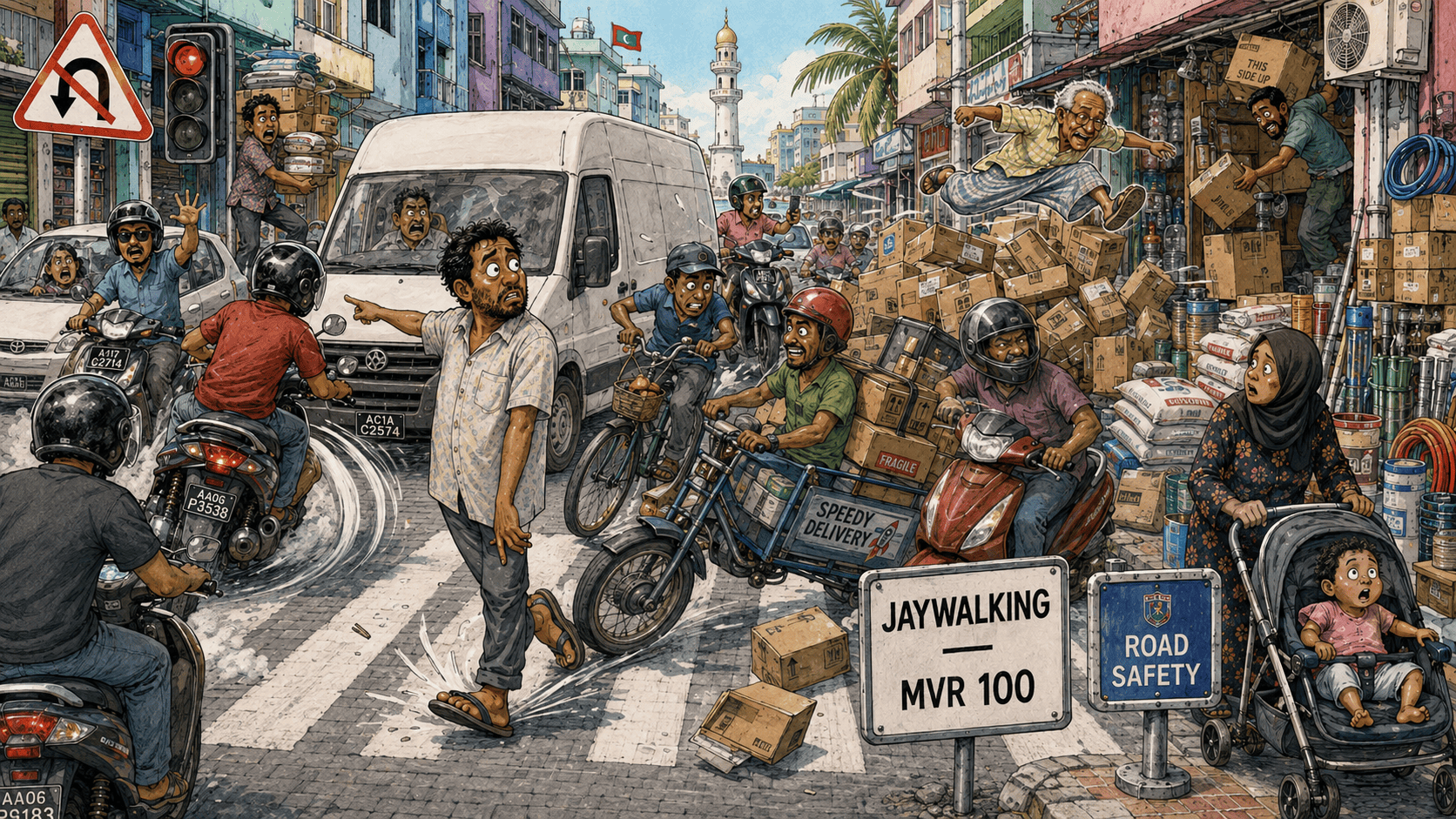
Jaywalking, zebra crossings and the magnificent disorder of Malé roads.
Parliament has passed the new Land Transport Bill, and among its many provisions is one that has already attracted public attention: a fine of MVR 100 for crossing the road illegally.
In other words, jaywalking is finally about to become an offence in the Maldives.
This is good news. It is necessary. It is long overdue.
It is also rather like introducing a rule against splashing water while the entire house is flooding.
To be precise, the bill was passed on 26 August with 47 members voting in favour and 12 against. It is not yet law at the time of writing. It must first receive presidential assent, after which it is expected to come into force in 30 days. Article 46 requires the ministry to establish the rules pedestrians must follow, including where and how roads may be crossed. Article 131 then imposes the MVR 100 fine on anyone who crosses in violation of those rules.
So, technically, the state has not merely fined jaywalking. It has announced that it will first define walking properly and then charge us for improvising.
This is entirely reasonable. In a city as crowded as Malé, pedestrians cannot continue crossing wherever inspiration strikes them. A road is not a living room, and reaching the other side is not a spiritual calling that must be answered immediately. When a zebra crossing is nearby, people should use it. When traffic is moving, people should wait. When a child is watching, adults should perhaps avoid demonstrating that road safety is an optional subject.
But any serious discussion of pedestrian responsibility must begin with an awkward academic question: what exactly is a pedestrian expected to do after reaching the zebra crossing?
Pray?
In most countries, the zebra crossing is a recognised part of the road-safety system. It signals that pedestrians have a designated place to cross and that motorists must respond accordingly. In Malé, it often functions as decorative road art. The pedestrian stands beside it. The motorcyclist sees the pedestrian. Their eyes meet. For one brief moment, two citizens participate in a beautiful act of mutual recognition.
Then the motorcyclist accelerates.
Sometimes another vehicle follows. Then another. Eventually, the pedestrian crosses during a gap, not because the zebra crossing protected him, but because traffic briefly became tired of trying to kill him.
The authorities are aware of the problem. In 2025, Police and Malé City Council launched a campaign to paint “LOOK RIGHT” near selected crossings. This was useful advice. In Malé, however, one must also look left, ahead, behind, diagonally and occasionally upward, because the normal geometry of traffic cannot always be trusted.
The new bill is broader than the MVR 100 fine. It introduces a demerit-point system, provides for automatic licence suspension when unpaid traffic fines reach MVR 5,000, proposes a 20-year general lifespan limit for vehicles, and establishes a Greater Malé Transport and Mobility Office. These are serious measures and, on paper, part of a more modern transport framework.
The phrase “on paper” is doing considerable work in that sentence.
Road discipline is not created by legislation alone. It is created through road design, public education, consistent enforcement and a shared belief that rules apply even when no police officer is watching. At present, Malé possesses written rules, painted lines, traffic signs and a highly creative population determined not to be limited by any of them.
Lane discipline, for example, is treated less as a legal obligation and more as a suggestion from a distant relative. A rider may suddenly move into the opposite lane because the correct lane contains three vehicles and patience is apparently a luxury item. The person already travelling lawfully in that lane must then slow down, move aside or achieve immediate enlightenment.
Indicators are equally misunderstood. Their proper function is to communicate an intention before a manoeuvre. In Malé, they are often activated during the turn, after the turn or not at all. The vehicle simply changes direction, leaving everyone else to discover the plot twist in real time.
And then there is the U-turn.
The Maldivian U-turn is not planned. It happens. A motorist remembers that his destination was behind him and immediately invites the entire road to participate in this personal revelation. No warning. No gradual positioning. Just a sudden horizontal act of faith.
If pedestrians are to be fined for crossing roads unpredictably, motorists must be held equally accountable for driving unpredictably. Otherwise, we are not creating road safety. We are merely deciding which group is easier to fine.
Then we come to the pavement—or what urban-planning literature would describe as pedestrian infrastructure and Malé businesses sometimes describe as additional storage.
Walking along certain streets requires the balance of a gymnast, the flexibility of a yoga instructor and the quiet acceptance of a man who has made peace with death. One shop has placed cartons outside. Another has displayed hardware. A motorcycle occupies what remains. A delivery is in progress. Somewhere beneath all this commercial activity, according to municipal records, there may be a pavement.
The pedestrian must step onto the road to continue walking. Once on the road, he may eventually cross it. Under the new system, this could make him an offender.
The logic is exquisite. First, we remove the pedestrian’s safe space. Then we punish him for leaving it.
Police have recently been towing vehicles parked on pavements and pedestrian areas in Hulhumalé, reminding the public that these spaces are legally reserved for those on foot. Similar enforcement has also targeted illegal parking on major roads in Malé. These efforts are welcome, but occasional operations cannot substitute for ordinary, continuous enforcement. A rule enforced for one week and forgotten the next is not a rule. It is an awareness campaign with a towing truck.
There is also a larger principle involved. Road safety is a system of reciprocal duties. The pedestrian must cross responsibly. The motorist must yield where required, remain in the correct lane, signal before turning, avoid reckless U-turns and keep off pedestrian spaces. Businesses must not convert pavements into warehouses. Authorities must maintain crossings, signs, lighting and walkable routes. Police must enforce all these duties consistently rather than waiting for public outrage to select the offence of the month.
Academically speaking, effective traffic governance depends on the system being coherent. Sarcastically speaking, everyone must stop behaving as though the road was inherited from their grandfather.
The MVR 100 fine may help. Even a small penalty can influence behaviour if people believe there is a realistic chance it will be imposed. But deterrence depends less on the amount than on certainty. A fine that exists only in a statute is merely literature—and unlike most literature, nobody reads it voluntarily.
The law must also be implemented with common sense. The ministry’s regulations should clearly define how far a person must be from a designated crossing before crossing elsewhere becomes illegal. They should account for roads with no pavement, crossings that are poorly placed, paths obstructed by vehicles or merchandise, people with disabilities, the elderly, children and emergency situations. The public must know the rules before enforcement begins. Otherwise, citizens will learn the law in the traditional Maldivian way: when someone uploads a fine slip to Facebook.
Most importantly, enforcement must be balanced. If a pedestrian pays MVR 100 for crossing outside a zebra crossing, the rider who refuses to stop at that zebra crossing should not be allowed to disappear majestically into traffic. If a pedestrian is told to remain on the pavement, the shopkeeper occupying it and the motorist parked on it should receive more than a polite social-media reminder.
The purpose of a road law is not to discipline one category of road user. It is to establish a predictable public space in which everyone knows what others are likely to do. Predictability saves lives. At present, travelling through Malé often demands the reflexes of an action hero and the fatalism of a philosopher.
So yes, let us have the jaywalking law. Let us use zebra crossings. Let us teach children to cross safely and adults to resist crossing wherever their feet develop political independence.
But let us also recognise the whole road.
Fine the jaywalker. Fine the reckless rider. Tow the pavement-blocking vehicle. Remove the shop stock. Enforce the lane. Penalise the sudden U-turn. Protect the zebra crossing. Design pavements that human beings can actually use.
Because Malé does not suffer from a shortage of rules. It suffers from our remarkable national ability to regard every rule as excellent advice for somebody else.
If we are going to bring order to our roads, one law may not be enough. We may indeed need a road-traffic Bible.
But even a Bible is of limited use when everyone believes he is the main character—and that the road will part for him.
It has been eleven years since Late Hon. Uz. Abdulla Hameed left this world.
Last year, on the tenth anniversary of his passing, I wrote about the faith he placed in me when I had lost faith in myself. This year, I found myself reflecting on the extraordinary journey of the man who gave me that second chance.
Born on 31 March 1939, Abdulla Hameed entered government service at just thirteen, beginning as a clerk at the communications office. By nineteen, he had become the Atoll Chief of Lhaviyani Atoll.
That was the beginning of a remarkable life in public service.
Over the decades, he served as a Member of Parliament, Cabinet Minister and Speaker of the People’s Majlis. He contributed to the development of Hulhulé Airport, the atolls and the education sector. He was also a respected literary figure who cared deeply about the Dhivehi language, our history and our culture.
He was eventually conferred the Order of Distinguished Rule of Izzuddeen.
Yet, titles and honours only tell us how high a man rose. They do not tell us how many people he lifted along the way.
I was one of them.
When I entered the film industry, I quickly became disillusioned. By the time I was transferred to the Ministry of Atolls Administration, where Hon. Abdulla Hameed served as minister, I was frustrated and almost ready to walk away from storytelling.
He must have seen something in me that I could no longer see in myself.
The TVM Office Drama Competition was one of the most anticipated events of Ramadan. The ministry’s previous entry had received harsh criticism. He could have chosen someone more experienced—or avoided taking the risk altogether.
Instead, he chose me.
He entrusted me with producing the ministry’s next drama, gave me complete creative freedom and instructed everyone to offer their full support.
He did not stand over my shoulder.
He stood behind me.
That year, the Ministry of Atolls won Best Drama and Best Actress. Over the next four years, we won twelve awards, including two more Best Drama titles.
But what I gained cannot be measured in trophies.
I experimented. I failed. I learned. I found my voice and, most importantly, my way back to storytelling.
Throughout those productions, he made sure my cast and crew were treated with dignity. To him, they were not merely government employees appearing in an office drama. They were artists, and he made them feel like artists.
During one celebration, he said something I have carried ever since:
“He is a gem that Atolls has.”
Perhaps he never realised what those words meant to me. One sentence, spoken with faith, became a lifeline for a young man drowning in doubt.
Whenever rejection becomes louder than hope, or I begin to question whether I still have anything meaningful to offer, I remember the man who saw a gem where I saw only broken stone.
On 18 August 2015, Hon. Abdulla Hameed passed away at the age of seventy-six. His body returned home draped in the national flag, and the country observed three days of official mourning.
The Maldives buried a statesman.
I lost a mentor.
Eleven years later, history remembers his journey from a thirteen-year-old clerk to the Speaker’s chair. I remember the man who trusted a discouraged young writer with a drama and opened a door when I believed every door had closed.
Perhaps that is the truest measure of a life—not merely how far someone rises, but how many others rise because of him.
Eleven years on, I am still writing. Every story, every character and every moment I have placed on a screen carries somewhere within it a small part of the faith he once placed in me.
His titles belong to history.
His words belong to my life.
May Allah fill his grave with light and grant him the highest place in Jannah.
On 3 November 1988, the distance between Colombo and Malé was measured not in miles, but in static.
I was in Colombo continuing my studies. Every day, I tuned in to Radio Maldives. The signal was faint, but whenever my mother’s voice emerged through the noise, it brought home a little closer.
Then Malé was attacked.
I knew what was happening, but the telephone lines had been cut and the radio signal had disappeared. I could not contact my family. I did not know if the people I loved were safe.
That night, I kept waking and turning on the radio.
Static.
Then, towards dawn, a signal returned.
And I heard my mother’s voice announcing that the Maldives had been saved.
To the nation, she was delivering the news.
To me, she was delivering my family back.
If my mother had gone to the radio station, I knew everyone at home must be safe. For a frightened son thousands of kilometres away, that was proof enough.
Thirty-eight years later, on the National Day of the Maldives, that memory returned to me.
My mother, Najma Hussain—affectionately known to the public as Najmaatha—received the National Award of Honour in the Field of News and Information Dissemination from the President of the Maldives for her outstanding service to the nation.
Today, the nation carried its gratitude back to her.
My mother joined Radio Maldives on 8 July 1970. She began as an announcer and rose through the institution as a senior announcer, presenter-producer, programme organiser, senior programme organiser and finally, director.
By the time she retired on 1 April 2009, she had devoted nearly thirty-nine years of her life to public broadcasting. Retirement, however, did not silence that familiar voice; she continues to lend it to private radio stations.
But job titles tell only a small part of her story.
She read the news, wrote and presented programmes, produced content and trained a new generation of broadcasters. Her programmes covered almost every part of Maldivian life—our national identity, Islamic history, fishing, health, family, youth, the environment, and Dhivehi language and literature.
In many ways, her work became a record of how a young country spoke to itself while it was growing.
She continued learning throughout her career, undertaking professional training in the Maldives and abroad. More importantly, she returned and shared that knowledge with those who followed her.
A voice can present a programme.
A mentor helps create many more voices.
My mother never served the nation in search of applause. Like so many people of her generation, she simply believed that the work entrusted to her had to be done properly.
This award does not create her worth.
It recognises what was already there.
For generations of Maldivians, Najmaattha was a familiar and trusted voice. Her programmes informed them, educated them and kept them company.
But my own history with that voice is different.
It is the voice I searched for through the static.
It is the voice that reached me when every other connection to home had been severed.
It is the voice that told me my country had been saved—and, without speaking directly to me, told me that my family was safe.
On that morning in 1988, I felt proud of my mother.
Today, I feel that same pride again.
Only deeper.
The nation may remember Najmaattha as a broadcaster, producer, mentor, director and recipient of the National Award of Honour.
I will always remember her as the voice beyond the static.
The voice that brought home back to me.
Congratulations, Mamma.
May Allah reward you for every moment you devoted to the nation, bless you with good health and happiness, and make this honour a source of pride in this life and the next.