Some days quietly remind you why cinema matters. Today was one of those days.
Kamanaa walked away with three major awards at the Karnatakaa International Film Festival 2025, and I couldn’t be prouder.
Best Director — Hussain Munawwar
Best Actor — Yousuf Shafeeu
Best Actress — Mariyam Azza
This isn’t just a list of trophies. It’s recognition for quiet courage, honest storytelling, and performances that didn’t beg for applause—but earned it anyway.
Munawwaru directed Kamanaa with restraint and confidence, trusting silence as much as dialogue. Yousuf Shafeeu delivered a performance that feels lived-in, not performed. And Azza—what can I say—she carried emotional weight with a grace that lingers long after the screen goes dark.
For Maldivian cinema, moments like this matter. Not because we chase validation, but because stories born in our small islands are finding resonance far beyond our shores.
There are films that entertain, films that inspire, and then there are films like Kan’bulo — films that confront. Films that hold your gaze and refuse to blink first. Directed by Hussain Munawwaru, Kan’bulo is not a safe film. It’s a brave, emotionally volatile narrative that pulses with truth — sometimes uncomfortable, often heartbreaking, and always deeply human.
The story traces back to Yuktha, the award-winning long story by Yashfa Abdul Qani. Her delicate yet devastating writing carried the emotional weight that demanded adaptation. Reshaping it for the screen meant preserving its soul while finding a visual rhythm to match its intensity.
At the heart of the film is Mariyam Azza, delivering one of her strongest performances to date. Playing Kan’bulo demands range and endurance, and she handles every moment — from innocence to devastation to resilience — with precision. Even her silences carry meaning.
The ensemble brings depth and texture: Sheela Najeeb with quiet strength, Wasia Mohamed with loyal presence, Shakeela with protective resilience, Ahmed Easa with tenderness, Ahmed Nimal with chilling intensity, and Ismail Rasheed in a performance that feels like a powerful return. Together, they anchor the film’s emotional truth.
The makeup and costume work of Rishfa Abdul Samad and Hussain Hazim (Sandy) supports the characters with subtle authenticity, while Mohamed Faisal (Fai) shapes sound into an emotional undercurrent that lingers. Ahmed Imthiyaz (Inthi) adds music that mourns, observes, and uplifts without ever overwhelming.
Editor Abdulla Muaz, handling both edit and color grading, balances past and present with seamless precision, letting the story flow like fractured memory while keeping the emotions grounded. His work ensures the narrative is coherent yet haunting.
Producer Ali Shaniz deserves recognition for backing a film of such weight, reuniting the trusted team from Kamanaa and giving space for significance over safety.
And at the center, Munawwaru directs with restraint and conviction. He doesn’t exploit pain; he lets it speak. His choices give the film its raw honesty, making it less of a story told and more of an experience endured.
Kan’bulo is not an easy watch, nor was it an easy script to write. But it is necessary. It stares directly at what many would rather look away from — and by the end, neither can we.
I have already posted a piece about Mariyam Azza’s performance, but after watching the latter half of Kan’bulo with music fully laid in, I couldn’t stay without posting again. While I could easily speak volumes about what director Hussain Munavvaru and composer Ahmed Imthiyaz (Inthi) have achieved in terms of emotional tonality, I find myself compelled to pause and reflect on something else — Azza’s performance in the titular role.
As a screenwriter, you often imagine the rhythms of a scene, the dialogue beats, the unspoken pauses. You hope that when it finally reaches the actor, they will not just recite what’s written, but breathe truth into it. What Azza has accomplished here is beyond that hope — it’s craft turned into pure emotional experience.
Kan’bulo is not a role built on grand speeches. It’s a role constructed on emotional honesty. Azza moves through one devastating moment after another, not as someone acting grief, fear, or resilience, but as someone inhabiting it. Her range and depth are astonishing — she can shift from innocence to devastation to quiet resilience in the span of a breath.
What impressed me most, however, was what she accomplished in silence. A glance downward, a stillness of breath, the weight of unspoken words — these were not voids, they were meaningful silences that spoke louder than any dialogue I could have written. This is where great actors separate themselves: in the negative space, in what they choose not to say, they reveal entire universes.
Azza’s performance is one of those rare instances where the actor’s commitment elevates the screenplay. Watching her, I realized that much of the emotional truth of Kan’bulo was not in the lines I had written but in the way she decided to live between them.
This is not just a performance. It’s a revelation of what cinema can do when an actor completely trusts the material, the director, and, most importantly, her own instincts. Mariyam Azza has carried Kan’bulo on her shoulders, and she has done so with brilliance, courage, and grace.
There’s a kind of silence in cinema that isn’t empty. It lingers. It presses down. It forces the audience to confront things they would rather not. With the release of the official trailer for Kan’bulo, that silence now belongs to us.
Watching this trailer unfold, even though I know the story inside out, I found myself holding my breath — not because of what it shows, but because of what it dares to suggest. This is not a film that chases spectacle. It chases truth. And it doesn’t ask for permission.
What strikes me most from a technical and structural perspective is how deliberately the trailer mirrors the film’s emotional architecture. It begins with tenderness, shifts into unease, and descends — not with melodrama, but with precision — into something far more suffocating. Director Hussain Munawwaru’s vision is clear: this is a story about the quiet destruction that happens behind closed doors, the kind of suffering that society often overlooks until it’s too late. The trailer reflects that ethos with restraint, leaving just enough unsaid to force the audience into those uncomfortable gaps.
From the trailer alone, the performances speak volumes, even in fragments. Mariyam Azza, in the titular role of Kan’bulo, carries a haunting vulnerability that’s impossible to look away from. In just a few glimpses, her embodiment of pain, fear, and defiance cuts deep. Sheela Najeeb’s restrained but devastating presence adds a maternal weight that lingers. Ismail Rasheed, with his trademark intensity, dominates his scenes with quiet menace and authority. Ahmed Easa, Wasia Mohamed, Shakeela, and Ahmed Nimal each bring a lived-in truth to their characters — even from these brief moments, you sense the years of pain, resilience, and buried secrets these roles demand. These are not performances built on spectacle; they are performances built on humanity, on raw emotional honesty, and on the quiet devastation of survival.
From a screenwriting standpoint, seeing this trailer gives me a sense of quiet satisfaction — it captures the essence of why I wrote it. Kan’bulo was never about shock value. It was about honesty. About confronting a truth that refuses to stay silent any longer.
And then there’s that ending — the harrowing wail of Kan’bulo’s newborn, piercing through the silence, rising with unbearable weight until it amplifies and collapses into the film’s haunting title. It’s a sound that stays with you, a cry that speaks not only for the newborn but for every unspeakable pain that has been buried beneath silence. The final post-title shot, with Kan’bulo weeping, her voice breaking as she cries out to her father in the background, “I would never sin,” leaves no doubt about the depths this story is prepared to explore. It’s a moment not designed for shock, but for reflection — and it lands with devastating clarity.
I believe this trailer has done exactly what it needed to do. It doesn’t offer easy answers. It invites questions. And it demands we listen — even when it’s uncomfortable. Because some stories don’t shout to be heard. Some stories whisper… and leave us haunted.
As a screenwriter, you live inside your characters long before anyone else does. You know their breath, their silences, their breaking points. You hear their words before they’re spoken — and sometimes, you wonder if any actor can truly become what you’ve imagined.
But then—fresh off two back-to-back blockbusters—superstar Mariyam Azza steps into the skin of Kan’bulo. The rest, as they say, is history.
Having just watched a rough cut of Kan’bulo, I’m still struggling to find words that match what I witnessed. Azza doesn’t just play Kan’bulo — she becomes her. Frame after frame, she dissolves into this underage girl confronting unthinkable suffering far beyond her years. It’s not just a performance — it’s a haunting possession of pain, fear, shame, defiance, and above all… truth.
From the first page of the script, I knew this character demanded an actor who could navigate delicate psychological territory with absolute control. There were moments with no dialogue, only silence and stillness — and Azza delivered them with quiet ferocity. Every micro-expression — a quiver in the jaw, a distant gaze, the way her shoulders drop when no one’s looking — landed exactly where I wrote it… and often, better than I wrote it.
She doesn’t overplay trauma. She doesn’t seek your sympathy. Instead, she does what great actors do — she makes you feel everything without asking for your permission.
What Azza achieves in Kan’bulo is an evolution from her phenomenal performance in Kamanaa. That film showed her range. Kan’bulo reveals her depth. She dives into raw emotional states and emerges with something painfully beautiful.
There’s a heartbreaking scene deep in the third act — one of the emotional pivots of the entire film — where the past comes crashing into the present, forcing Kan’bulo to confront something she had long buried. It’s a moment of reckoning, of raw realization, and watching Azza deliver it left me breathless. The way she processes that tidal wave of guilt, confusion, and heartbreak — without a single false note — was nothing short of extraordinary. A single glance, a stifled breath, the trembling silence between her words… she made that scene hurt. And in doing so, she elevated a page I had wrestled with for weeks into something that now feels unforgettable.
It’s rare for a screenwriter to feel seen — word for word, emotion for emotion. But Mariyam Azza saw Kan’bulo. And through her, I believe the world will too.
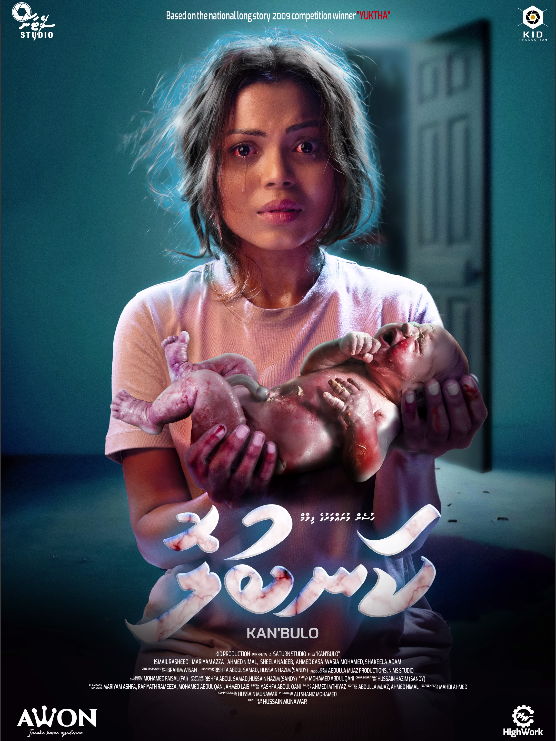
This morning, the official poster for Kanbulo was released. And if it made your heart skip a beat — good. It’s meant to.
A girl. A newborn. Blood-soaked hands. Eyes wide open — not with fear… but with something worse: disbelief. And yet, she’s still standing.
The girl on this poster — portrayed heartbreakingly by Mariyam Azza — came to me first through the pages of Yuktha, the 2006 National Award-winning novel inspired by true events. I remember the moment I finished reading it: I was frozen. Gasping. Shattered. And I knew — without a doubt — that she would never leave me until her voice reached the screen.
The poster doesn’t sell a fantasy. It doesn’t glamorize. It doesn’t comfort. It unsettles. Because Kanbulo isn’t here to entertain. She’s here to speak — for those who never could.
Writing Kanbulo wasn’t like any other screenplay. It tore something out of me. There were days I sat blank, unable to type a word. And nights when writing just a single scene left me emotionally gutted. But I kept going. Because silence was never an option — not for her.
We renamed the film Kanbulo — a name spoken with affection, like “sweetie” or “darling.” But don’t be fooled by its softness. This film bites. It bleeds. It fights back. It confronts the quiet violence so many women endure — behind closed doors, beneath polite conversations, under the weight of shame that isn’t theirs to carry.
The official poster, brilliantly designed by Abdulla Muaz, captures that very roar—unflinching, visceral, and impossible to look away from.
This isn’t fiction. It’s a mirror. One many will want to look away from. But I hope you won’t.
I’m proud to be reuniting with director Hussain Munavvaru for our fourth film together. After Kamanaa, this film takes a very different turn. Kanbulo doesn’t flirt. It doesn’t seduce. It screams. And for once, we’re ready to listen.
Kan’bulo opens 31 August 2025. And when it does — I hope it stirs something in you. Not just pity. Not just rage. But action. Empathy. Reflection. And the courage to believe those who’ve been silenced for far too long.
Until then — Hold your daughters. Protect the vulnerable. And when someone finally trusts you enough to speak… Listen. Fully. Fiercely. Without turning away.
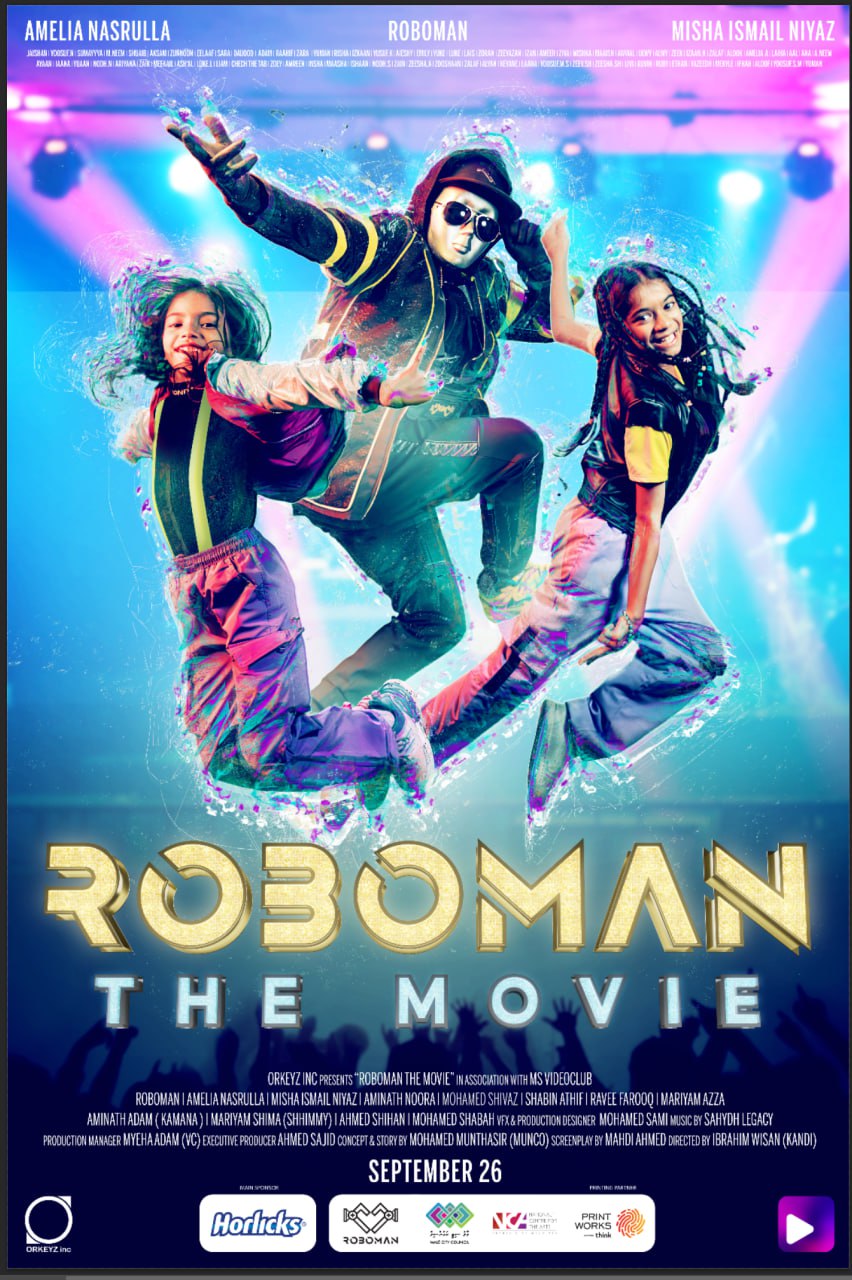
Roboman: The Movie is a family-oriented musical that beautifully blends heartwarming moments, dance, and stunning visual effects with an engaging time-travel narrative. Directed by Ibrahim Wisan and produced by Mohamed Munthasir and Ahmed Saji of Orkeyz Inc., the film is a bold, fresh entry into Dhivehi cinema. With standout performances from newcomers Amelia Nasrulla Shakeeb and Misha Ismail Niyaz, along with breathtaking cinematography and CGI by Mohamed Saami, this film is a cinematic treat for audiences of all ages.
The film begins in 2040, where Roboman, a beloved masked hero and national icon, is living peacefully—until he discovers that his timeline has been drastically altered. His arch-nemesis, Umar, has tampered with the past, specifically the events of 2024 during the finale of the Robo Junior Challenge. Due to this interference, Roboman finds himself labeled a convicted criminal, hunted by the authorities for crimes he didn’t commit. As the police close in, Roboman is forced to use time-travel technology to return to 2024 and stop Umar from rewriting history.
In 2024, the focus shifts to Ahu (played by Amelia) and Asee (played by Misha), two young cousins competing in the Robo Junior Challenge, a prestigious dance competition. Despite being the younger of the two, Ahu is more confident and self-assured. However, as an orphan living with her aunt, she feels the weight of being treated differently by the family. Although Ahu can sense the subtle discrimination, Asee’s unwavering support makes her feel truly part of the family. Ahu, in turn, becomes Asee’s source of strength, giving her the confidence to perform and pursue her dreams.
Unknown to both, their competition is at the center of Umar’s plan to discredit Roboman and shift the narrative of history in his favor.
As the competition unfolds, Roboman races against time to prevent Umar from permanently tarnishing his legacy. Along the way, Ahu and Asee’s journey intersects with Roboman’s, leading to a thrilling climax where friendship, family bonds, and the fate of the future are at stake.
Amelia brings depth and charisma to the role of Ahu, portraying her as a strong, confident young girl who faces discrimination but never lets it break her spirit. Despite being younger than Asee, Ahu is the more assured one, and it’s her quiet strength that inspires her cousin. Amelia’s portrayal of Ahu’s resilience and determination is captivating, particularly in moments where she has to balance her personal struggles with her role as Asee’s emotional anchor. Her dance performances are dynamic, reflecting not just her skill but her internal drive.
Misha excels as Asee, the cousin who struggles with the pressures of competition. While Asee initially lacks the confidence to perform at her best, it’s Ahu who bolsters her and gives her the courage to shine. Misha beautifully captures Asee’s vulnerability and her deep love for Ahu, making their bond one of the emotional highlights of the film.
Roboman (played by the real-life showman) delivers a performance filled with seriousness and mystery. As both the masked hero and the judge of the Robo Junior Challenge, Roboman’s silent yet expressive presence raises the stakes of the story. His dual role in both the present day and 2040 adds urgency and drama to the narrative.
Shabin portrays Umar (both in 2024 and 2040), bringing complexity to the antagonist. His depiction of the younger, bitter Umar highlights his jealousy and ambition, while his portrayal of the older Umar exudes menace and cunning. Shabin’s performances add depth to the film’s villain, making him a worthy adversary to Roboman.
Fathimath Noora and Mohamed Shivaz give strong performances as Asee’s loving parents, grounding the film in relatable family dynamics. However, subtle hints of favoritism toward Asee, despite their love for Ahu, provide an emotional undercurrent to Ahu’s story. Their support of Asee, along with their gradual realization of Ahu’s strength, adds an important layer to the narrative. Sobah and Gobbe, as Akbar and Aton, play Umar’s friends who eventually discover his nefarious plot and decide to help Roboman, adding complexity to their characters.
The film also features a fun cameo by superstars Mariyam Azza and Ravi Farooq as themselves, playing the cool judges of the Robo Junior Challenge, adding an exciting celebrity twist.
Mohamed Saami’s cinematography and visual effects are nothing short of spectacular. His portrayal of a futuristic Malé in 2040 is visually breathtaking. The futuristic scenes, particularly Roboman’s music show and his high-tech apartment with an AI bot, blend seamlessly with the live-action elements. Saami’s dynamic camera angles and fluid motion in the dance sequences add energy and excitement, while the time-travel sequences are handled with precision, making them visually captivating.
The music by Shahyd Legacy perfectly complements the story, enhancing both the emotional and action-packed moments. The soundtrack balances pulsating beats for the dance competition scenes with more poignant melodies for the quieter, introspective moments. Shahyd Legacy’s music drives the film’s energy while also underscoring its emotional depth, particularly during Ahu’s and Asee’s character development arcs.
Production Manager Fathimath Myeha plays a pivotal role in keeping the film on track, from coordinating auditions to managing the complex shooting schedules. Her work behind the scenes ensured that the film’s ambitious goals were met without sacrificing quality.
The production, led by Mohamed Munthasir and Ahmed Saji, demonstrates a clear vision and dedication to pushing the boundaries of Dhivehi cinema. Munthasir’s concept, inspired by the real-life showman Roboman, adds an authentic touch to the film, while Saji’s role in assembling a top-notch technical team ensures that every aspect—from CGI to choreography—meets the highest standards.
Director Ibrahim Wisan expertly handles the ambitious time-travel narrative while keeping the heart of the story grounded in its emotional core. His direction ensures a smooth transition between the futuristic 2040 and the more grounded 2024, maintaining tension and excitement throughout. Wisan’s balance between dance, humor, and heartfelt moments makes Roboman: The Movie an engaging watch for families and young audiences alike.
Roboman: The Movie is a landmark achievement in Dhivehi cinema, offering a unique blend of family-friendly storytelling, visually stunning effects, and emotional depth. With its innovative time-travel plot, strong performances, and heartfelt messages about perseverance, friendship, and family, the film sets a new standard for the Maldivian film industry. It’s a family entertainer you won’t want to miss!
Since its release on 27th August 2024, Kamanaa has taken the Maldivian box office by storm, surpassing all expectations and becoming an unexpected blockbuster. The film’s gripping storyline, powerful performances, and raw portrayal of domestic violence have resonated deeply with audiences, leading to a massive surge in demand.
A Phenomenal Start and Growing Momentum
From the very first day, Kamanaa has been a runaway success. The scheduled shows sold out well in advance, prompting the producer to add late-night screenings to accommodate eager moviegoers. In a testament to the film’s popularity, even these additional late-night shows have quickly sold out. The overwhelming demand has made Kamanaa a cultural phenomenon, with fans flocking to theaters to witness the story unfold on the big screen.
A Nationwide Sensation
The excitement around Kamanaa isn’t limited to the capital city of Malé; it has spread like wildfire across the Maldives. The reception in the islands has been nothing short of overwhelming, with many islands queuing up to host the film’s premiere. The producer has been inundated with requests, showcasing the film’s wide-reaching impact. The anticipation and enthusiasm from audiences in every corner of the country have turned Kamanaa into more than just a film—it has become a nationwide event.
The Ingredients of Success
Several factors have contributed to the extraordinary success of Kamanaa. First and foremost, the direction by Hussain Munawar has been lauded for its raw and honest portrayal of a deeply sensitive issue. The gripping story, based on true events, has struck a chord with viewers, making them feel every moment of tension and emotion on screen. The performances by the stellar cast are central to this film’s success:
Yoosuf Shafeeu delivers a chillingly authentic performance as Haider, transitioning from a loving husband to a man consumed by his darker impulses. His depth and nuance bring Haider’s complex character to life.
Mariyam Azza shines in the titular role of Kamanaa, portraying the strength and resilience of a woman enduring domestic violence with heartbreaking authenticity. Her transformation, both physically and emotionally, adds immense weight to her character.
Aminath Rashfa as Nora brings complexity and depth to her role. As the woman caught in an illicit affair with Haider, she navigates her character’s emotional turmoil with finesse, capturing both allure and guilt, while her chemistry with Yoosuf Shafeeu creates an electrifying tension.
Mohamed Rasheed as Abbas delivers a dignified performance, portraying a husband unknowingly caught in a web of deceit. His portrayal adds weight to the story, grounding it in the stark reality of betrayal and broken trust.
Natasha Jaleel as Zulfa, Abbas’s elder wife, exudes a calm yet commanding presence. Her character embodies wisdom and stability, serving as a quiet counterbalance to the turmoil surrounding the main characters.
Mohamed Manik shines in a supporting role as Nabeel, a friend trying to reform Haider. His nuanced portrayal adds emotional depth, enhancing the film’s dramatic impact and making Nabeel a memorable character.
Creative Contributions
The creative efforts of the crew have significantly elevated the film’s impact. Abdulla Muaz, responsible for editing, CGI, and color grading, has delivered exceptional work that shapes the film’s narrative flow and visual tone. His precise editing ensures the film maintains its tension and intensity throughout, while his CGI and color grading add a hauntingly realistic quality to the story’s most gripping moments.
Cinematography by Shivaz Abdulla further enhances the storytelling, with carefully crafted shots that capture both the beauty and brutality of the narrative. His use of lighting and framing creates a visual contrast between the characters’ outward appearances and their hidden struggles, drawing viewers deeper into the emotional landscape of the film.
Rishfa Abdul Samad significantly shaped Kamanaa with her compelling story and sharp casting choices, ensuring a strong ensemble. As a costume designer and makeup artist, her meticulous attention to detail brought authenticity to each character, enhancing the film’s emotional depth and realism.
Sound Design and Music
The sound design by Mohamed Faisal (Fai) has played a critical role in the film’s immersive experience. Utilizing the newly installed 5.1 surround sound system at Olympus Theatre, Fai has created an auditory landscape that amplifies the emotional highs and lows, making each scene more impactful. The music score by Ahmed Imthiyaz (Inthi)complements this, adding layers of emotion that underscore the film’s most powerful moments. Ravee Farooq’s song choreography adds yet another dimension to the film, bringing cultural vibrancy and rhythm that enriches the narrative.
Ali Shaniz: The Driving Force Behind the Success
A special mention must go to Ali Shaniz, the producer whose tireless dedication made Kamanaa a reality. His hands-on approach throughout every phase—from pre-production to marketing—ensured that every detail was meticulously executed. His efforts to promote the film, particularly in reaching audiences across the islands, have been instrumental in the overwhelming success of Kamanaa.
A Film That Sparks Conversations
Kamanaa’s unexpected success is not just about numbers; it’s about its ability to resonate with the audience and spark essential conversations on domestic violence and societal norms. The film’s raw portrayal and thought-provoking narrative have encouraged viewers to reflect on these realities long after they’ve left the cinema.
Looking Ahead: The Journey Continues
With its unprecedented box office run, Kamanaa continues to capture hearts and minds across the Maldives. As more islands line up to screen the film, and as audiences continue to clamor for more shows, it’s clear that Kamanaa is more than just a cinematic success—it’s a cultural moment. The film’s triumph is an indication to the power of storytelling, the strength of its cast and crew, and the importance of tackling vital social issues through art.
Kamanaa is not just a movie; it is an experience that leaves a profound impact, one that challenges and inspires. And this is only the beginning of its journey.
Kamanaa is a profound exploration of domestic violence and betrayal, a thought-provoking journey skillfully directed by Hussain Munawar. This spiritual sequel to his earlier work, Sazaa, delves deep into the complexities of human relationships, offering a raw, unfiltered portrayal of the often-hidden realities that many women endure.
The narrative centers on Haider, a man who initially appears to be a devoted husband. However, his darker side emerges as he embarks on an extramarital affair with Nora. When his wife, Kamanaa, discovers the affair, Haider’s true nature comes to the forefront, leading to a series of violent and emotionally charged events. Based on actual incidents shared by Rishfa Abdul Samad, the film is both intense and brutally honest, offering a raw portrayal of domestic violence that is as compelling as it is unsettling.
Yoosuf Shafeeu (Youppe) delivers a masterful performance as Haider, seamlessly transitioning from a loving husband to a man driven by dark impulses. His portrayal is chillingly authentic, particularly during moments of intense emotional conflict. Youppe’s ability to convey deep internal turmoil through subtle expressions and gestures is remarkable. In the post-credit scene, he proves why he continues to reign in the Dhivehi film industry.
Mariyam Azza excels in the titular role, portraying Kamanaa with quiet strength and resilience. Her performance is deeply moving, capturing the character’s pain and endurance with sensitivity and grace. Azza’s commitment to the role, including gaining weight and donning a burqa, adds an extra layer of authenticity to her portrayal. Her scenes, particularly those where she grapples with her husband’s betrayal and violence, are filled with raw emotion, making Kamanaa a character who resonates deeply with the audience.
Aminath Rashfa (Asha), as Nora, brings complexity and depth to her character. As the other woman in Haider’s life, she navigates the emotional intricacies of her role with finesse, capturing both the allure and the inevitable consequences of her actions. Her chemistry with Youppe is electric, creating a captivating and unsettling tension.
Mohamed Rasheed as Abbas, Nora’s husband, and Nathasha Jaleel as Zulfa, Abbas’s elder wife, provide strong supporting performances. Rasheed’s portrayal of Abbas is one of quiet dignity, while Nathasha’s Zulfa offers wisdom and stability, grounding the film in moments of intense drama.
Rishfa’s role as the glamour makeup artist and costume designer in Kamanaa is nothing short of transformative. Her keen eye for detail and deep understanding of character development allowed her to craft looks perfectly encapsulating each character’s personality and journey. From the subtle yet impactful wardrobe choices to the meticulously designed costumes, Rishfa ensured that every visual element added depth to the story. Her spot-on casting decisions brought together a cast that embodied their roles, elevating the film’s emotional and dramatic impact.
Mohamed Manik played a crucial role as the dynamic Production Manager of Kamanaa, seamlessly handling the film’s challenging logistics while contributing to the creative process. His expertise in special effects makeup added a layer of realism to the characters, particularly in portraying violence and its aftermath. Additionally, Manik took on the supporting role as Nabeel, a character who earnestly tries to reform Haider, adding depth and nuance to the story. His multifaceted involvement was vital in bringing Kamanaa to life.
Shivaz Abdulla’s cinematography complements Munawar’s vision with carefully crafted shots that enhance the emotional intensity of the narrative. The lighting and framing are particularly effective in highlighting the contrast between the characters’ public facades and their private turmoil.
The sound design by Mohamed Faisal (Fai) is a critical element of Kamanaa‘s success. Utilizing the newly installed 5.1 surround sound system at Olympus Theatre, Fai creates an immersive auditory experience that heightens the film’s emotional impact. Every sound, from the quiet moments of tension to the explosive outbursts of violence, is meticulously crafted to draw the audience deeper into the story.
Ahmed Imthiyaz (Inthi)’s rousing score complements the narrative and underscores the film’s most poignant moments, while Ravee Farooq’s song choreography adds more depth to the relationship of the pairs appearing in each song.
Abdulla Muaz’s work as an editor, CGI artist, and color grader is exemplary, contributing significantly to the film’s overall impact. The editing is sharp and precise, ensuring the narrative flows seamlessly while maintaining the tension and suspense driving the story. The CGI is used sparingly but effectively, enhancing the film’s realism without detracting from its gritty, grounded tone. The color grading is particularly noteworthy, with muted tones and stark contrasts that reflect the bleakness and emotional weight of the story.
Hussain Munawar directs Kamanaa with an unflinching eye, committed to portraying violence in its rawest, most honest form. Munawar’s approach to filmmaking is marked by his dedication to realism. He believes that the only way to confront societal issues like domestic violence is to present them without filters. Kamanaa is a film that challenges its audience to confront uncomfortable truths, making them more socially aware. Kudos to him for assembling the right cast and an effective crew to bring his vision to success.
Last but not least, Ali Shaniz’s unwavering dedication as the producer of Kamanaa is admirable. From pre-production to the final release, Shaniz was deeply involved in every aspect of the film’s journey. His hands-on approach ensured that every detail was meticulously managed, from securing resources during production to overseeing the intricate post-production processes. His passion extended beyond the creative realm as he drove marketing efforts to ensure Kamanaa reached its audience. Shaniz’s relentless commitment is the cornerstone that made Kamanaa a reality.
In short, Kamanaa is a film that does not shy away from the harsh realities of domestic violence. It is a powerful, thought-provoking piece of cinema that challenges its audience to confront uncomfortable truths. The performances, particularly by Youppe, Azza and Asha, bring depth and authenticity to their roles. Hussain Munawar’s direction, combined with the stellar work of his devoted crew, including Muaz’s exceptional editing, visual effects and color grading, makes Kamanaa a must-see film that will leave a lasting impact on its viewers, sparking important conversations and raising awareness about domestic violence.
P.S. Wait for the post-credit scene to witness Azza’s unbelievable physical transformation.
It’s no secret that superstar Mariyam Azza is the darling of the Dhivehi film industry and has the rare ability to masterfully embody any role she is offered, thanks to her unwavering commitment and dedication to her craft. Over the years, Azza has proven time and again that she can delve into the depths of any character and bring it to life with authenticity and emotion.
Kamanaa marks her third project based on a screenplay I’ve written. Our first collaboration was the critically acclaimed film Hahdhu, released in 2017, where Azza received a Best Actress nomination at the National Film Awards for her portrayal of a free-thinking woman whose life takes a dramatic turn after becoming involved with a traveler. Her nuanced performance captured the complexities of a character torn between her ideals and the harsh realities of life—and it was this mesmerizing performance that led the love of her life to call her to compliment her, proving that sometimes art imitates life in the most unexpected ways.
Our second project together was the TV drama Rugyah, which aired on Raajje TV in 2021, directed by her multi-talented husband and the love of her life, Abdulla Muaz. In Rugyah, Azza delivered another powerful performance, playing the estranged sister of her real-life sister, Rishmy. The story required Azza to stand up against an exorcist who abused her sister, marking a reunion between the two sisters on screen after a long hiatus. Her portrayal was intense, reflecting the emotional and psychological turmoil of her character with incredible depth.
In Kamanaa, Azza takes on the challenging titular role of a mild-mannered, loving wife who becomes a victim of domestic violence. The role required Azza to portray a woman enduring immense pain and suffering, yet never giving in to the violence inflicted upon her. To prepare for this demanding role, Azza committed herself fully, gaining weight by indulging in chocolates from pre-production and wearing a veil to authentically capture the character’s physical and emotional state, only to shed 20 kilos for the emotionally charged post-credit scene. Her unwavering dedication to the role proves her incredible talent and commitment to her craft.
One of the most striking moments in Kamanaa is when Azza’s character discovers the secret life of her husband. In this pivotal scene, Azza’s performance is nothing short of mesmerizing. She conveys the intensity of the moment through her eyes and facial expressions alone, speaking volumes without uttering a word. The raw emotion she brings to the screen allows the audience to feel her character’s pain and disbelief as if they were experiencing it firsthand.
Another notable scene is when she returns home from a scan, alone and overwhelmed. As she stands before Haidar, her composure shatters. Barely holding back tears, she whispers, “I can’t do this by myself.” The line, delivered with heartbreaking fragility, perfectly encapsulates her profound loneliness and desperation. The slow unraveling of her emotions in that moment captures the intense depth of her sorrow in a way that leaves a lasting impact.
Kamanaa is set to release on the 27th of August 2024. This film promises to be a poignant and powerful exploration of resilience and strength, brought to life by Azza’s incredible talent. Her ability to fully immerse herself in a role and convey the deepest emotions proves her status as one of the finest actors in the industry today.
Stay tuned for a cinematic experience that will leave you moved, inspired, and in awe of Mariyam Azza’s remarkable talent.






 Mahdi Ahmed