Mahdi Ahmed

Scripting waves of imagination from the sunny side of the Maldives.

Posts tagged ‘film’

YASHFA: ADAPTING HER AWARD-WINNING STORY INTO KAN’BULO

In 2009, a quiet storm passed through Maldivian literature. It came in the form of a long story titled Yuktha, penned with grace and conviction by Yashfa Abdul Qani. The piece went on to win first place at the National Long Story Competition — and rightfully so. It wasn’t just a work of fiction; it was a reflection of buried truths, crafted with emotional intelligence and a deep understanding of the unspoken.

When I was handed this story to adapt, I knew immediately that it demanded more than a simple retelling. It asked for care. It asked for bravery. And it asked for honesty.

Adapting a long story into a screenplay is never just about converting prose into scenes. It’s about translation — not of language, but of essence. What works powerfully on the page, nestled between narration and inner monologue, must now live and breathe through images, dialogue, silences, and performance. You’re not just recreating the story — you’re restructuring it so it thrives in a visual and temporal medium.

And with Kan’bulo, the weight of that responsibility was greater than usual. The story had resonance. It had urgency. But most of all, it had a protagonist who demanded her truth be told — not sensationalized, not softened — but told with authenticity.

I approached the adaptation process not as someone trying to rework a text, but as someone trying to protect it. To preserve the emotional heartbeat of Yashfa’s writing while allowing the film version to have its own rhythm. That meant hard choices — what to keep, what to let go, what to reimagine, and how to give characters a voice when the page had once carried their silence.

It was a delicate balance of loyalty and liberty. And I hope I’ve honored the spirit of what Yashfa created.

As Kan’bulo prepares to meet its audience, I want to take a moment to express my respect and gratitude to Yashfa Abdul Qani. Without her vision, there would be no story to adapt. Her courage in telling this story laid the foundation for everything that followed. I was just the one invited to build on it.

Kan’bulo is set to be released on 31 August 2025.

IBRAHIM WISAN (KANDI): PAINTING KAN’BULO IN LIGHT AND SHADOW

Fresh off directing last year’s family blockbuster Roboman, Kandi returns to his roots behind the camera — not as a director this time, but as the cinematographer of Kan’bulo. His deep understanding of visual storytelling and how cinematography can shape emotional resonance is on full display here. Kan’bulo is a far cry from the lighter, broader appeal of Roboman. It’s a film rooted in silence, restraint, and emotional nuance. It demands sensitivity over spectacle, and Kandi delivers exactly that.

What makes this collaboration even more meaningful is the history Kandi shares with Hussain Munavvaru, the director of Kan’bulo. Few may know this, but Kandi isn’t just Munavvaru’s close relative — he’s also the one who introduced Munavvaru to the world of cinema. It was Kandi who first handed a teenage Munavvaru a camera, sparking the journey that would eventually lead to Munavvaru’s acclaimed directorial career. Before he helmed his breakout debut Sazaa, Munavvaru began his path through cinematography — a path illuminated by Kandi’s guidance.

For Munavvaru, having Kandi serve as cinematographer on Kan’bulo wasn’t just a professional choice; it was the fulfillment of a long-held creative dream. This collaboration feels like a full-circle moment — mentor and mentee reunited, now as equals, crafting a story that demands precision, empathy, and technical restraint.

Kan’bulo isn’t driven by spectacle. It breathes in small spaces, long silences, and fragile emotional landscapes. Kandi’s cinematography reflects that reality. His camera work is defined by discipline and clarity. There’s no unnecessary flourish — only carefully composed frames that serve the emotional architecture of the film. His use of muted palettes, purposeful lighting, and visual contrast to delineate memory from present tense demonstrates his deep understanding of the psychological demands embedded in the story.

As a screenwriter, my responsibility ends with the words on the page. It’s artists like Kandi who elevate those words into visual poetry — translating silence into space, subtext into shadow, and emotion into light. In Kan’bulo, his lens doesn’t demand attention; it simply exists where it needs to, holding every frame with quiet, deliberate weight. I have no doubt the audience will feel the presence of Kandi’s craft in every frame.

Kan’bulo is set to be released on 31 August 2025.

HUSSAIN MUNAWWARU: CRAFTING THE UNSEEN SILENCE OF KAN’BULO

My creative journey with Hussain Munawwaru spans well over a decade. From the brutal realism of Sazaa to the devastating truths of Dhilakani, and more recently the uncomfortable introspection of Kamanaa, our collaborations have always been rooted in a shared commitment to confronting uncomfortable realities through cinema. With Kan’bulo, our fourth project together, Munawwaru’s direction once again proves why he remains one of the most fearless filmmakers working in Dhivehi cinema today.

Kan’bulo began in the wake of Kamanaa’s success — fresh after its theatrical run. Munawwaru handed me a digital copy of Yuktha, the 2009 National Award-winning long story, itself inspired by true events. I finished reading it in a single breathless sitting.

At its core, it was a harrowing account of suffering through the eyes of a 9-year-old. But Munawwaru, in his wisdom and restraint as a responsible storyteller, proposed a crucial shift: the protagonist’s age should be increased to 16 or 17. His reasoning was both artistic and ethical. While Kan’bulo still demands courage from its audience, asking them to endure the discomfort of confronting realities often left unspoken, portraying such trauma through the innocence of a 9-year-old would veer too close to the unbearable for our already conservative audience.

That decision speaks volumes about Munawwaru’s maturity as a filmmaker. He doesn’t flinch from darkness, but he understands the weight of responsibility — knowing when to push, and when to protect. He understands that cinema isn’t just about shock; it’s about resonance. It’s about asking the audience to walk the line with you without turning away in numbness.

What Munawwaru achieves with Kan’bulo is perhaps his most restrained, yet most quietly brutal work to date. Where Kamanaa confronted violence with raw, graphic immediacy, Kan’bulo lingers in the silences. His direction here is defined not by how loudly a scene can speak, but by how deeply it can wound without words. This film doesn’t move on dramatic cues or conventional pacing — it breathes in long pauses, in glances, in the weight of what’s left unsaid. Munawwaru lets the camera observe, unblinking, without interference. In doing so, he allows the audience no escape. They must sit with the discomfort. They must feel the slow erosion of the human spirit unfold.

Technically, Munawwaru continues to refine his visual language — muted palettes, claustrophobic framing, and stillness used as both tension and release. His collaboration with Fai on sound and Inthi on music furthers this precision. But equally vital to shaping the fractured emotional rhythm of Kan’bulo is the meticulous work of Abdulla Muaz, whose editing serves as the narrative’s silent architect. Nothing is there by accident. Every moment feels curated to serve the psychological architecture of the film.

As a screenwriter, I trust few directors to carry the weight of my scripts with the same reverence for subtext and emotional integrity as Munawwaru. He reads beyond dialogue. He listens for what isn’t spoken. He understands that trauma doesn’t always scream; sometimes, it barely whispers. And it’s in that silence where Munawwaru does his most harrowing work.

Kan’bulo is not Kamanaa. It’s a different film with a different pulse. But like every film we’ve created together, it is guided by Munawwaru’s unwavering belief that the stories we tell matter only if they remain true — no matter how difficult they are to watch.

Kan’bulo is set to be released on 31 August 2025.

ROBOMAN: THE MOVIE: FROM ROCK TO REEL

Photo credits to the owner

For years, Shahyd Legacy has been renowned for his powerful riffs and electrifying performances as the lead guitarist of the band Sacred Legacy. Known for his technical prowess and the raw energy he brought to the stage, Shahyd carved out a name for himself as one of the most talented musicians in the Maldives. However, his musical journey has taken an exciting turn from the world of rock to the captivating realm of film scoring, where he is now composing music for feature-length movies. His latest project marks a significant milestone: Roboman: The Movie, his first foray into creating music for a family-oriented film.

Transitioning from rock music to film composition might seem like a leap, but for Shahyd, it’s a natural evolution of his creative expression. With Roboman: The Movie, Shahyd faced a unique challenge: crafting a score that would appeal not only to his fans but also to a broader, more diverse audience, particularly children and families. It’s a task that requires a delicate balance of creating music that is both emotionally engaging and universally accessible.

Understanding the need to keep his score appealing to a general audience, Shahyd delved deep into his creative well to compose music that aligns perfectly with the film’s tone. The story of Roboman: The Movie—filled with heart, humor, and adventure—demanded a score that could enhance its narrative and resonate with viewers of all ages. Shahyd’s approach to composing for this film was to blend his rock roots with a more melodic, whimsical style, creating a soundscape that is both endearing and memorable.

One of the standout elements of Shahyd’s work on Roboman: The Movie is the soundtrack. More than just background music, the soundtrack pieces are emotionally touching, with melodies that linger in the heart long after the credits roll. Each piece reflects the journey of the characters, from moments of joy and excitement to those of introspection and growth. The music becomes an integral part of the film’s storytelling, guiding the audience through the highs and lows of the narrative.

Photo credits to the owner

For Shahyd, composing for a family film was about more than just making beautiful music—it was about connecting with the audience on a deeper level. He wanted the score to be something that children could hum to themselves and that parents would find moving. His goal was to create music that would bring families together, allowing them to experience the film’s magic in its fullest form.

Shahyd Legacy’s venture into film scoring, particularly for a family film, highlights the versatility of his talent and his dedication to exploring new creative horizons. It shows that his music, whether in the form of electrifying guitar solos or touching film scores, is always evolving. With Roboman: The Movie, he has proven that he can not only rock the stage but also move the hearts of audiences in theaters.

On 26 September 2024, get ready to be moved, entertained, and inspired by the music of Roboman: The Movie—brought to life by the incredible talent of Shahyd Legacy.

MR. & MRS. MAHI: A CINEMATIC BOUNDARY

Mr. & Mrs. Mahi (2024) is a cinematic innings that hits a six with its unique blend of romance and sports drama. Directed by Sharan Sharma, the film takes the audience on a gripping journey through the lives of Mahendra ‘Mahi’ Agarwal (Rajkummar Rao) and his wife, Mahima ‘Mahi’ Agarwal (Janhvi Kapoor), as they navigate the pitch of life and cricket.

Rajkummar Rao’s portrayal of Mahendra is a standout performance, like a batsman who starts his innings with a series of flawless cover drives. His character, a failed cricketer turned coach, is deeply flawed yet incredibly relatable. Mahendra’s struggle with his insecurities and jealousy is like a bowler facing a tough over, trying to find his rhythm. This internal conflict adds layers to his character, making him the focus of the film’s narrative.

Janhvi Kapoor delivers a knockout performance, displaying her growth as an actress. Her portrayal of Mahima is both nuanced and powerful, much like a cricketer who plays a match-winning innings under pressure. Janhvi brings a refreshing authenticity to her character, capturing Mahima’s determination and vulnerability with equal finesse. Her on-screen presence is magnetic, drawing the audience into Mahima’s journey from an aspiring cricketer to a celebrated player. The emotional depth she brings to her role is commendable, especially in scenes where she grapples with the challenges of balancing her personal and professional life.

Her chemistry with Rajkummar Rao is natural, creating a dynamic partnership that feels like a well-coordinated cricket duo. Janhvi’s ability to convey a wide range of emotions—from joy and excitement to frustration and sorrow—adds depth to her character.

The supporting cast adds significant richness to the film, with standout performances by Kumud Mishra and Zarina Wahab. Kumud Mishra delivers a sincere performance as a father who sees Mahendra as a failure but fails to see his own selfishness mirrored in his son. Zarina Wahab brings warmth and grace to the screen as Mahendra’s mother, serving as the emotional anchor for him, providing unwavering support and encouragement. Wahab’s performance is marked by a gentle yet strong presence, embodying the essence of a mother who enlightens her son in one of the film’s most touching scenes.

The screenplay, written by director Sharan Sharma and Nikhil Mehrotra, is a masterstroke, weaving together the highs and lows of both cricket and personal relationships. The narrative flows seamlessly, much like a well-crafted innings, with each scene building upon the last to create a cohesive and engaging story. The dialogues are sharp and impactful, capturing the essence of the characters’ struggles and triumphs. The screenplay effectively balances the tension of cricket matches with the emotional depth of the characters’ personal lives, making it a compelling watch from start to finish.

The music is the soul of this film, like a well-timed boundary that lifts the spirits of the crowd. The original music, composed by John Stewart Eduri, is both endearing and evocative, perfectly complementing the film’s emotional beats and enhancing the tension and excitement of the cricket scenes, making the audience feel every moment of the game. The music stays with you long after the credits roll, much like a memorable match-winning performance.

Sharan Sharma’s direction is much like a captain leading his team to victory. He brings out the best in his actors, guiding them through complex emotional landscapes with finesse. Sharma’s attention to detail is evident in how he captures the nuances of cricket, from the intensity of training sessions to the thrill of match day. His ability to blend the sport with the characters’ personal journeys is commendable, creating a film that resonates on multiple levels. The pacing is perfect, allowing the story to unfold naturally while keeping the audience hooked.

This is a must-watch for cricket enthusiasts and movie lovers alike.

P.S. The remake of the photo wall in Kumud Mishra’s shop at the end stirred my tear glands.

MAHARAJA: A Masterclass in Suspense and Emotions

Tamil film “Maharaja” (2024), masterfully penned and directed by Nithilan Saminathan, has mesmerized both audiences and critics. The film’s clever screenplay and multifaceted elements contribute significantly to its impact.

The narrative begins with a simple burglary, but the plot takes an intriguing turn when the protagonist, a mild mannered barber named Maharaja, portrayed brilliantly by Vijay Sethupathi, claims that his stolen “Lakshmi” is missing. This ambiguity hooks viewers instantly, leaving the audience to ponder whether Maharaja speaks of a literal valuable object or something more profound. Saminathan masterfully sustains this mystery, engaging viewers actively with the storyline.

The film’s non-linear narrative structure oscillates between the present, where Maharaja is on his quest to find his beloved “Lakshmi” and flashbacks that unveil his past. This dual approach not only builds suspense by leaving questions unanswered but also provides a deeper insight into Maharaja’s motivations. As his past unfolds, the audience witnesses the events that molded him and the emotional core driving his actions. This non-linear storytelling, though challenging at first, ultimately is rewarding as all narrative threads converge seamlessly.

While “Maharaja” fits within the thriller genre, Saminathan skillfully avoids a purely dark and gritty tone. The script injects humor through Maharaja’s interactions with a quirky police officer and several other oddball characters, providing comic relief without undermining the film’s seriousness. Additionally, the script explores Maharaja’s vulnerability, his love for his family, and the devastation wrought by the loss of his “Lakshmi.” This emotional depth adds weight to his actions, rendering him a more relatable protagonist.

The screenplay maintains suspense with well-placed twists and turns. Just as the audience thinks they have the plot figured out, the film surprises with a new revelation. These twists are not mere shocks; they naturally arise from the plot and character development. The climax, in particular, is lauded for its emotional resonance and the way it ties together all narrative elements.

Saminathan excels in using the power of suggestion and incorporating motifs and symbols throughout the film. Maharaja’s grief and rage are often conveyed through subtle expressions and actions rather than overt exposition. This technique allows viewers to connect with the character emotionally and engage actively with the story. This approach not only strengthens the film’s emotional impact but also fosters audience participation.

Initially, the missing “Lakshmi” serves as a McGuffin, a plot-driving object with no intrinsic value to the story. However, as the narrative progresses, “Lakshmi” evolves into a critical element tied to Maharaja’s past and motivation. It rises above the role of a simple McGuffin and becomes a Chekhov’s Gun. Similarly, other seemingly minor details introduced early in the film pay off later, foreshadowing future plot developments and solidifying the film’s tightly woven script.

The film features powerful performances by the lead cast, particularly Vijay Sethupathi, Anurag Kashyap as Selvam, the main antagonist, and the supporting actors. Sethupathi delivers a career-best performance, balancing vulnerability and intensity with finesse.

In summary, “Maharaja” (2024) stands as a masterclass in clever and engaging storytelling. It takes a familiar plot and elevates it through its unique structure, well-developed characters, and masterful use of suspense, humor, and emotional depth. The film exemplifies how filmmakers can employ various narrative techniques to craft a truly gripping cinematic experience.

Highly recommended.

P.S. The scene where Nallasivan re-enacts the robbery in Maharaja’s presence, along with the investigating police, and demonstrates how he strangled Maharaja reminded me of a powerful composition style Steven Spielberg used in his classic, The Color Purple, when Albert, engrossed in his newspaper, sees Cecile for the first time. Pure cinema magic.

KILL: A Gripping, Brutal Ride on the Rails

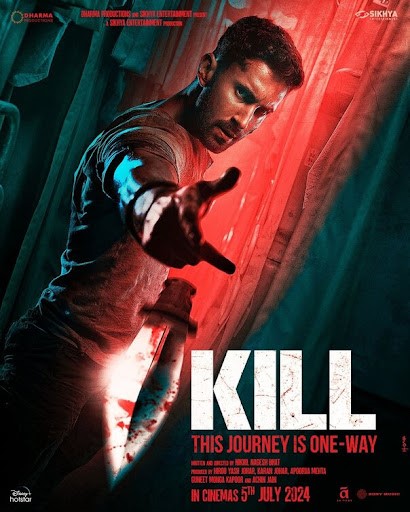
“Kill,” the latest Hindi action thriller from writer-director Nikhil Nagesh Bhat, captivates critics and audiences worldwide with its intense action sequences and daring departure from traditional Bollywood formulas. Set entirely on a train, the film eschews song-and-dance numbers and larger-than-life heroes, opting instead for a raw and unrelenting portrayal of violence.

The plot follows Amrit, a stoic army commando portrayed with impressive intensity by Lakshya, who boards a train to New Delhi to prevent his love, Tulika (Tanya Maniktala), from entering an unwanted arranged marriage. His mission gets derailed violently when a ruthless gang of dacoits, led by the merciless Fani (Raghav Juyal), hijacks the train. Driven by love and a strong sense of justice, Amrit becomes a one-man army, taking down the dacoits in a series of bone-crunching, jaw-dropping, and blood-gushing fight sequences that intensify with each frame.

The true highlight of “Kill” is its unapologetic and astonishing action. The fight scenes, a mix of martial arts and raw street brawling, are expertly devised by action directors Se-yeong Oh and Parvez Sheikh. Their creativity, supported by Rafey Mehmood’s brilliant cinematography, leaves viewers claustrophobic and on the edge of their seats as Amrit navigates the confined train compartments, creating a relentless atmosphere of tension.

Bhat’s concept, surprisingly inspired by James Cameron’s “Aliens,” focuses on a protagonist protecting someone vulnerable. Howerver, Bhat shifts the narrative’s perspective back and forth from protagonist to antagonist, elevating “Kill” beyond a typical action film by making it grittier, more relatable, and unexpectedly dramatic.

Lakshya, as Amrit, embodies the quiet rage of a soldier pushed to his limits. His steely gaze and determined body language convey more than words could. Meanwhile, Raghav Juyal, more popular as a dancer and choreographer, transforms into the chillingly charismatic villain, Fani. His menacing demeanor and razor-sharp delivery make him a formidable adversary in the vein of Hans Gruber.

The supporting cast also delivers strong performances, especially the dacoits. Cleverly, Bhat makes the narrative compelling by making all of them family, and their familial ties add an explosive emotional depth. Each bloody confrontation and brutal death realistically intensifies their horror and thirst for vengeance. Bhat also keeps the tension escalating amongst them by adding a conflict between their patriarch, Beni (Ashish Vidyarthi), and his son as Fani.

Kudos to editor Shivkumar V. Panicker for the film’s impeccably calibrated pace. Bhat, who never sits in the first edit, found Panicker ruthlessly cutting 12 minutes from the opening of his original vision and placing the main title card at an unexpected moment, which served as a great shock to everyone.

Production designer Mayur Sharma also deserves praise for constructing the train on a soundstage with movable walls to accommodate the fast-paced and intricate fight scenes Bhat envisioned.

In “Kill,” Bhat highlights the importance of art in portraying graphic violence and blood. The explicit violence serves to emphasize the stakes, desperation, and raw human emotions at play, making the film not just a visual experience but an immersive, visceral journey.

“Kill” is a bold experiment in Hindi cinema. Its raw energy, stellar performances, and innovative fight choreography make it a must-watch for fans of action thrillers seeking something fresh from Bollywood. The film’s relentless intensity evokes a profound response, leaving the audience either shaken or mesmerized.

P.S. For some strange reason, I burst into tears once the end credits started rolling. I’m not sure if I was overwhelmed by the brutal violence or the arduous journey Amrit had to endure.