Mahdi Ahmed

Scripting waves of imagination from the sunny side of the Maldives.

Posts tagged ‘Domestic Violence’

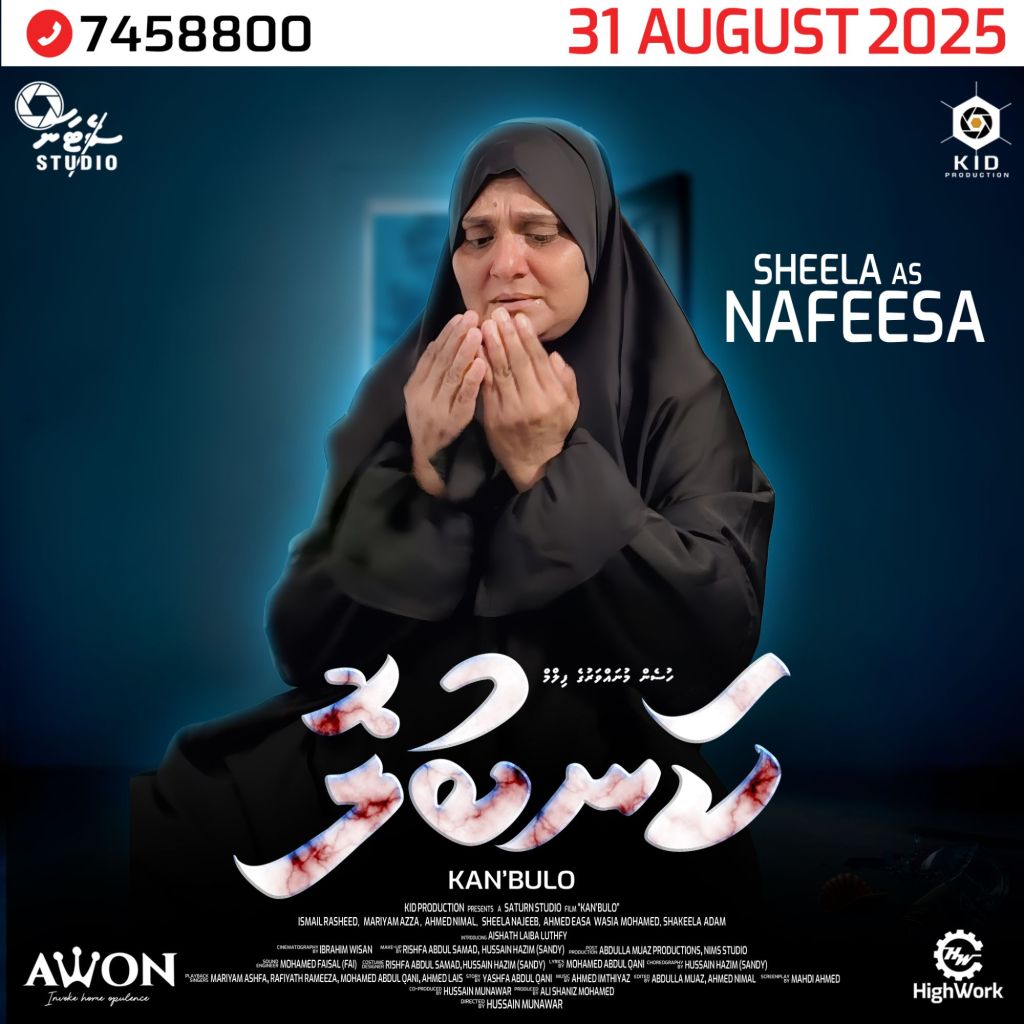
SHEELA NAJEEB: THE QUIET FORCE BEHIND NAFEESA

As a screenwriter, you often build characters knowing full well they require an actor with presence beyond words — someone who understands that not all performances are loud, but the best ones linger long after the scene ends. In Kan’bulo, Sheela Najeeb’s portrayal of Nafeesa is a textbook example of this rare craft.

Sheela doesn’t just perform — she elevates. What she brings to Nafeesa isn’t simply emotion; it’s a kind of silent authority, a dignity wrapped in layers of grief, faith, and resilience. She carries the weight of the character’s suffering with remarkable restraint, never slipping into melodrama. Her stillness, her pauses, the precision in how she delivers even the smallest reaction — these are not accidental choices. They are the marks of an actor deeply tuned into the unspoken architecture of a scene.

What’s equally remarkable is how Sheela’s performance functions like a gravity well for the ensemble. She anchors those around her, allowing other actors to find the right emotional temperature within their own roles. In scenes where the material is heavy, she brings balance. In scenes where others might falter, she raises the bar through sheer presence.

As a screenwriter, this is the kind of actor you dream of writing for — someone who understands the power of subtext, who knows the difference between playing a line and living inside it. Watching the dailies and now the rough cut, I can say this with certainty: Sheela Najeeb gives Nafeesa the quiet strength the story demands. And through her, everyone else shines brighter.

In Kan’bulo, her work isn’t just a performance. It’s a masterclass in understanding that sometimes, a mother’s grief and love can fill a screen more completely than any dialogue ever could.

Kan’bulo is set to be released on 31 August 2025.

KAMANAA: A Raw Portrayal of Domestic Violence

Kamanaa is a profound exploration of domestic violence and betrayal, a thought-provoking journey skillfully directed by Hussain Munawar. This spiritual sequel to his earlier work, Sazaa, delves deep into the complexities of human relationships, offering a raw, unfiltered portrayal of the often-hidden realities that many women endure.

The narrative centers on Haider, a man who initially appears to be a devoted husband. However, his darker side emerges as he embarks on an extramarital affair with Nora. When his wife, Kamanaa, discovers the affair, Haider’s true nature comes to the forefront, leading to a series of violent and emotionally charged events. Based on actual incidents shared by Rishfa Abdul Samad, the film is both intense and brutally honest, offering a raw portrayal of domestic violence that is as compelling as it is unsettling.

Yoosuf Shafeeu (Youppe) delivers a masterful performance as Haider, seamlessly transitioning from a loving husband to a man driven by dark impulses. His portrayal is chillingly authentic, particularly during moments of intense emotional conflict. Youppe’s ability to convey deep internal turmoil through subtle expressions and gestures is remarkable. In the post-credit scene, he proves why he continues to reign in the Dhivehi film industry.

Mariyam Azza excels in the titular role, portraying Kamanaa with quiet strength and resilience. Her performance is deeply moving, capturing the character’s pain and endurance with sensitivity and grace. Azza’s commitment to the role, including gaining weight and donning a burqa, adds an extra layer of authenticity to her portrayal. Her scenes, particularly those where she grapples with her husband’s betrayal and violence, are filled with raw emotion, making Kamanaa a character who resonates deeply with the audience.

Aminath Rashfa (Asha), as Nora, brings complexity and depth to her character. As the other woman in Haider’s life, she navigates the emotional intricacies of her role with finesse, capturing both the allure and the inevitable consequences of her actions. Her chemistry with Youppe is electric, creating a captivating and unsettling tension.

Mohamed Rasheed as Abbas, Nora’s husband, and Nathasha Jaleel as Zulfa, Abbas’s elder wife, provide strong supporting performances. Rasheed’s portrayal of Abbas is one of quiet dignity, while Nathasha’s Zulfa offers wisdom and stability, grounding the film in moments of intense drama.

Rishfa’s role as the glamour makeup artist and costume designer in Kamanaa is nothing short of transformative. Her keen eye for detail and deep understanding of character development allowed her to craft looks perfectly encapsulating each character’s personality and journey. From the subtle yet impactful wardrobe choices to the meticulously designed costumes, Rishfa ensured that every visual element added depth to the story. Her spot-on casting decisions brought together a cast that embodied their roles, elevating the film’s emotional and dramatic impact.

Mohamed Manik played a crucial role as the dynamic Production Manager of Kamanaa, seamlessly handling the film’s challenging logistics while contributing to the creative process. His expertise in special effects makeup added a layer of realism to the characters, particularly in portraying violence and its aftermath. Additionally, Manik took on the supporting role as Nabeel, a character who earnestly tries to reform Haider, adding depth and nuance to the story. His multifaceted involvement was vital in bringing Kamanaa to life.

Shivaz Abdulla’s cinematography complements Munawar’s vision with carefully crafted shots that enhance the emotional intensity of the narrative. The lighting and framing are particularly effective in highlighting the contrast between the characters’ public facades and their private turmoil.

The sound design by Mohamed Faisal (Fai) is a critical element of Kamanaa‘s success. Utilizing the newly installed 5.1 surround sound system at Olympus Theatre, Fai creates an immersive auditory experience that heightens the film’s emotional impact. Every sound, from the quiet moments of tension to the explosive outbursts of violence, is meticulously crafted to draw the audience deeper into the story.

Ahmed Imthiyaz (Inthi)’s rousing score complements the narrative and underscores the film’s most poignant moments, while Ravee Farooq’s song choreography adds more depth to the relationship of the pairs appearing in each song.

Abdulla Muaz’s work as an editor, CGI artist, and color grader is exemplary, contributing significantly to the film’s overall impact. The editing is sharp and precise, ensuring the narrative flows seamlessly while maintaining the tension and suspense driving the story. The CGI is used sparingly but effectively, enhancing the film’s realism without detracting from its gritty, grounded tone. The color grading is particularly noteworthy, with muted tones and stark contrasts that reflect the bleakness and emotional weight of the story.

Hussain Munawar directs Kamanaa with an unflinching eye, committed to portraying violence in its rawest, most honest form. Munawar’s approach to filmmaking is marked by his dedication to realism. He believes that the only way to confront societal issues like domestic violence is to present them without filters. Kamanaa is a film that challenges its audience to confront uncomfortable truths, making them more socially aware. Kudos to him for assembling the right cast and an effective crew to bring his vision to success.

Last but not least, Ali Shaniz’s unwavering dedication as the producer of Kamanaa is admirable. From pre-production to the final release, Shaniz was deeply involved in every aspect of the film’s journey. His hands-on approach ensured that every detail was meticulously managed, from securing resources during production to overseeing the intricate post-production processes. His passion extended beyond the creative realm as he drove marketing efforts to ensure Kamanaa reached its audience. Shaniz’s relentless commitment is the cornerstone that made Kamanaa a reality.

In short, Kamanaa is a film that does not shy away from the harsh realities of domestic violence. It is a powerful, thought-provoking piece of cinema that challenges its audience to confront uncomfortable truths. The performances, particularly by Youppe, Azza and Asha, bring depth and authenticity to their roles. Hussain Munawar’s direction, combined with the stellar work of his devoted crew, including Muaz’s exceptional editing, visual effects and color grading, makes Kamanaa a must-see film that will leave a lasting impact on its viewers, sparking important conversations and raising awareness about domestic violence.

P.S. Wait for the post-credit scene to witness Azza’s unbelievable physical transformation.
KAMANAA: MUNAVVAR UNFILTERED

Thirteen years ago, on a sweltering afternoon, I first encountered Hussain Munawar. The image is still clear. A slightly battered red Toyota Ist was chasing on the road. There he was, squeezing through the backseat window. He wore a long-sleeved horizontally striped T-shirt clinging to his frame, his hair tightly braided. His demeanor was far from pleasant as he harassed a young girl on the back of a motorbike. This unsettling introduction was my first glimpse of the character Tomas. Hussain portrayed this role so convincingly in the critically acclaimed Dhivehi film Loodhifa.

This gritty scene encapsulated the essence of Munawar’s directing style—unflinching realism.

My collaboration with Hussain began in late April 2010. He was only 22 years. He asked me to doctor a screenplay. The screenplay was eventually re-structured and re-written for his directorial debut. That screenplay became Sazaa, the first Dhivehi film to confront the issue of violence against women with such raw intensity.

Hussain’s approach to Sazaa was unapologetic. He believed that to make a genuine impact, the violence had to be depicted as it happened—brutal and graphic. His reasoning was clear. The public needed to understand the shocking reality some women endure. The only way to convey that was through an honest portrayal.

We continued working together on Dhilakani in 2013, and eleven years later, Hussain approached me again. Over coffee at Olympus, he shared a story his wife, Rish, had told him. It was a true account of a loving husband who resorted to extreme violence. We immediately saw the connection to Sazaa and decided that this story would be its spiritual sequel. Thus, Kamanaa was conceived.

Hussain’s commitment to portraying violence in its rawest form has never wavered. He is a deep thinker who approaches each project with a seriousness that demands authenticity. His philosophy is straightforward. If the public is to grasp the gravity of domestic violence, they must see it as it truly is. No filters, no sugar-coating.

Kamanaa is not just a film; it’s a re-enactment of real incidents. The violence portrayed is graphic and shockingly brutal, but it’s necessary. Hussain wants the public to confront the harsh reality some women face. He aims to spark a conversation that needs to happen.

Kamanaa is set to be released on 27 August 2024. Brace yourselves for a film that doesn’t shy away from the truth but forces us to confront it head-on.

KAMANAA: Unveiling the Haunting Reality of Domestic Violence

It all began one early morning on 04th June 2023 at Olympus Cafe. As usual, I sat with director Hussain Munawar, affectionately known as Kudafoolhu in the film fraternity, for our morning coffee. With his characteristic enthusiasm, he told me he had a story to share—a true one narrated by his wife, Rish, who got it from the source.

When he finished recounting the series of incidents, my coffee had gone cold, untouched except for one sip. Like the coffee, I felt a chill. Lately, stories with violence have been hard to stomach, and this one, about domestic violence, hit particularly hard. Munawar wanted it to be a spiritual sequel to his debut film “Sazaa,” which also dealt with violence against women and was our first collaboration in 2011. He promised to get an audio recording of the interview with the victim, and I agreed to start the detailed outlining once I received it. Little did I know this story would haunt me for the rest of the day.

The dramatic weight of the story put my brain into overdrive. That evening, on my way to Vilimale’ from Male’, I began crafting the screenplay on the ferry using my trusty Samsung S22 Ultra. By the time I reached Vilimale’, I had a rough outline. Later that evening, sprawled on the sitting room floor, I built up the backstory for all the separate acts of violence inflicted by a husband on his mild-mannered wife. I developed the characters, including the minor ones, and outlined the violent incidents leading up to the climax, staying true to the real story while reimagining it for the screen.

Days turned into weeks and weeks into months. I kept reminding Hussain about the interviews, but due to the subject’s sensitivity, Rish was still unable to record them. Meanwhile, casting had begun. Hussain locked down Mariyam Azza, the most sought-after actress, for the victimized wife and was negotiating with Yoosuf Shafeeu, the most decorated actor, for the violent husband role. He also scouted for an equally renowned actress to play the other woman. Despite some casting setbacks, he eventually onboarded the most up and coming actress, Aminath Rashfa, for the latter role. Veteran actor Mohamed Rasheed and promising actress Natasha Jaleel, along with Mohamed Manik, were assembled for the cast. I tweaked the characters and scenes to better fit the actors’ strengths, making my outline even more engaging.

Still waiting for the interviews, Hussain eventually informed me that he had set a date to begin production. He urged me to start writing. Luckily, I had the rough outline ready. I revised the outline in a day, removing repetitive violence and adding fresh, brutal scenes. Voila, the outline was complete and looked good.

With three weeks to write the screenplay, I divided my time, spending two hours in the morning and two in the evening. By the end of the final week, I had a draft ready and immediately sent it to Hussain for feedback. He shared it with the cast, and I received valuable input, particularly from Rish, who suggested additional scenes leading up to critical violent incidents and some character name changes.

The meeting with Yoosuf Shafeeu was a pivotal moment. When he approved the unrestricted interaction with the other woman, I couldn’t help but grin, my heart racing like a bullet train. I finished the final draft that night, adding intense violence and refining the interactions.

After a journey that began with a chilling tale over coffee, Hussain finally gave me the final title of the screenplay: ‘Kamanaa,’ a loving term in Dhivehi used to address a wife. What started as a daunting task had transformed into a powerful screenplay, getting ready to be brought to life on the big screen.

Kamanaa is set to release on 27th August 2024.