Mahdi Ahmed

Scripting waves of imagination from the sunny side of the Maldives.

Posts tagged ‘books’

HINITHUNVELAASHEY KALAA: MY SMILE, MY JOURNEY

Seventeen years ago, today—on August 25, 2008, at around 8:45 pm—I wrapped up the final episode (Episode 52) of Hinithunvelaashey Kalaa, a series from TVM that went on to win the hearts of the nation. I was sitting inside, wearing only shorts, with rain tapping a busy Morse code on the windows. My heart and body were warmed—not just by the embrace of my ever-loving wife, who helped me kiss goodbye to some corny lines—but by the sheer joy of finishing the journey.
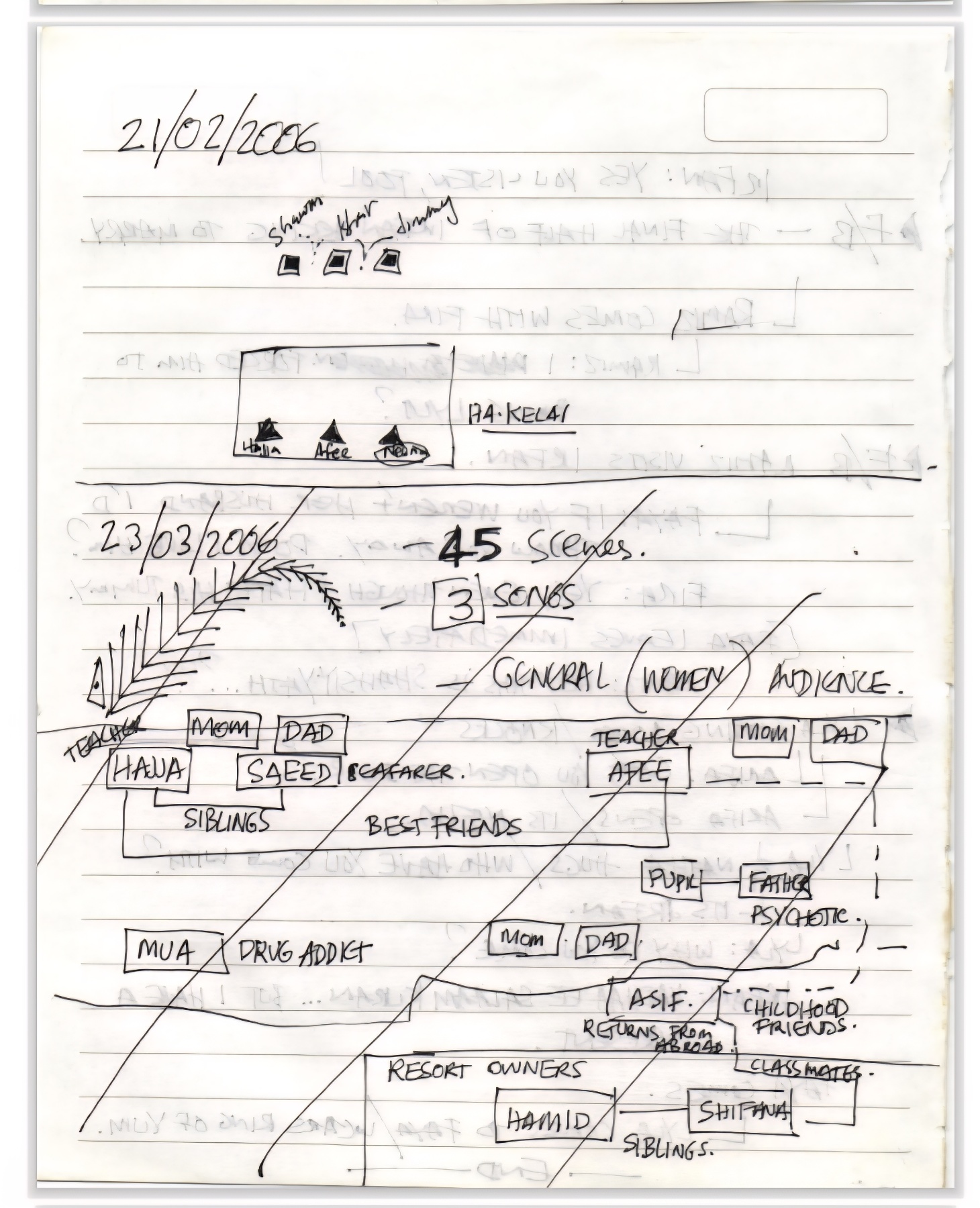
It all began on February 21, 2006, one late morning, under a breezy sky at West Park. I sat with director Abdul Faththaah by the sea, scribbling notes in my worn-out, flower-covered notebook, sipping papaya juice (plus a squeeze of lime), while he sipped a milk coffee. He had a seed of a concept—a 52-episode serial called Hinithunvelaashey Kalaa—about two childhood friends whose lives were wildly different yet bound by a shared past.

From that meeting, characters sprang to life. Ina, the tomboyish farmer girl in Kelai, cap on her head, sun on her shoulders. Fazu, the diligent teacher with a quiet soul. Around them, layers of family, history, and society emerged. The story wasn’t just a drama—it was a slice of the Maldives, its struggles and hopes stitched into every scene.

I scripted the first 32 episodes in just over a month—obsessed and restless, averaging almost an episode a day, since production had already begun in Ha. Kelai and the scripts had to keep flowing to match the shoot. My mind was on fire—literally waking at odd hours, skull burning, yet never able to stop typing. That first arc, set entirely in Kelai, poured out in one feverish burst.

Then something unexpected happened.

Once filming wrapped on the 32 episodes and editing began, the material didn’t quite fit the boxes I had built. Each episode overflowed into the next. Before long, the original 32 had ballooned into 40 episodes.

What could have been a headache turned out to be a gift. Suddenly, I had 12 more episodes to write—episodes that would bring the story to Malé. It was a creative second wind. Instead of dragging my feet, I leaned in. Those episodes gave space for new twists, deeper arcs, and an ending that felt more earned. To my surprise, even Faththaah sighed in relief—the story had room to breathe.

The series first went on air on July 26, 2006—Independence Day in the Maldives. A proud date to begin a journey. But like all long journeys, life had its way of testing us. Around Episode 33, one of our actors ran into real-life trouble, and TVM had no choice but to pull him off the screen. Policy was policy.

The series came to a sudden halt. Weeks stretched into months. And then, more than a year later, re-started again—from Episode 1. Frustration, yes. Suspense, absolutely. But looking back, it was also a strange kind of gift. The audience got to live the story twice, and I found the space to refine the series finale.

By late August 2008, writing Episodes 51 and 52 felt bittersweet. On that rainy evening, August 25th, I typed the final words of Episode 52, closed my laptop, and hugged my wife. That hug—warm, knowing, and peaceful—was my personal wrap party. The final episode later aired on November 11, 2008—Republic Day in the Maldives.

If I could send a postcard to that former me, I’d say:

You did it. You wrangled 52 episodes—that’s equivalent to thirteen feature films worth of storytelling.

You wrestled with long nights, reruns, rewrites, cast drama, and even a mid-series collapse. You turned chaos into creation. And you gave Maldivian audiences a story that made them laugh, cry, debate, and remember.

Hinithunvelaashey Kalaa wasn’t just a TV series. It was a chapter of my life. A love letter to storytelling. A memory stitched forever into the fabric of Maldivian television.

And more than that—it sharpened my craft. Writing this series allowed me to experiment with rhythm, dialogue, symbolism, cliffhangers, and emotional pacing in ways I never had before. I discovered the power of layering subplots, weaving historical flashbacks, planting narrative traps, and using pauses and silences as deliberately as dialogue itself. Many of the screenwriting “tricks” I still use today—those playful double meanings, those quiet beats before an explosion of emotion—were born in those 52 episodes. It was the project that turned me from a writer into a screenwriter. And I will always be indebted to director Fathaah for giving me this opportunity of a lifetime.

Seventeen years on, I look back and realize: every page, every scene, every sleepless night was part of a greater script—the story of my own becoming. That rainy evening in August 2008 was not an ending, but the beginning of everything that followed.

Because sometimes, the greatest journeys are written between two words—

FADE OUT.

YASHFA: ADAPTING HER AWARD-WINNING STORY INTO KAN’BULO

In 2009, a quiet storm passed through Maldivian literature. It came in the form of a long story titled Yuktha, penned with grace and conviction by Yashfa Abdul Qani. The piece went on to win first place at the National Long Story Competition — and rightfully so. It wasn’t just a work of fiction; it was a reflection of buried truths, crafted with emotional intelligence and a deep understanding of the unspoken.

When I was handed this story to adapt, I knew immediately that it demanded more than a simple retelling. It asked for care. It asked for bravery. And it asked for honesty.

Adapting a long story into a screenplay is never just about converting prose into scenes. It’s about translation — not of language, but of essence. What works powerfully on the page, nestled between narration and inner monologue, must now live and breathe through images, dialogue, silences, and performance. You’re not just recreating the story — you’re restructuring it so it thrives in a visual and temporal medium.

And with Kan’bulo, the weight of that responsibility was greater than usual. The story had resonance. It had urgency. But most of all, it had a protagonist who demanded her truth be told — not sensationalized, not softened — but told with authenticity.

I approached the adaptation process not as someone trying to rework a text, but as someone trying to protect it. To preserve the emotional heartbeat of Yashfa’s writing while allowing the film version to have its own rhythm. That meant hard choices — what to keep, what to let go, what to reimagine, and how to give characters a voice when the page had once carried their silence.

It was a delicate balance of loyalty and liberty. And I hope I’ve honored the spirit of what Yashfa created.

As Kan’bulo prepares to meet its audience, I want to take a moment to express my respect and gratitude to Yashfa Abdul Qani. Without her vision, there would be no story to adapt. Her courage in telling this story laid the foundation for everything that followed. I was just the one invited to build on it.

Kan’bulo is set to be released on 31 August 2025.

THUDARUM (2025): WHEN MALAYALAM CINEMA WHISPERS THUNDER AND THAT SMILE…

There’s something quietly powerful about a film that doesn’t beg for your attention. Thudarum, directed by Tharun Moorthy, isn’t trying to be loud. It doesn’t explode with plot twists or shout with background scores. Instead, it breathes. It lingers. It invites you in.

At the center of this stillness is Mohanlal, playing Shanmughan—a humble taxi driver from Ranni, known lovingly as “Benz.” Not because he owns a luxury car, but because he drives a lovingly preserved vintage Ambassador. Like the car, Shanmughan is solid, graceful, and full of unspoken stories. That small detail says everything without ever spelling it out.

And then there’s George.

If Shanmughan is a smoulder waiting to flare, George is ice in human form. Played with unnerving calm by newcomer Prakash Varma, George is the kind of villain who never yells. He doesn’t need to. His stillness is menacing. His smile? It chills the spine. Every time he appears on screen, the temperature drops just a bit.

The plot—on paper—is familiar: guilt, justice, a slow-burning sense of revenge. But in Tharun Moorthy’s hands, it becomes something far more personal. This isn’t just a story being told; it’s one being remembered.

What truly stands out is how the film weaves in nostalgia. Old Malayalam songs aren’t just there for aesthetic—they carry memory. They haunt. They heal. They act as bookmarks in Shanmughan’s emotional journey. For older audiences, these tunes will hit like waves of memory; for younger ones, they may spark curiosity.

Visually, Thudarum is pure mood. The sleepy lanes of Ranni, the warm glow of late afternoons, the shadowy corners of quiet homes—everything is framed with purpose by cinematographer Shaji Kumar. And Jakes Bejoy’s background score? It whispers, it doesn’t scream. It holds the film’s emotional weight without ever tipping the balance.

This isn’t a film for those looking for speed. Thudarum walks. Slowly. But that’s exactly the point.

You’re meant to feel the silence. To sit with the characters. To live in their moments.

Watch it for Mohanlal’s haunting restraint.
Watch it for George’s bone-deep chill.
Watch it because every old song carries a ghost.
And because Malayalam cinema, at its best, doesn’t shout. It whispers—and that whisper can be thunderous.

P.S. If this really is Prakash Varma’s debut, we’ve just met one of the most chilling new faces in Malayalam cinema. What a start.

MADULU MOHAMED WAHEED: THE LAST VERSE OF A GUARDIAN

This morning—April 14, 2025—the final chapter of a remarkable book closed.

My dear friend, Madulu Mohamed Waheed, passed away at the age of 77, while seeking treatment for his illness.

He was no ordinary man—he was a living manuscript.

A towering volume in the library of Maldivian literature and journalism.

His words did more than fill pages—they stirred thought, preserved culture, and gave breath to Dhivehi language.

He was not merely a writer. He was the binding that held our language together.

In 2019, he was awarded the National Award of Honor—a bookmark in a career richly underlined by purpose.

As Special Envoy of the Dhivehi Academy, he wrote till the ink ran dry.

His dedication? Unmatched. His margin notes? Timeless.

But there’s a personal grief scribbled in the margins of my heart.

He used to call some mornings and say, “Free for breakfast?”

It was never just about eating—it was about the chapters we were both writing.

About the drafts, the rewrites, the plots half-formed in our minds.

He’d help me find the right phrase, the perfect form, the word that unlocked a scene.

And when he published something new, he placed a copy in my hands.

Weeks before illness stole his final sentences, he said to me: “Let’s meet for another breakfast soon.”

We never turned that page.

And after my father passed, I found myself in one of those breakfasts—lost.

I spilled my sorrow on the table like ink.

He didn’t edit my grief.

He told me stories— verses about my father I had never read.

He reminded me that no one truly disappears from the book of life, as long as someone remembers their chapter.

Today, I feel the same ache.

Another book I cherished has closed.

But some books never really end.

They sit on our shelves—dog-eared, beloved, often revisited.

Rest now, my dearest friend.

The nation mourns.

I mourn.

And somewhere, in the silence between sentences— your voice will still turn the page.

Thank you for every word.

Rest in peace.

REKHACHITRAM: A CINEMATIC LOVE LETTER WRAPPED IN A MURDER MYSTERY

In Rekhachithram, director Jofin T. Chacko invites us on a journey that goes beyond time, blending mystery with a deep-seated love for Malayalam cinema’s illustrious past. The film intricately weaves a narrative that not only keeps the audience on the edge of their seats but also tugs at the nostalgic strings of those who cherish the golden age of Malayalam films.

The story centers around Vivek Gopinath, portrayed by Asif Ali, a police officer seeking redemption after a suspension. His assignment to investigate a 40-year-old murder case leads him to the enigmatic Rekha, played by Anaswara Rajan, an aspiring actress from the 1980s. The plot masterfully intertwines the investigation with the production of the real-life 1985 film Kathodu Kathoram, directed by Bharathan and starring Mammootty. This clever narrative choice creates an alternate history that feels both authentic and mesmerizing.

Chacko’s direction shines as he seamlessly transitions between the past and present, capturing the essence of the 1980s Malayalam film industry. The meticulous recreation of film sets, the depiction of industry stalwarts, and the subtle nods to iconic moments evoke a profound sense of nostalgia. The film doesn’t merely rely on these elements for sentimental value; they are integral to the storyline, enriching the viewing experience.

Asif Ali delivers a nuanced performance as Vivek, embodying the character’s determination and vulnerability. Anaswara Rajan’s portrayal of Rekha is both poignant and compelling, capturing the aspirations and challenges of an actress in that era. The supporting cast, including Manoj K. Jayan as Vincent and Zarin Shihab as young Pushpa, contribute significantly to the film’s depth and authenticity.

The film’s technical aspects are commendable. Appu Prabhakar’s cinematography beautifully captures the contrasting eras, while Mujeeb Majeed’s music subtly enhances the narrative without overshadowing it.

Rekhachithram is more than just a murder mystery; it’s a heartfelt tribute to Malayalam cinema’s rich heritage. It celebrates the art form, the artists, and the timeless stories that have shaped the industry. For cinephiles and casual viewers alike, this film offers a captivating blend of suspense and nostalgia, reminding us of the enduring magic of cinema.

Highly recommended.

P.S. The use of AI technology to recreate Mammootty’s appearance from the 1985 film is both innovative and respectful, adding a layer of realism that fans will appreciate.

ROBOMAN: THE MOVIE: VISION OF KANDI

Ibrahim Wisan, popular in the filmdom as Kandi, is a name that has become synonymous with drama and visual storytelling in Dhivehi cinema. Known for his work as an old-school cinematographer, Kandi has always had a keen eye for detail and a deep understanding of the visual language of film. With Roboman: The Movie, Kandi takes his career to new heights, marking his first venture into the family film genre and adding another remarkable chapter to his already illustrious career.

Before stepping into the director’s chair, Kandi was widely recognized for his exceptional work behind the camera. As a cinematographer, he contributed to many critically acclaimed projects, known for his ability to capture the perfect shot, evoke emotion, and enhance the narrative through his visual style. His technical prowess and creative vision were evident from the start, making him a sought-after name in the industry.

However, Kandi’s talents were not limited to cinematography alone. His passion for storytelling soon led him to explore the world of direction. His first foray into directing was with a children’s short film, Pink Fairy that charmed audiences with its innocence and imagination. The short film showcased his ability to connect with younger viewers, bringing out the pure and magical essence of childhood through his lens. This marked the beginning of his journey as a director—a journey that would soon take him to new heights.

Roboman: The Movie represents a significant leap for Kandi, as it is his first feature-length film in the family genre. This project allowed him to blend his skills as a cinematographer with his directorial vision, creating a movie that is both visually stunning and emotionally resonant. Kandi’s transition from shorts to feature films showcases his versatility and willingness to explore new genres, pushing the boundaries of his craft.

With Roboman: The Movie, Kandi has ventured into the family genre, a space that requires a delicate balance of humor, emotion, and drama. The film tells the story of two young cousins, Ahu and Asee, who navigate the highs and lows of friendship, rivalry, and dreams as they compete in the Robo Junior Challenge. It’s a narrative that is both heartwarming and thought-provoking, filled with moments of joy, tension, and redemption.

What sets Roboman: The Movie apart is Kandi’s ability to bring a fresh perspective to the family film genre. His background in cinematography is evident in the film’s visual language. Each frame is carefully composed to convey the story’s emotional beats, from the vibrant and energetic dance sequences to the more intimate, character-driven moments. Kandi’s dynamic direction, coupled with fluid camerawork and stunning visual effects by Mohamed Saami, creates a cinematic experience that is both entertaining and visually captivating.

Kandi’s direction also brings out the best in his cast, particularly the newcomers, Amelia and Misha, who play Ahu and Asee. Their chemistry and performances add a layer of authenticity and relatability to the film, making the story resonate with audiences of all ages.

Roboman: The Movie marks a new chapter in Kandi’s career, highlighting his growth as a filmmaker and his ability to handle a full-length feature in a genre he had not previously explored. His dedication to creating a film that appeals to both children and adults shows his commitment to expanding the horizons of Dhivehi cinema. Kandi’s approach to directing this film is not just about entertainment; it’s about telling a story that speaks to the hearts of its viewers, encouraging them to dream, to support each other, and to confront challenges with courage.

Kandi’s journey from cinematographer to director has been marked by bold choices, a relentless pursuit of excellence, and a deep understanding of the art of filmmaking. Roboman: The Movie is not just another film on his resume—it’s a statement of his growth, his vision, and his passion for storytelling.

Roboman: The Movie is set to hit cinemas on 26th September 2024. Stay tuned for more updates and keep an eye on Kandi’s ever-evolving journey as one of the Maldives’ most promising directors.