Mahdi Ahmed

Scripting waves of imagination from the sunny side of the Maldives.

Posts tagged ‘31 August 2025’

WASIA MOHAMED: THE STRENGTH OF SILENT LOYALTY

As screenwriters, we often craft characters who serve as mirrors — reflections of resilience, of quiet strength, of the loyalty that endures even when it fractures under its own hidden weight. In Kan’bulo, that mirror is Maree. And bringing her to life with sincerity and depth is the talented Wasia Mohamed, a young actor whose performance has exceeded every expectation.

Maree’s character was always designed to walk a delicate line. On the surface, she is the steadfast friend — the one who remains when others fade, the one who stands shoulder-to-shoulder with Kan’bulo even when the world feels impossible. But beneath that loyalty is complexity. Maree carries layers the audience may not see at first glance — contradictions, internal struggles, and choices born from survival. These dimensions required an actor who could convey strength without bravado, vulnerability without overt displays of weakness. Wasia brought precisely that.

What struck me most while watching the dailies and the rough cut is Wasia’s understanding of emotional rhythm. She knows when to hold back. She knows when to let the cracks show. And more importantly, she understands that Maree’s impact is not in dramatic declarations but in her presence — her being there, quietly, consistently, even when it costs her something.

From a writing perspective, Maree is a vital piece of the film’s emotional architecture. She softens the darkness while never being spared from it. Watching Wasia step into this role with such maturity and nuance affirms why emerging talents deserve space in stories like this. Her work doesn’t demand attention; it earns it, moment by moment, scene by scene.

In Kan’bulo, loyalty and friendship aren’t written as easy. They’re written as choices — and Wasia Mohamed reminds us, through Maree, just how powerful those choices can be.

Kan’bulo is set to be released on 31 August 2025.
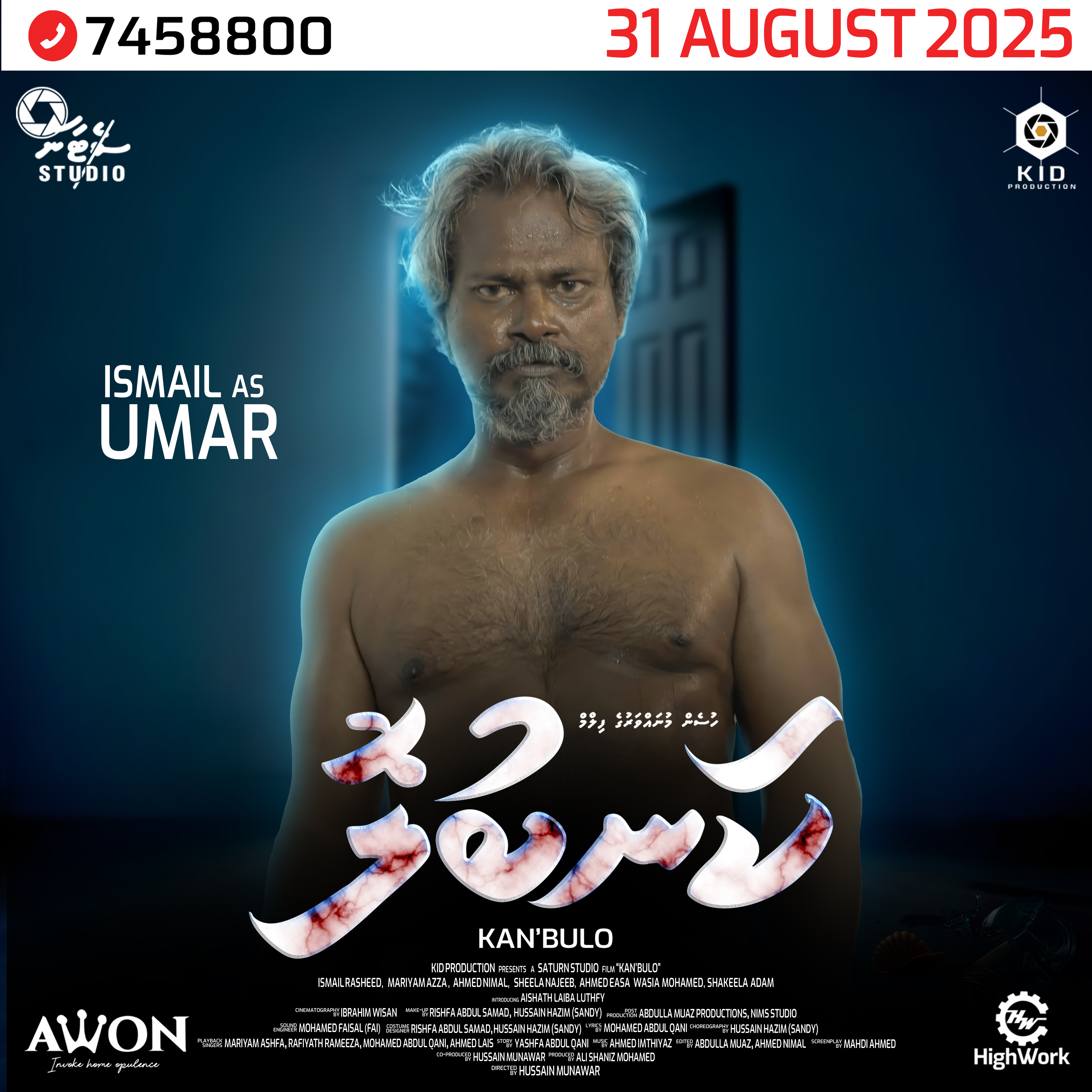
ISMAIL RASHEED: A MASTERCLASS IN PRECISION

Some collaborations in this industry aren’t born from coincidence — they’re built through trust, craft, and a shared commitment to storytelling that challenges both the artist and the audience. My journey with Ismail Rasheed goes back over a decade, to 2013’s Ingili — a film that, at the time, was considered experimental for Maldivian cinema. It was a project I wrote and produced alongside Munawwaru and Ravee, and it marked a milestone for all of us. Ingili became the first Dhivehi film to receive international recognition, earning a Bronze Award while Ismail Rasheed took home Best Actor for a performance that redefined expectations of psychological tension on screen.

Fast forward to Kan’bulo, and once again, Ismail Rasheed proves why he remains one of the most versatile and consistently brilliant actors working today. His role as Umarbe may seem quieter on the surface, but like many of the characters in this film, it’s not about volume — it’s about precision. About knowing when to hold back and when to let a crack of emotion bleed through. That level of restraint isn’t taught. It’s earned through years of honing one’s instincts.

As a screenwriter, working with an actor like Ismail Rasheed is both a privilege and a rare alignment of intent. He understands nuance. He understands rhythm. And most importantly, he understands the unsaid — the spaces between the lines where real character work lives. Watching the dailies and rough cut of Kan’bulo, it’s clear he approaches this role with the same dedication to detail and truth that earned him accolades in Ingili. He shapes scenes through posture, silence, and the subtlest shifts in gaze — choices that don’t announce themselves, but leave an undeniable impact.

What I admire most about Ismail Rasheed is that he never approaches a role as “just another character.” Whether in a psychological thriller like Ingili or a deeply human drama like Kan’bulo, he fully inhabits the emotional architecture of the story. He’s an actor who brings gravity to every frame, reminding us why storytelling matters in the first place.

For me, this collaboration isn’t just professional. It’s a continuation of a creative conversation we began years ago — one rooted in respect for the craft and a shared belief in the power of honest, unflinching cinema.

Kan’bulo is set to be released on 31 August 2025.
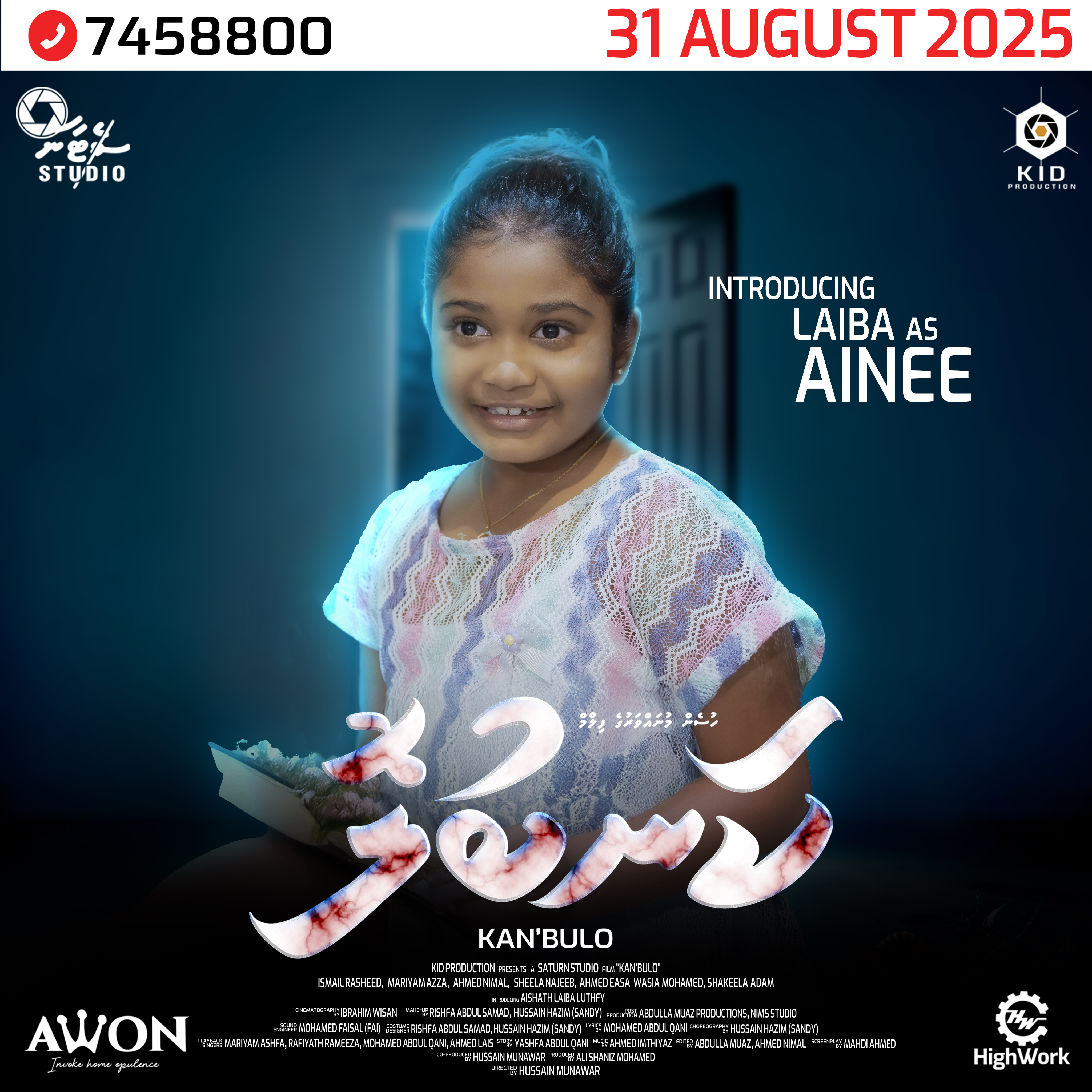
LAIBA: THE LIGHT IN THE DARK

As a screenwriter, you often write characters knowing they serve as emotional anchors for the story. Sometimes it’s not the protagonist, nor the antagonist, but a quiet presence — a small yet vital light that reminds everyone, including the audience, what is still worth holding onto. In Kan’bulo, that light is Ainee. And bringing her to life is the young and incredibly talented Laiba.

Laiba’s portrayal of Ainee goes beyond simply playing a child on screen. She brings an authenticity and warmth that is rare, even among seasoned actors. In a story shaped by silence, grief, and healing, her innocence doesn’t just soften the narrative — it sharpens its emotional impact. She makes us believe in hope without forcing it. She becomes the pulse of gentleness within a world weighed down by pain.

What impressed me most, as I watched the dailies and the early cuts, was her natural understanding of emotional rhythm. She listens in scenes. She reacts honestly. There’s no artificial sweetness in her performance — only truth. Her interactions with the cast bring out dimensions in their performances that even I, as the writer, hadn’t fully anticipated.

Writing Ainee was my attempt to thread hope through a heavy narrative. Seeing Laiba embody that hope so effortlessly is a reminder that sometimes, the smallest characters carry the greatest emotional weight.

Laiba’s Ainee doesn’t just brighten scenes. She lifts the film.

Kan’bulo is set to be released on 31 August 2025.

MARIYAM SHAKEELA: THE WEIGHT OF COMPASSION

Writing Kan’bulo was, from the very beginning, a study in contrasts — silence and screams, darkness and light, survival and surrender. Among the constellation of characters, there is one figure who quietly becomes the lighthouse in this storm: Zaheena, portrayed with absolute depth and dignity by the legendary Mariyam Shakeela.

What makes Zaheena essential to this story isn’t simply her relationship to the protagonist. It’s the emotional function she serves within the structure of the screenplay. She is the still point in a world spinning out of control. She is not reactive but grounded. Where others in the narrative waver, she holds steady — and in doing so, carries more emotional weight than she will ever speak aloud.

Shakeela brings to Zaheena a quiet ache beneath her strength, a heaviness in her presence that only seasoned actors can deliver with such restraint. It’s not what she says; it’s what she allows herself to carry between the lines. That is a difficult thing to write. It’s even harder to perform. Yet Shakeela moves through this role as though she’s been living with Zaheena’s quiet burden long before the cameras rolled.

Watching her in the dailies and the rough cut, I was struck by how often she anchors a scene without a single dramatic flourish. She listens. She absorbs. She reacts with precision. It’s a masterclass in subtext-driven performance. Her warmth isn’t soft — it’s forged from experience. Her compassion isn’t theatrical — it’s survival.

As a writer, Zaheena was always meant to symbolize hope, resilience, and the unseen cost of bearing witness to pain over time. Shakeela embodies this with a grace that elevates everyone who shares the frame with her.

Kan’bulo is a story about survival. But without Zaheena, it would lack the humanity that makes survival possible.

Kan’bulo is set to be released on 31 August 2025.

AHMED NIMAL: COMMANDING THE SCREEN WITHOUT A WORD WASTED

One of the great pleasures of writing for cinema is crafting characters who carry weight without explanation — characters who can shift the energy of a scene the moment they step into frame. In Kan’bulo, that weight belongs to Ahmed Nimal’s portrayal of Rauf.

Working with Nimal is a lesson in how less is always more when you trust the actor. His performance isn’t loud. It’s not theatrical. It doesn’t demand attention — it commands it. From the earliest drafts, Director Munavvaru and I knew Rauf needed to be played by someone who could embody presence with precision. Someone who understands that authority doesn’t come from shouting; it comes from the quiet confidence of someone who believes they control the room, the situation — and sometimes, the people.

Watching the dailies and the rough cut, it became clear to me how much Nimal brought beyond what was written. His understanding of pacing, of silence, of stillness, transformed simple scenes into something tense, layered, and unforgettable. His performance shapes the emotional landscape of this film. He fills the gaps between the lines with something unspoken but deeply felt.

Audiences may not know what to make of Rauf at first. And that’s by design. Ahmed Nimal ensures that with every glance, every gesture, they’ll lean in closer — trying to understand him, trying to figure him out. That is the mark of an actor fully in control of his craft.

As a screenwriter, there’s no greater reward than seeing an actor breathe life into a role in ways you didn’t even imagine. Ahmed Nimal does this, and more. His work in Kan’bulo will stay with you long after the credits roll.

Kan’bulo is set to be released on 31 August 2025.
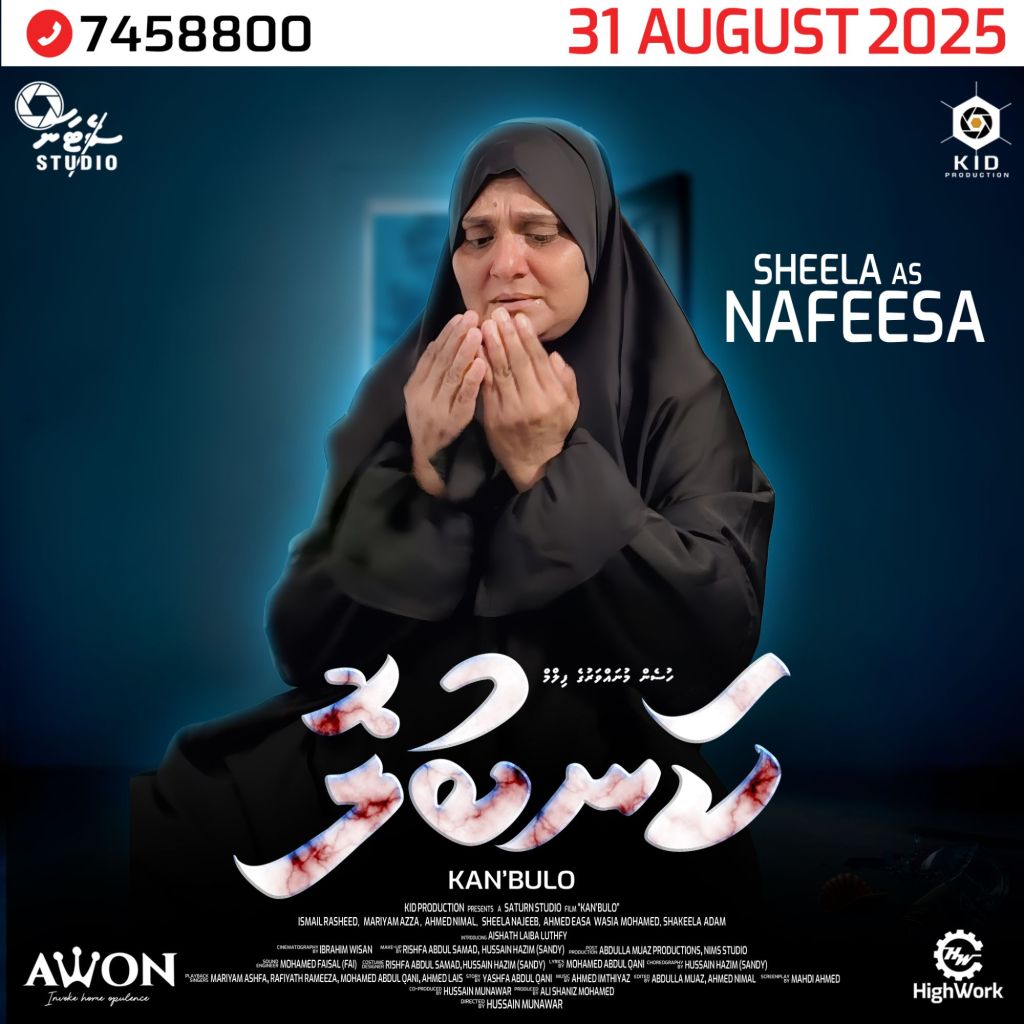
SHEELA NAJEEB: THE QUIET FORCE BEHIND NAFEESA

As a screenwriter, you often build characters knowing full well they require an actor with presence beyond words — someone who understands that not all performances are loud, but the best ones linger long after the scene ends. In Kan’bulo, Sheela Najeeb’s portrayal of Nafeesa is a textbook example of this rare craft.

Sheela doesn’t just perform — she elevates. What she brings to Nafeesa isn’t simply emotion; it’s a kind of silent authority, a dignity wrapped in layers of grief, faith, and resilience. She carries the weight of the character’s suffering with remarkable restraint, never slipping into melodrama. Her stillness, her pauses, the precision in how she delivers even the smallest reaction — these are not accidental choices. They are the marks of an actor deeply tuned into the unspoken architecture of a scene.

What’s equally remarkable is how Sheela’s performance functions like a gravity well for the ensemble. She anchors those around her, allowing other actors to find the right emotional temperature within their own roles. In scenes where the material is heavy, she brings balance. In scenes where others might falter, she raises the bar through sheer presence.

As a screenwriter, this is the kind of actor you dream of writing for — someone who understands the power of subtext, who knows the difference between playing a line and living inside it. Watching the dailies and now the rough cut, I can say this with certainty: Sheela Najeeb gives Nafeesa the quiet strength the story demands. And through her, everyone else shines brighter.

In Kan’bulo, her work isn’t just a performance. It’s a masterclass in understanding that sometimes, a mother’s grief and love can fill a screen more completely than any dialogue ever could.

Kan’bulo is set to be released on 31 August 2025.

WHEN A POSTER HURTS MORE THAN A SCENE

This morning, the official poster for Kanbulo was released.
And if it made your heart skip a beat — good.
It’s meant to.

A girl. A newborn.
Blood-soaked hands.
Eyes wide open — not with fear… but with something worse: disbelief.
And yet, she’s still standing.

The girl on this poster — portrayed heartbreakingly by Mariyam Azza — came to me first through the pages of Yuktha, the 2006 National Award-winning novel inspired by true events.
I remember the moment I finished reading it: I was frozen. Gasping. Shattered.
And I knew — without a doubt — that she would never leave me until her voice reached the screen.

The poster doesn’t sell a fantasy. It doesn’t glamorize. It doesn’t comfort.
It unsettles.
Because Kanbulo isn’t here to entertain.
She’s here to speak — for those who never could.

Writing Kanbulo wasn’t like any other screenplay.
It tore something out of me.
There were days I sat blank, unable to type a word.
And nights when writing just a single scene left me emotionally gutted.
But I kept going.
Because silence was never an option — not for her.

We renamed the film Kanbulo — a name spoken with affection, like “sweetie” or “darling.”
But don’t be fooled by its softness.
This film bites. It bleeds. It fights back.
It confronts the quiet violence so many women endure — behind closed doors, beneath polite conversations, under the weight of shame that isn’t theirs to carry.

The official poster, brilliantly designed by Abdulla Muaz, captures that very roar—unflinching, visceral, and impossible to look away from.

This isn’t fiction.
It’s a mirror.
One many will want to look away from.
But I hope you won’t.

I’m proud to be reuniting with director Hussain Munavvaru for our fourth film together. After Kamanaa, this film takes a very different turn.
Kanbulo doesn’t flirt. It doesn’t seduce.
It screams.
And for once, we’re ready to listen.

Kan’bulo opens 31 August 2025.
And when it does — I hope it stirs something in you.
Not just pity. Not just rage.
But action.
Empathy.
Reflection.
And the courage to believe those who’ve been silenced for far too long.

Until then —
Hold your daughters.
Protect the vulnerable.
And when someone finally trusts you enough to speak…
Listen. Fully. Fiercely. Without turning away.