Mahdi Ahmed

Scripting waves of imagination from the sunny side of the Maldives.

Posts from the ‘Entertainment’ category

WHEN A POSTER HURTS MORE THAN A SCENE

This morning, the official poster for Kanbulo was released.
And if it made your heart skip a beat — good.
It’s meant to.

A girl. A newborn.
Blood-soaked hands.
Eyes wide open — not with fear… but with something worse: disbelief.
And yet, she’s still standing.

The girl on this poster — portrayed heartbreakingly by Mariyam Azza — came to me first through the pages of Yuktha, the 2006 National Award-winning novel inspired by true events.
I remember the moment I finished reading it: I was frozen. Gasping. Shattered.
And I knew — without a doubt — that she would never leave me until her voice reached the screen.

The poster doesn’t sell a fantasy. It doesn’t glamorize. It doesn’t comfort.
It unsettles.
Because Kanbulo isn’t here to entertain.
She’s here to speak — for those who never could.

Writing Kanbulo wasn’t like any other screenplay.
It tore something out of me.
There were days I sat blank, unable to type a word.
And nights when writing just a single scene left me emotionally gutted.
But I kept going.
Because silence was never an option — not for her.

We renamed the film Kanbulo — a name spoken with affection, like “sweetie” or “darling.”
But don’t be fooled by its softness.
This film bites. It bleeds. It fights back.
It confronts the quiet violence so many women endure — behind closed doors, beneath polite conversations, under the weight of shame that isn’t theirs to carry.

The official poster, brilliantly designed by Abdulla Muaz, captures that very roar—unflinching, visceral, and impossible to look away from.

This isn’t fiction.
It’s a mirror.
One many will want to look away from.
But I hope you won’t.

I’m proud to be reuniting with director Hussain Munavvaru for our fourth film together. After Kamanaa, this film takes a very different turn.
Kanbulo doesn’t flirt. It doesn’t seduce.
It screams.
And for once, we’re ready to listen.

Kan’bulo opens 31 August 2025.
And when it does — I hope it stirs something in you.
Not just pity. Not just rage.
But action.
Empathy.
Reflection.
And the courage to believe those who’ve been silenced for far too long.

Until then —
Hold your daughters.
Protect the vulnerable.
And when someone finally trusts you enough to speak…
Listen. Fully. Fiercely. Without turning away.

F1 (2025): KOSINSKI’S PIT-PERFECT LAP

I revved into F1 (2025) expecting Top Gun: Pit Crew Edition — Brad Pitt, visor down, throttle open, powering through the backstretch of midlife. And sure, that turbo-charged swagger is here. But director Joseph Kosinski doesn’t just run a few hot laps for show — he gives us a full Grand Prix of emotion, grit, and grease. This isn’t just another studio pit stop — it’s a championship-level drama wrapped in racing gear.

Kosinski drives the film like someone who knows every corner of the circuit. Fresh off the Top Gun: Maverick podium, he brings the same aerodynamic precision — but this time, he downshifts when needed. F1 isn’t just spectacle; it breathes. He’s got a mechanic’s eye for detail and a racer’s instinct for timing, crafting scenes that glide, grip, and occasionally gut-punch. Under his direction, F1 becomes more than a race movie — it’s a story of wear, tear, and redemption, told in carbon fiber.

Pitt plays Sonny Hayes, a once-legendary driver pulled back to the grid to coach a rising star — Damson Idris, magnetic and refreshingly grounded. It’s the classic “one last lap” setup, but Pitt doesn’t come in hot. He eases into the role with restraint, playing Sonny like a man still haunted by the corners he missed — both on the track and off. There’s a scene where he watches Idris from the pit wall after a brutal qualifying run — no words, just a look that says, I’ve been there. It’s a quiet pass of the baton. No melodrama. Just respect.

Javier Bardem and Kerry Condon round out the team with precision casting. Bardem, as the seasoned team principal, mixes pit wall wisdom with ruthless edge — a man who can quote philosophy and still gamble on slicks in the rain. His moments with Pitt crackle, like two old engines revving in sync, each carrying scars from different races. Meanwhile, Condon plays the team’s technical director with steely calm. She’s the data whisperer, the emotional barometer, the quiet pulse beneath the roar. Together, they give the film its backbone.

And the racing? Holy downforce. F1 doesn’t rely on green screen trickery — it hugs the tarmac. Real cars, real tracks, real speed. Every turn, overtake, and braking point feels electric. Claudio Miranda’s cinematography is pure art — racing shot like high-velocity ballet. You don’t just see the speed. You feel it press into your chest.

Hans Zimmer doesn’t just score the film — he tunes it. His compositions rise and idle like an engine under pressure, syncing perfectly with the film’s emotional pulse. It’s not peak bombastic Zimmer — it’s restrained and elegant.

What really impresses is how F1 downshifts at the right moments. Between tire screeches and engine roars, it finds its quiet gears. The bond between Pitt and Idris is warm and lived-in — like two drivers who’ve seen different races but respect the same finish line. Their chemistry never fishtails into sentimentality. It stays grounded.

Sure, the plot hugs the underdog racing line a little tightly, and the final stretch may be a touch too clean. But when a film lets you feel every emotional gearshift, every mental chicane — you don’t mind a smooth corner or two.

F1 isn’t just about taking the checkered flag. It’s about staying in the race — battered, aging, but still chasing the ghost of who you once were. Brad Pitt may be burning through the latter laps of his career, but here, he’s running rich — eyes on the apex, soul on the line.

Slam the pedal. This one’s worth the full circuit.

P.S. Pitt and Idris actually drove specially modified Formula 2 cars dressed up to look like F1 monsters. With real telemetry, real rigs, and real speed. So, when you see Pitt dive into a corner at 150 mph, that’s no digital illusion. That’s a man inside a carbon-fiber bullet, grinning like a driver who still lives for the redline.

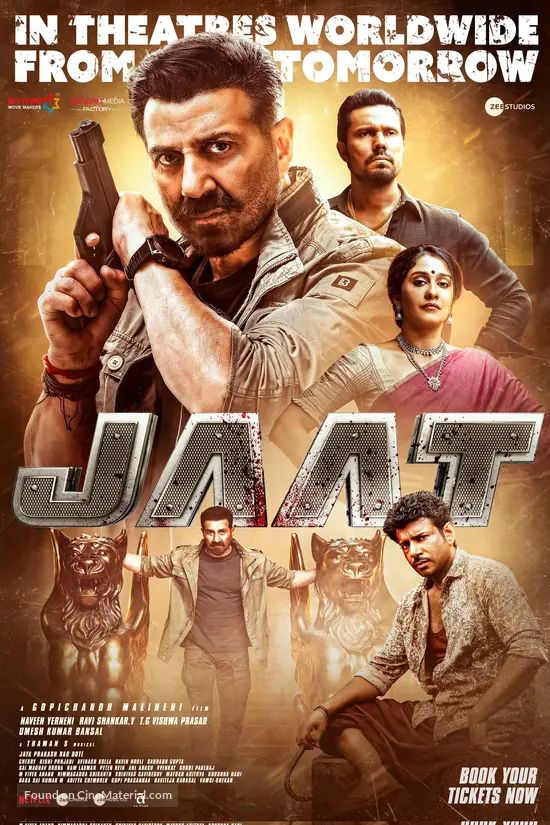
JAAT (2025): SO RIDICULOUS, IT’S GLORIOUSLY ADDICTIVE

Forget logic—Jaat kicks it off in a hot Andhra coastal village terrorized by Ranatunga (Randeep Hooda), a Sri Lankan crime lord who discovered JTF gold and went full-on despot mode. Enter Sunny Deol as a mysterious stranger/ farmer-turned-saviour who casually demands, “Sorry” for spilled idlis—because yep, that’s how action drama begins these days.

Our hero is Baldev Pratap Singh, the Jaat, who said it best: “Yeh dhaai kilo ke haath ki taakat poora  dekh chuka hai. Ab South dekhega.” (“The power of these two‑and‑a‑half‑kilo hands has already rattled the North. Now the South will feel it.”) 

That one-liner lands like a cannon. It’s Salman Khan’s Kuch Kuch Hota Hai heartbreak, meets Damini righteous rage, all wrapped in one glorious punch.

What follows is 153 minutes of physics-defying carnage—villains flying off in mid-air, idli plates turning into high-stakes catalysts, and massive hero-origin flashbacks that feel half indie documentary, half South Indian vigilante spectacle. Director Gopichand Malineni brings his Telugu flair to Bollywood with manic speed and massy swagger.

Sunny is in full “growl-and-shout” mode—less method actor, more method thunderbolt or bulldozer. Randeep Hooda? Menacing, regal, and with enough screen presence to make you forget Sunny exists—within seconds. He has a certain swagger when he smokes his bidi.

Sure, the second half sputters with slower pacing and melodrama, but who cares when there’s an item song (“Sorry Bol”) that practically dares you to stay seated?

Final Take

Plot: A stranger with a beef over idlis crashes a criminal empire.

Action: Bodies explode like Bollywood fireworks.

Dialogue: Stirring one-liners delivered with all the conviction of a guy lifting gold bricks for breakfast.

Fun Factor: Ridiculously watchable—even if you know it’s ridiculous.

Why I Rooted for It:

1. Sunny’s charisma is colossal: you believe those hands could rip through steel.

2. It’s unapologetically dumb in the best way—popcorn cinema that never apologizes.

3. That “two-and-a-half-kilo” line? Whistle-worthy moment.

If you’re in the mood for massy mayhem, nostalgic bravado, and one spectacularly silly hero sequence after another—Jaat is your guilty pleasure. It’s absurd, it’s indulgent, and yes, you’ll find yourself cheering loud enough to wake the village.

P.S. I’ll probably watch it again the next time I feel low on adrenaline. Even my wife—who treats slow-mo punches like mosquito bites on her patience—was hooked. She said, “This is nonsense.” Then sat stone-faced for 153 minutes like it was the SATs.

THUDARUM (2025): WHEN MALAYALAM CINEMA WHISPERS THUNDER AND THAT SMILE…

There’s something quietly powerful about a film that doesn’t beg for your attention. Thudarum, directed by Tharun Moorthy, isn’t trying to be loud. It doesn’t explode with plot twists or shout with background scores. Instead, it breathes. It lingers. It invites you in.

At the center of this stillness is Mohanlal, playing Shanmughan—a humble taxi driver from Ranni, known lovingly as “Benz.” Not because he owns a luxury car, but because he drives a lovingly preserved vintage Ambassador. Like the car, Shanmughan is solid, graceful, and full of unspoken stories. That small detail says everything without ever spelling it out.

And then there’s George.

If Shanmughan is a smoulder waiting to flare, George is ice in human form. Played with unnerving calm by newcomer Prakash Varma, George is the kind of villain who never yells. He doesn’t need to. His stillness is menacing. His smile? It chills the spine. Every time he appears on screen, the temperature drops just a bit.

The plot—on paper—is familiar: guilt, justice, a slow-burning sense of revenge. But in Tharun Moorthy’s hands, it becomes something far more personal. This isn’t just a story being told; it’s one being remembered.

What truly stands out is how the film weaves in nostalgia. Old Malayalam songs aren’t just there for aesthetic—they carry memory. They haunt. They heal. They act as bookmarks in Shanmughan’s emotional journey. For older audiences, these tunes will hit like waves of memory; for younger ones, they may spark curiosity.

Visually, Thudarum is pure mood. The sleepy lanes of Ranni, the warm glow of late afternoons, the shadowy corners of quiet homes—everything is framed with purpose by cinematographer Shaji Kumar. And Jakes Bejoy’s background score? It whispers, it doesn’t scream. It holds the film’s emotional weight without ever tipping the balance.

This isn’t a film for those looking for speed. Thudarum walks. Slowly. But that’s exactly the point.

You’re meant to feel the silence. To sit with the characters. To live in their moments.

Watch it for Mohanlal’s haunting restraint.
Watch it for George’s bone-deep chill.
Watch it because every old song carries a ghost.
And because Malayalam cinema, at its best, doesn’t shout. It whispers—and that whisper can be thunderous.

P.S. If this really is Prakash Varma’s debut, we’ve just met one of the most chilling new faces in Malayalam cinema. What a start.

THE QUIET CHECKMATE

Some stories… you don’t just write.
You survive them.

I just wrapped the final scene of a screenplay I’ve been living with for over a month. And I say living with because this wasn’t one of those breezy weekend scripts where characters flirt and plots resolve with a kiss in the rain. No. This one had sharp edges. And it knew where to cut.

It took me to dark, silent places—places where grief doesn’t shout, it watches. Where every character’s arc is forged in silence and pain. I found myself pacing my room at midnight, questioning not just the characters’ motives, but my own. I felt like I was walking barefoot on broken glass—knowing I had to cross, but dreading every step.

At one point, I had to pause and study the intricacies of a specific chess move. I thought I’d just Google a cool play and move on. But no. The scene demanded more. The stakes were higher. So I ended up neck-deep in Sicilian Defense, Zugzwang, and the beautiful cruelty of the Smothered Mate. That moment became a quiet war. No weapons. Just minds trying to outlive each other on a checkered battlefield.

What began as a simple idea—a flicker—turned into something heavier. Something real. This script tested me. And strangely, I’m grateful for that.

I’m not going to reveal the title just yet. Not the plot either.
Let’s just say… some sparks don’t just light up a room.
They burn through your soul.

More soon.

DRAGON (2025): A DRAMEDY ON REDEMPTION

“Dragon” (2025) is a Tamil cinematic gem that takes you on an emotional rollercoaster, blending humor, drama, and romance into a narrative that’s both engaging and thought-provoking. Written and directed by Ashwath Marimuthu, this film showcases the journey of D. Raghavan, affectionately known as ‘Dragon,’ portrayed with remarkable depth by Pradeep Ranganathan.

Pradeep masterfully captures the essence of Raghavan, a rebellious college student burdened with 48 arrears, making his journey from academic underachiever to a man confronting his past both believable and deeply engaging. Pradeep’s performance is a harmonious blend of humor and emotional depth, allowing audiences to connect with Raghavan’s struggles and triumphs on a personal level. His nuanced acting ensures that Raghavan’s transformation is not just seen but felt, making this film a truly immersive cinematic experience.

Anupama Parameswaran shines as Keerthi, bringing a nuanced performance that adds layers to the storyline. Kayadu Lohar, as Pallavi, delivers a compelling portrayal that complements the ensemble cast, including notable performances by Mysskin, Gautham Vasudev Menon, and K. S. Ravikumar.

Leon James’ musical score is the soul of the film, perfectly capturing the essence of each scene and elevating the overall experience. The cinematography by Niketh Bommireddy paints each frame with a vibrancy that mirrors the protagonist’s tumultuous journey.

The editing by Pradeep E. Ragav crafts a rhythm that effortlessly shifts from college mischief to heartfelt drama. Each scene flows smoothly, ensuring that even the predictable beats hit just right. It’s as if the cuts know exactly when to hit the gas or slam on the brakes, keeping the film crisp and engaging—solid editing that gives Dragon its cool, modern pulse.

However, what sets “Dragon” apart is the adept screenplay by Marimuthu, blending conventional narrative structures with inventive storytelling techniques. His screenplay seamlessly integrates humor and drama, ensuring that each scene propels the story forward while deepening character development. The strategic placement of comedic elements provides relief without undermining the narrative’s emotional weight. Additionally, the screenplay’s pacing maintains audience engagement, balancing moments of levity with poignant sequences that resonate on a human level.

This film seamlessly weaves a tale of redemption without being preachy. It holds a mirror to society’s pressures and the lengths one might go to overcome personal failures. The film doesn’t shy away from showcasing the protagonist’s flaws, making his redemption arc all the more satisfying.

In essence, “Dragon” is more than just a film; it’s an experience that resonates deeply, reminding us of the power of second chances and the human spirit’s resilience. A must-watch that leaves you reflecting long after the credits roll.

P.S. The poignant scene at the end between Dragon and his father, Dhanapal, portrayed with heartfelt sincerity by George Maryan, is one of the film’s most emotionally charged moments. If that scene doesn’t open your floodgates, then maybe nothing will.

ADOLESCENCE: A PARENT’S WORST NIGHTMARE, UNFOLDING IN REAL TIME

Watching Adolescence as a parent feels like having your heart ripped out, examined under a harsh light, and then handed back with a quiet reminder of how fragile youth really is. The series throws us into the nightmare of the Miller family, whose 13-year-old son, Jamie, is arrested for the unthinkable—murdering a classmate. From the moment the police arrive, there’s no escape. It’s raw, relentless, and terrifying in its realism, a reminder that no family is immune to tragedy.

The choice to shoot each episode in a single continuous take is nothing short of brilliant. It pulls us deep into the chaos, refusing to let us look away. Every moment feels unfiltered, immediate, and painfully real. Stephen Graham delivers a devastating performance as Eddie Miller, a father drowning in confusion, rage, and unbearable grief.

But the real revelation here is Owen Cooper. In his first-ever role, the young actor carries the weight of the entire series on his small shoulders—and he does it masterfully. His Jamie is unsettlingly complex: one moment just a scared boy, the next an unreadable enigma. There are scenes where he barely speaks, yet his silence is deafening. His blank stares, sudden shifts in emotion, and the terrifying emptiness in his eyes make it impossible to look away. It’s a performance that feels so natural, so lived-in, that it’s hard to believe this is his debut. Cooper doesn’t just act—he inhabits Jamie in a way that makes the story feel disturbingly real.

And then there’s Episode Three. The moment Jamie meets his clinical psychologist, Briony Aniston. I was completely frozen. It’s the kind of scene that burrows into your chest and refuses to leave. Briony, played with unsettling brilliance by Erin Doherty, an actress whose name I immediately had to look up, is not what I expected. She’s not afraid of Jamie. She doesn’t treat him like a monster. Instead, there’s an eerie, almost hypnotic connection between them—one that feels dangerous and inevitable. Their conversation is quiet, measured, yet charged with an intensity that makes every second unbearable. It’s in this moment that I realized Adolescence isn’t just a story about crime or guilt—it’s about the terrifying unpredictability of young minds, the way connections can form in the most unexpected places, and how sometimes, the scariest thing isn’t the crime itself, but what lingers in its aftermath.

But Adolescence isn’t just about one family’s nightmare—it’s a wake-up call. Jamie’s slow descent into online radicalization is a stark reminder that the dangers we fear for our children aren’t just in the streets or at school. They lurk behind screens, in algorithms, in the quiet corners of the internet where kids seek meaning and end up lost. It forces parents to face a brutal truth: our protection can’t stop at the front door—we have to be present in the digital world too.

This series isn’t entertainment. It’s a gut punch. A plea. A brutal but necessary confrontation with the reality of modern parenting. It makes you question everything—how well you really know your child, whether you’re asking the right questions, whether you’re paying enough attention. And the scariest part? Even when you do everything right, it might not be enough.

Adolescence is the kind of show that lingers long after the credits roll. It breaks you, but it also forces you to see what’s at stake. And as parents, that’s something we can’t afford to ignore.

Adolescence is an unflinching, gut-wrenching experience that every parent must watch.

P.S. Actor Stephen Graham’s personal investment in the project stemmed from a deep concern about the hidden struggles of modern teenagers, making the series not just a performance but a passion project driven by real-life fears and experiences.

REKHACHITRAM: A CINEMATIC LOVE LETTER WRAPPED IN A MURDER MYSTERY

In Rekhachithram, director Jofin T. Chacko invites us on a journey that goes beyond time, blending mystery with a deep-seated love for Malayalam cinema’s illustrious past. The film intricately weaves a narrative that not only keeps the audience on the edge of their seats but also tugs at the nostalgic strings of those who cherish the golden age of Malayalam films.

The story centers around Vivek Gopinath, portrayed by Asif Ali, a police officer seeking redemption after a suspension. His assignment to investigate a 40-year-old murder case leads him to the enigmatic Rekha, played by Anaswara Rajan, an aspiring actress from the 1980s. The plot masterfully intertwines the investigation with the production of the real-life 1985 film Kathodu Kathoram, directed by Bharathan and starring Mammootty. This clever narrative choice creates an alternate history that feels both authentic and mesmerizing.

Chacko’s direction shines as he seamlessly transitions between the past and present, capturing the essence of the 1980s Malayalam film industry. The meticulous recreation of film sets, the depiction of industry stalwarts, and the subtle nods to iconic moments evoke a profound sense of nostalgia. The film doesn’t merely rely on these elements for sentimental value; they are integral to the storyline, enriching the viewing experience.

Asif Ali delivers a nuanced performance as Vivek, embodying the character’s determination and vulnerability. Anaswara Rajan’s portrayal of Rekha is both poignant and compelling, capturing the aspirations and challenges of an actress in that era. The supporting cast, including Manoj K. Jayan as Vincent and Zarin Shihab as young Pushpa, contribute significantly to the film’s depth and authenticity.

The film’s technical aspects are commendable. Appu Prabhakar’s cinematography beautifully captures the contrasting eras, while Mujeeb Majeed’s music subtly enhances the narrative without overshadowing it.

Rekhachithram is more than just a murder mystery; it’s a heartfelt tribute to Malayalam cinema’s rich heritage. It celebrates the art form, the artists, and the timeless stories that have shaped the industry. For cinephiles and casual viewers alike, this film offers a captivating blend of suspense and nostalgia, reminding us of the enduring magic of cinema.

Highly recommended.

P.S. The use of AI technology to recreate Mammootty’s appearance from the 1985 film is both innovative and respectful, adding a layer of realism that fans will appreciate.

TURNING PAIN INTO ART

I’m thrilled to announce that I’ve just wrapped up my latest screenplay, my first project of 2025—a journey that has been as emotionally taxing as it has been creatively liberating. This new film is a follow-up to Kamanaa, last year’s mega blockbuster, and I’m excited to be pairing once again with producer/ director, Hussain Munawwaru—our fourth collaboration together. Production is set to kick off in early April, and I can hardly wait to see our shared vision come to life on screen.

This screenplay is loosely based on a National Award-winning Dhivehi novel inspired by true events. Without giving away any spoilers, I can share that this film follows the remarkable journey of a resilient protagonist—a tale of survival, redemption, and finding hope amid life’s deepest sorrows.

In writing this screenplay, I dove into the raw, unfiltered depths of human emotion. I explored the painful echoes of a troubled past, the agony of loss, and the slow, often painful road toward healing. Every page challenged me to confront the complexities of the human spirit and its capacity to endure, even when burdened by unbearable weight. There were moments when the emotional toll felt almost overwhelming, yet every tear shed in the creative process became a tribute to the strength that emerges when vulnerability is embraced.

I hope this screenplay jolts audiences awake, exposing the raw, horrifying truths of our society that too many have tried to bury.

Stay tuned for more updates as we approach the start of production in April.

Cheers!

LIGHTS, CAMERA… AI? DIRECTING MY FIRST DHIVEHI MUSIC VIDEO WITH SORA!

Somewhere in the depths of my curious mind (which, according to some, runs on expired Wi-Fi signals), I decided to put AI to the ultimate test: directing a Dhivehi music video. Because why not?

First, a huge Shukuriyyaa! to singer Theyravaa for selecting this song for my experiment. His trust in my AI-driven madness is truly appreciated.

And an even bigger, heartfelt thank you to Baiskoafu for giving me the official approval to use this song, which is under their copyright. Without their support, this experiment wouldn’t have been possible.

Now, let’s be clear—I never had a screenplay. No shot list, no scene breakdowns, nothing. I just listened to the song and rendered the shots as I went, trusting my instincts (and Sora’s AI magic) to make something out of thin air. Basically, I directed this like a rogue filmmaker who forgot to hire a crew.

Since I’m running ChatGPT Plus (and not some elite, unlimited AI overlord version), I quickly realized that my credits had the lifespan of a plate of short eats at a Maldivian tea shop— gone before I could blink. This meant I had to wait, sip some tea, contemplate life, and then wait some more while Sora took its sweet time rendering the videos.

Despite these delays, I must admit—I was thoroughly impressed with the results. The AI-generated visuals matched the mood of the song quite well, and the whole thing had a certain vibe. But (and it’s a big but, like those seen in oddly-proportioned AI renders), keeping consistency in characters was nearly impossible. One second, my main character had wavy hair, and the next, she looked like she had just returned from a wind tunnel. If Sora could introduce a character consistency feature, it would be an absolute game-changer.

Since this was a test, I rushed through it with the urgency of me sprinting to catch the last ferry to Vilimale’. Naturally, there were some odd occurrences here and there (like characters suddenly morphing into entirely new people), but overall, I’m thrilled with how it turned out, my first-ever AI-directed Dhivehi music video.

So, thank you, Sora, for the AI wizardry. Thank you, Theyrvaa, for the music. And thank you, Baiskoafu, for allowing me to bring this experiment to life. Now, dear Sora, please—for the love of continuity—fix the character consistency issue before I start directing a full-length AI film. Because I just might.