Mahdi Ahmed

Scripting waves of imagination from the sunny side of the Maldives.

Posts by mahdiahmed

THE WEIGHT AND GIFT OF GRIEF

Grief is a strange companion. It doesn’t knock politely before entering. It doesn’t leave when we ask it to. And it doesn’t speak when we beg for answers. Instead, it lingers — quietly and stubbornly — in the corners of our days. It shows up in the silence of mornings, in the middle of conversations, or in the way the light falls on an empty chair.

Today, I had a deeply emotional conversation with a good friend whose parent passed away recently. As he shared his sorrow, I felt his pain echo within me, pulling me back to my own loss — the day I said goodbye to my father three years ago. Different stories, different people, yet grief spoke in the same language. It made me realize that while no two losses are identical, the emptiness they leave behind often feels hauntingly familiar.

When we lose a parent, the world shifts beneath our feet. A piece of the foundation we have always relied on is suddenly gone. No matter how old we are, or how strong we believe ourselves to be, their absence leaves us feeling strangely small. Yet even in those moments, grief doesn’t feel like the end of something — it feels like a reminder of what continues to guide us, even in absence.

And here lies the deeper truth about grief: it is not something that truly heals. We often hear people say that time heals everything. But grief isn’t a wound that closes; it’s a scar that becomes part of us. It doesn’t shrink with time — instead, we grow around it. We learn to carry it.

Within that truth is something almost comforting: grief exists only because love existed. If the pain feels endless, it is because the love was vast. To grieve deeply is to have loved deeply. And so, grief becomes both our burden and our proof.

What I’ve come to realize is that grieving is not about staying in sorrow. It’s about remembering. It’s about keeping alive the laughter, the lessons, the stubbornness, the kindness, the everyday things that made them who they were. When we live by what they gave us, they remain here — woven into the fabric of our days.

So maybe grief is not a thief after all. Maybe it is a guardian. It guards the love we had, reminding us that though time moves forward, bonds are eternal.

To my friend — and to anyone walking through this shadow — I say: let grief sit with you. Don’t rush it away. Let it teach you, shape you, and even soften you. One day, it will stop feeling like a storm and start feeling like a quiet sea. The waves will still come, but you’ll learn to float.

And perhaps, with time, grief transforms. It begins as sorrow, sharp and unbearable. But slowly, it becomes gratitude — gratitude for having had someone to miss so deeply. Gratitude that their love was strong enough to outlast even their presence.

Because grief is not the end of love. It is love’s echo — and if we listen closely, that echo can guide us forward, gently, into the light.

A STORY THAT WOULDN’T LEAVE ALONE

Some scripts you wrestle into shape. Others… they quietly unravel you while you’re trying to write them.

This one was different from the very beginning.

It arrived as a spec script from a brilliant writer/director, with a strong central idea — but instead of tracing the original lines, I found myself slowly dismantling it, piece by piece, and rebuilding it into something far more internal. Far more unsettling. And far more… me.

The journey wasn’t straightforward. In fact, I don’t think I’ve ever rewritten the third act of a screenplay so many times in my life — not because it didn’t work, but because I kept uncovering deeper truths the characters were hiding. Especially the protagonist. He wasn’t just grieving. He was living in the ghost of what he lost.

What began as a psychological drama soon evolved into something deeper — a layered family story about what holds people together even when they drift apart. At its heart, this became a film about how much a family needs each other to stay afloat — even when one of them has emotionally disappeared.

This is a story about presence, absence, memory, and guilt — but not in the ways we usually tell them. Every character carries a wound. Some show it. Some bury it. Some don’t even know it’s there until it explodes into the room. The screenplay flirts with silence, leans into hallucination, and plays with emotional withholding in ways that made me both uncomfortable and strangely fulfilled.

At its core, it’s an exploration of how grief, when unprocessed, can become a kind of architecture — building rooms we live in, long after we should have left. I was fascinated by the idea of a man who hasn’t just lost his mother… but one who hasn’t let her go. That subtle difference shaped everything.

And let’s not forget the child in the story — quietly drawing her emotions in her art book. That subplot, in particular, shook me. Sometimes children say more in silence than adults ever do in monologues.

Now that it’s wrapped — and I mean really wrapped — I feel both emptied and enriched. Like I’ve said goodbye to someone I never really met… but somehow knew intimately.

This script didn’t come easy. But it came honestly. And I think that’s what makes this one special.

The title is still under wraps for now — but the screenplay is ready. And when it finds its audience, I hope it sits with them quietly… the same way it sat with me.

I can’t wait for you to meet it.

More soon.

THREE YEARS WITHOUT YOU

It’s been three years, Bappa.

Three years since that early morning of August 5th, 2022, when the world seemed to hold its breath… and never let it out again.

I was there beside you in that cold, sterile ER. The hum of machines. The smell of antiseptic. When your vitals began to fade, they wheeled you into the resuscitation room—right in front of me. The door was left slightly open, as if it didn’t dare close.

I could see your feet on the bed. Every time they pressed the paddles to your chest, your body fought back in violent jolts, your feet lifting from the bed with each surge of electricity. I wanted to run in. I wanted to scream. But I stood there, trapped inside my own skin, my hands trembling, my heart begging the clock to turn back.

Forty-five minutes. That’s how long they tried to bring you back. Forty-five minutes of hope and horror, braided so tightly I couldn’t breathe. And then at 07:33 AM—it stopped. One moment they were fighting for you, the next… silence. An ending so abrupt it felt like a blade.

Three years. People say time heals. But it doesn’t. Not really. Time only teaches you how to walk with the wound. The emptiness doesn’t shrink—it just learns to hide in the folds of your days. Until a smell, a sound, a memory slices you open again. Some memories of you sit quietly in corners, like the cane you left behind. Like the flip-flops you wore the last time we rushed you to the ER. And through it all, what remains untouched—what never fades—is a love that stays forever, quietly holding everything you left behind.

Your dreams still live here. The big ones, the stubborn ones, the ones you never got to chase. Some fulfilled. Others, sadly, taking far longer to fulfill than we first dreamed.

I wish you had laughed more. I wish you had seen more. I wish I had said the words I thought I had time to say.

Three years, Bappa.

And I still miss you in ways words cannot carry.

I love you, Bappa.

May Allah grant you the highest place in Jannat al-Firdaus, where there is no pain, only peace and light. May Allah bless your soul for the love, prayers, and dreams you carried.

Amen.

AHMED LAIS: A VOICE THAT FOUND ITS MOMENT

Some voices don’t just sing — they remember, they ache, they belong. Ahmed Lais has one of those rare voices.

At just 27, Lais’s journey into the cinematic world is already a compelling story. Many still remember him as the bright-eyed 10-year-old who made his acting debut in one of 2009’s biggest blockbusters. His performance wasn’t just well received — it was extraordinary. He walked away with the Best Debutant (Male) and Best Child Artist awards at the 1st Maldives Film Awards, and earned a Best Supporting Actor nomination at the prestigious 6th National Film Awards — a rare feat for someone so young.

And yet, instead of riding that wave into a long-acting career, Lais chose a quieter, riskier road — music. While others may have questioned his decision to step away from the spotlight, Lais knew that his voice had its own path to follow. He submitted demos, quietly auditioned for high-profile projects, but his defining moment had yet to arrive.

Until Kan’bulo.

Director Hussain Munawwaru, always a keen observer of raw talent, heard something unmistakable in Lais’s voice — a kind of sorrowful warmth, a tender ache that couldn’t be faked. And when it came time to record the film’s most haunting romantic track, Munawwaru knew exactly who should sing it.

Lais didn’t just step up — he soared.

The result is a song that doesn’t merely accompany a scene; it inhabits it. Lais’s voice trembles with longing and loss, echoing the emotional core of Kan’bulo itself. It’s not showy. It’s not loud. It’s true. And that truth lingers long after the final note fades.

For a young man who once lit up the screen as a child, Ahmed Lais has now left a lasting impression as a vocalist. This isn’t just a song in a film — it’s a moment. And it belongs to him.

Here’s to finding your voice — and to finally being heard.

Kan’bulo is set to release on 31 August 2025.

RISHFA AND SANDY: COSTUME & MAKE-UP IN KAN’BULO

Behind every memorable character in cinema lies an invisible language — one stitched into fabric, shaded onto skin, and brushed into detail. It’s not always spoken, but it’s deeply felt. And in Kan’bulo, that language is crafted with precision and empathy by Rishfa Abdul Samad and Hussain Hazim (Sandy).

For those who watched Kamanaa, you already know the caliber of Rishfa’s work. Her costume and make-up design for that film didn’t just complement the narrative — it elevated it. She returned for Kan’bulo, not just with her signature subtlety, but with an evolved sensibility for the film’s rawer emotional terrain.

Joining her this time is Sandy — Hussain Hazim — whose meticulous attention to detail and bold visual instincts brought a vital layer of texture to the world of Kan’bulo. Where Rishfa’s approach grounds characters in emotional realism, Sandy’s contribution adds grit and authenticity to their external realities. Together, they’ve created a lookbook of broken innocence, inner scars, and quiet resilience — all without a word being spoken.

Make-up and costume are often the most overlooked departments when discussing the emotional impact of a scene. But in a story like Kan’bulo, where the transformation of a character is internal as much as it is external, Rishfa and Sandy’s work becomes more than aesthetic — it becomes storytelling. The bruises that don’t just mark pain but history. The wardrobe that doesn’t just clothe, but constricts or frees. Every choice they made helped define who these characters are, even before the first line of dialogue is spoken.

Their collaboration is not only visually cohesive but narratively sensitive. It speaks volumes in silence. And as a screenwriter, I can’t express how powerful it is to see your characters come to life not just in performance, but in appearance — in posture, in presence, in how they wear their world on their skin.

In Kan’bulo, the pain is visible, the transformation is visual, and thanks to Rishfa and Sandy, the truth is in the details.

Kan’bulo is set to be released on 31 August 2025.

YASHFA: ADAPTING HER AWARD-WINNING STORY INTO KAN’BULO

In 2009, a quiet storm passed through Maldivian literature. It came in the form of a long story titled Yuktha, penned with grace and conviction by Yashfa Abdul Qani. The piece went on to win first place at the National Long Story Competition — and rightfully so. It wasn’t just a work of fiction; it was a reflection of buried truths, crafted with emotional intelligence and a deep understanding of the unspoken.

When I was handed this story to adapt, I knew immediately that it demanded more than a simple retelling. It asked for care. It asked for bravery. And it asked for honesty.

Adapting a long story into a screenplay is never just about converting prose into scenes. It’s about translation — not of language, but of essence. What works powerfully on the page, nestled between narration and inner monologue, must now live and breathe through images, dialogue, silences, and performance. You’re not just recreating the story — you’re restructuring it so it thrives in a visual and temporal medium.

And with Kan’bulo, the weight of that responsibility was greater than usual. The story had resonance. It had urgency. But most of all, it had a protagonist who demanded her truth be told — not sensationalized, not softened — but told with authenticity.

I approached the adaptation process not as someone trying to rework a text, but as someone trying to protect it. To preserve the emotional heartbeat of Yashfa’s writing while allowing the film version to have its own rhythm. That meant hard choices — what to keep, what to let go, what to reimagine, and how to give characters a voice when the page had once carried their silence.

It was a delicate balance of loyalty and liberty. And I hope I’ve honored the spirit of what Yashfa created.

As Kan’bulo prepares to meet its audience, I want to take a moment to express my respect and gratitude to Yashfa Abdul Qani. Without her vision, there would be no story to adapt. Her courage in telling this story laid the foundation for everything that followed. I was just the one invited to build on it.

Kan’bulo is set to be released on 31 August 2025.

IBRAHIM WISAN (KANDI): PAINTING KAN’BULO IN LIGHT AND SHADOW

Fresh off directing last year’s family blockbuster Roboman, Kandi returns to his roots behind the camera — not as a director this time, but as the cinematographer of Kan’bulo. His deep understanding of visual storytelling and how cinematography can shape emotional resonance is on full display here. Kan’bulo is a far cry from the lighter, broader appeal of Roboman. It’s a film rooted in silence, restraint, and emotional nuance. It demands sensitivity over spectacle, and Kandi delivers exactly that.

What makes this collaboration even more meaningful is the history Kandi shares with Hussain Munavvaru, the director of Kan’bulo. Few may know this, but Kandi isn’t just Munavvaru’s close relative — he’s also the one who introduced Munavvaru to the world of cinema. It was Kandi who first handed a teenage Munavvaru a camera, sparking the journey that would eventually lead to Munavvaru’s acclaimed directorial career. Before he helmed his breakout debut Sazaa, Munavvaru began his path through cinematography — a path illuminated by Kandi’s guidance.

For Munavvaru, having Kandi serve as cinematographer on Kan’bulo wasn’t just a professional choice; it was the fulfillment of a long-held creative dream. This collaboration feels like a full-circle moment — mentor and mentee reunited, now as equals, crafting a story that demands precision, empathy, and technical restraint.

Kan’bulo isn’t driven by spectacle. It breathes in small spaces, long silences, and fragile emotional landscapes. Kandi’s cinematography reflects that reality. His camera work is defined by discipline and clarity. There’s no unnecessary flourish — only carefully composed frames that serve the emotional architecture of the film. His use of muted palettes, purposeful lighting, and visual contrast to delineate memory from present tense demonstrates his deep understanding of the psychological demands embedded in the story.

As a screenwriter, my responsibility ends with the words on the page. It’s artists like Kandi who elevate those words into visual poetry — translating silence into space, subtext into shadow, and emotion into light. In Kan’bulo, his lens doesn’t demand attention; it simply exists where it needs to, holding every frame with quiet, deliberate weight. I have no doubt the audience will feel the presence of Kandi’s craft in every frame.

Kan’bulo is set to be released on 31 August 2025.

ABDULLA MUAZ (BHAAI): THE ARCHITECT OF KAN’BULO’S FRAGILE NARRATIVE

Post-production isn’t simply where a film comes together — it’s where a film finds its rhythm, its heartbeat, and in the case of Kan’bulo, its delicate sense of emotional balance. Once again, my dear Bhaai, Abdulla Muaz, has proven why he remains a cornerstone of these creative collaborations. His work here is nothing short of masterful.

Having helmed the post-production on last year’s blockbuster Kamanaa, Bhaai was already well-versed in shaping narratives with precision. But Kan’bulo presented a different challenge altogether. This wasn’t about adrenaline or momentum. This was about restraint. This was about holding the audience gently through a narrative that moves between timelines, memory and reality, often with only the subtlest of cues to guide them.

Equally vital to shaping the fractured emotional rhythm of Kan’bulo is Bhaai’s meticulous craftsmanship. His editing serves as the narrative’s silent architect, ensuring that every shift — whether past to present, memory to reality — is not only seamless but emotionally coherent. The audience never feels lost, even as the characters themselves unravel. That clarity isn’t accidental. It’s built, frame by frame, with an editor’s understanding of not just story structure but emotional continuity.

What sets Bhaai apart, as always, is his ability to see beyond the edit. His color grading is subtle yet deliberate, drawing a clear psychological distinction between timelines, anchoring the audience visually even as the narrative blurs. His restrained but effective visual effects work — often invisible by design — provides the transitions the story demands without ever feeling indulgent. Every decision serves the emotional truth of the film.

It’s also worth mentioning that before Bhaai took the reins fully, Ahmed Nimal provided the first rough edit. His early work laid a strong foundation for Bhaai to build upon, ensuring that the heart of the story remained intact as it moved through the complexities of post-production.

Where Kamanaa was about precision in pacing and visual impact, Kan’bulo is about nuance, about finding beauty in silence, about allowing the audience to breathe within the story’s spaces. Bhaai understood this instinctively. His touch is everywhere in this film — not loud, not obvious, but essential. His work has given Kan’bulo its rhythm, its clarity, and above all, its emotional resonance.

As we approach Kan’bulo’s release, I can confidently say that Bhaai’s artistry has once again elevated the material far beyond the page. His dedication, patience, and precision remain an integral part of why this film works as it does.

Kan’bulo is set to be released on 31 August 2025.

KAN’BULO TRAILER CROSSES 1 MILLION VIEWS ON INSTAGRAM IN 15 HOURS!

We just made history.

In just 15 hours, the official trailer of Kan’bulo has reached 1 million views on Instagram — an unprecedented feat for a Maldivian film.

Let that sink in. One million eyes. One million hearts. One million souls who paused, watched, and felt something. That’s not just a number — that’s a wave of belief in our team.

As the screenwriter, I’m overwhelmed with gratitude — to the audience who embraced the trailer with such passion, and to the incredible team behind Kan’bulo who poured their hearts into every beat, every frame, every emotion. From the cast who embodied pain and resilience, to the director, cinematographer, editor, composer, sound designer — everyone showed up with fire.

This moment belongs to all of you. The ones who shared it, commented on it, talked about it, and believed in it. Thank you for proving that Maldivian stories told with honesty and care can connect on this scale.

We see you. We feel your love. And we carry it with us as we move forward.

From our hearts to yours — thank you.

Kan’bulo is set to be released on 31 August 2025

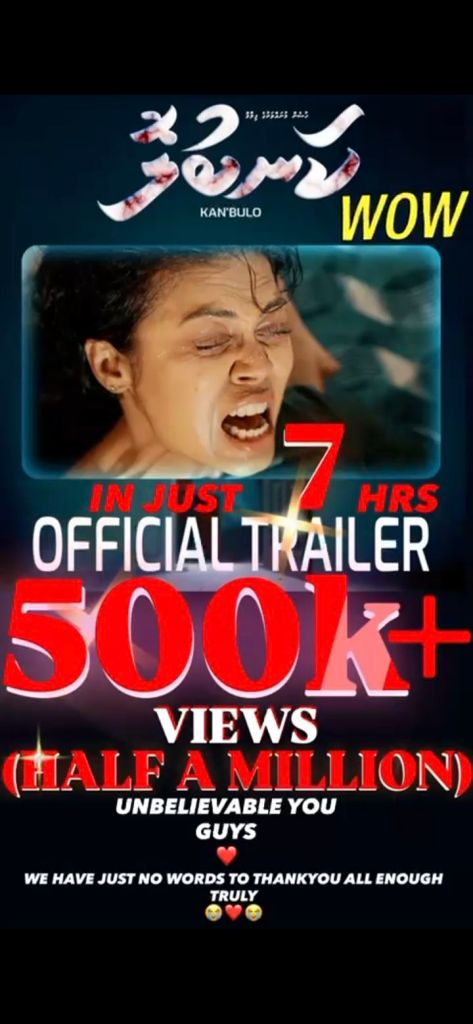
KAN’BULO TRAILER HITS 500K+ VIEWS IN UNDER 7 HOURS

What just happened is something I don’t think any of us expected—at least not this soon.

In less than 7 hours after its release, the official trailer of Kan’bulo has surpassed 500,000 views on Instagram. Let that sink in for a moment. Half a million views. On a Maldivian film trailer.

This isn’t just a number. It’s a milestone. A cultural shift. A reminder that when you tell stories with honesty, when you pour your soul into the writing, the direction, the performances, the design, the edit, the sound, the score—people feel it. And they show up for it.

On behalf of our entire Kan’bulo team, I want to extend my deepest gratitude to every single person who watched, shared, commented, cried, and connected. You’ve amplified our voices beyond anything we imagined. You’ve reminded us why we do what we do.

To be part of this movement—to tell stories that matter, to collaborate with artists who care fiercely about the craft, to witness this kind of response—it’s humbling, and deeply moving.

From the bottom of my heart: thank you. Let’s keep the conversation going.

Kan’bulo is set to be released on 31 August 2025