KILL: A Gripping, Brutal Ride on the Rails
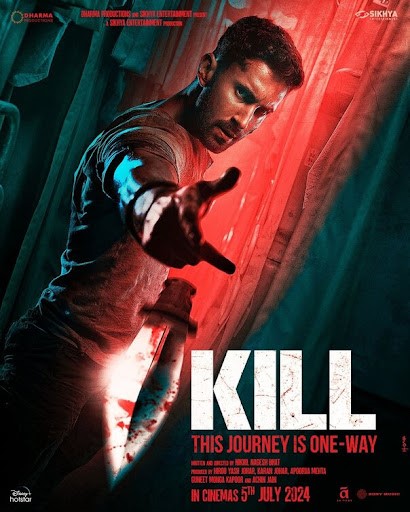
“Kill,” the latest Hindi action thriller from writer-director Nikhil Nagesh Bhat, captivates critics and audiences worldwide with its intense action sequences and daring departure from traditional Bollywood formulas. Set entirely on a train, the film eschews song-and-dance numbers and larger-than-life heroes, opting instead for a raw and unrelenting portrayal of violence.
The plot follows Amrit, a stoic army commando portrayed with impressive intensity by Lakshya, who boards a train to New Delhi to prevent his love, Tulika (Tanya Maniktala), from entering an unwanted arranged marriage. His mission gets derailed violently when a ruthless gang of dacoits, led by the merciless Fani (Raghav Juyal), hijacks the train. Driven by love and a strong sense of justice, Amrit becomes a one-man army, taking down the dacoits in a series of bone-crunching, jaw-dropping, and blood-gushing fight sequences that intensify with each frame.
The true highlight of “Kill” is its unapologetic and astonishing action. The fight scenes, a mix of martial arts and raw street brawling, are expertly devised by action directors Se-yeong Oh and Parvez Sheikh. Their creativity, supported by Rafey Mehmood’s brilliant cinematography, leaves viewers claustrophobic and on the edge of their seats as Amrit navigates the confined train compartments, creating a relentless atmosphere of tension.
Bhat’s concept, surprisingly inspired by James Cameron’s “Aliens,” focuses on a protagonist protecting someone vulnerable. Howerver, Bhat shifts the narrative’s perspective back and forth from protagonist to antagonist, elevating “Kill” beyond a typical action film by making it grittier, more relatable, and unexpectedly dramatic.
Lakshya, as Amrit, embodies the quiet rage of a soldier pushed to his limits. His steely gaze and determined body language convey more than words could. Meanwhile, Raghav Juyal, more popular as a dancer and choreographer, transforms into the chillingly charismatic villain, Fani. His menacing demeanor and razor-sharp delivery make him a formidable adversary in the vein of Hans Gruber.
The supporting cast also delivers strong performances, especially the dacoits. Cleverly, Bhat makes the narrative compelling by making all of them family, and their familial ties add an explosive emotional depth. Each bloody confrontation and brutal death realistically intensifies their horror and thirst for vengeance. Bhat also keeps the tension escalating amongst them by adding a conflict between their patriarch, Beni (Ashish Vidyarthi), and his son as Fani.
Kudos to editor Shivkumar V. Panicker for the film’s impeccably calibrated pace. Bhat, who never sits in the first edit, found Panicker ruthlessly cutting 12 minutes from the opening of his original vision and placing the main title card at an unexpected moment, which served as a great shock to everyone.
Production designer Mayur Sharma also deserves praise for constructing the train on a soundstage with movable walls to accommodate the fast-paced and intricate fight scenes Bhat envisioned.
In “Kill,” Bhat highlights the importance of art in portraying graphic violence and blood. The explicit violence serves to emphasize the stakes, desperation, and raw human emotions at play, making the film not just a visual experience but an immersive, visceral journey.
“Kill” is a bold experiment in Hindi cinema. Its raw energy, stellar performances, and innovative fight choreography make it a must-watch for fans of action thrillers seeking something fresh from Bollywood. The film’s relentless intensity evokes a profound response, leaving the audience either shaken or mesmerized.
P.S. For some strange reason, I burst into tears once the end credits started rolling. I’m not sure if I was overwhelmed by the brutal violence or the arduous journey Amrit had to endure.
 Mahdi Ahmed
Leave a comment