THE MVR100 WALK OF SHAME
Jaywalking, zebra crossings and the magnificent disorder of Malé roads.
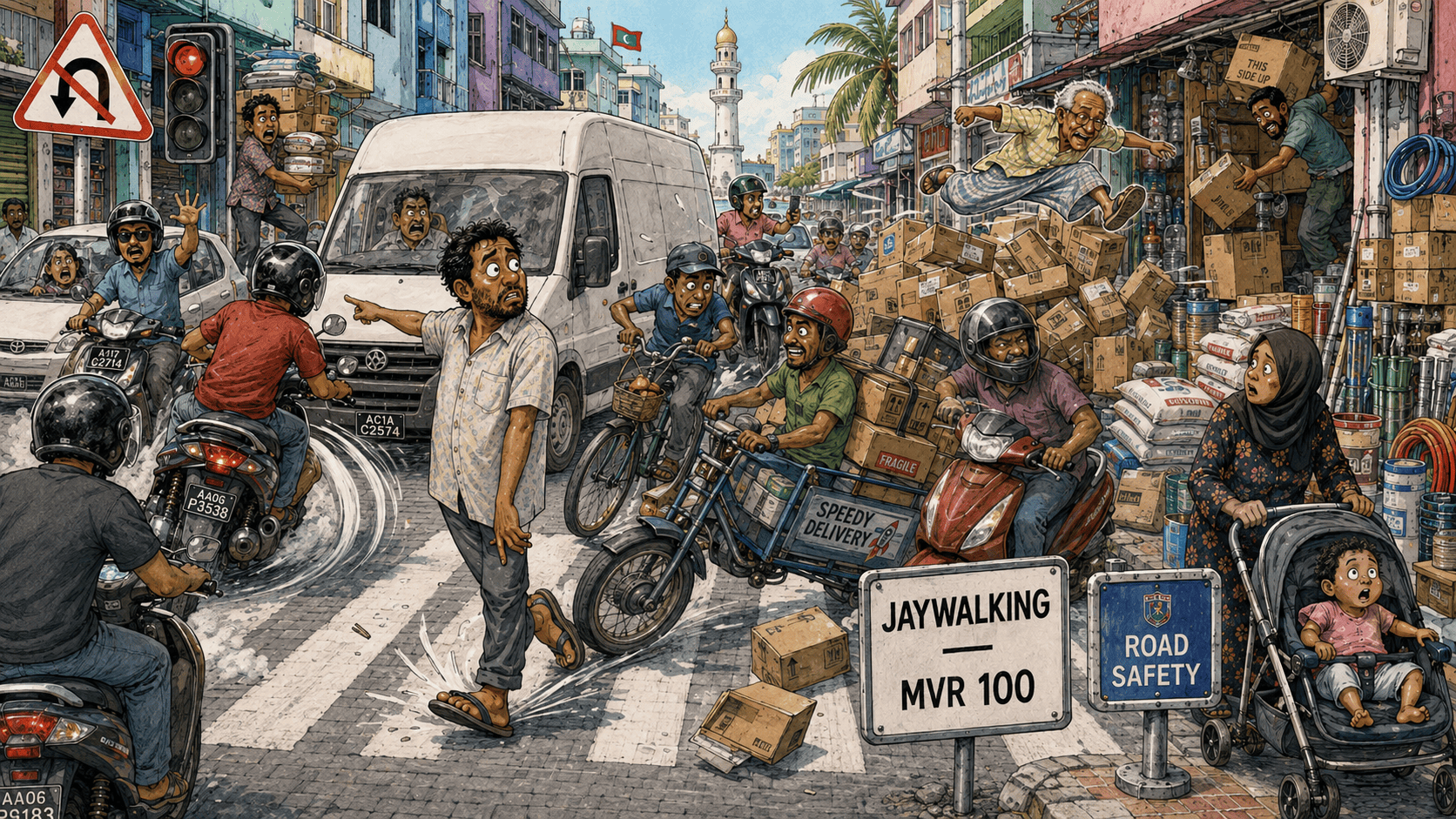
Parliament has passed the new Land Transport Bill, and among its many provisions is one that has already attracted public attention: a fine of MVR 100 for crossing the road illegally.
In other words, jaywalking is finally about to become an offence in the Maldives.
This is good news. It is necessary. It is long overdue.
It is also rather like introducing a rule against splashing water while the entire house is flooding.
To be precise, the bill was passed on 26 August with 47 members voting in favour and 12 against. It is not yet law at the time of writing. It must first receive presidential assent, after which it is expected to come into force in 30 days. Article 46 requires the ministry to establish the rules pedestrians must follow, including where and how roads may be crossed. Article 131 then imposes the MVR 100 fine on anyone who crosses in violation of those rules.
So, technically, the state has not merely fined jaywalking. It has announced that it will first define walking properly and then charge us for improvising.
This is entirely reasonable. In a city as crowded as Malé, pedestrians cannot continue crossing wherever inspiration strikes them. A road is not a living room, and reaching the other side is not a spiritual calling that must be answered immediately. When a zebra crossing is nearby, people should use it. When traffic is moving, people should wait. When a child is watching, adults should perhaps avoid demonstrating that road safety is an optional subject.
But any serious discussion of pedestrian responsibility must begin with an awkward academic question: what exactly is a pedestrian expected to do after reaching the zebra crossing?
Pray?
In most countries, the zebra crossing is a recognised part of the road-safety system. It signals that pedestrians have a designated place to cross and that motorists must respond accordingly. In Malé, it often functions as decorative road art. The pedestrian stands beside it. The motorcyclist sees the pedestrian. Their eyes meet. For one brief moment, two citizens participate in a beautiful act of mutual recognition.
Then the motorcyclist accelerates.
Sometimes another vehicle follows. Then another. Eventually, the pedestrian crosses during a gap, not because the zebra crossing protected him, but because traffic briefly became tired of trying to kill him.
The authorities are aware of the problem. In 2025, Police and Malé City Council launched a campaign to paint “LOOK RIGHT” near selected crossings. This was useful advice. In Malé, however, one must also look left, ahead, behind, diagonally and occasionally upward, because the normal geometry of traffic cannot always be trusted.
The new bill is broader than the MVR 100 fine. It introduces a demerit-point system, provides for automatic licence suspension when unpaid traffic fines reach MVR 5,000, proposes a 20-year general lifespan limit for vehicles, and establishes a Greater Malé Transport and Mobility Office. These are serious measures and, on paper, part of a more modern transport framework.
The phrase “on paper” is doing considerable work in that sentence.
Road discipline is not created by legislation alone. It is created through road design, public education, consistent enforcement and a shared belief that rules apply even when no police officer is watching. At present, Malé possesses written rules, painted lines, traffic signs and a highly creative population determined not to be limited by any of them.
Lane discipline, for example, is treated less as a legal obligation and more as a suggestion from a distant relative. A rider may suddenly move into the opposite lane because the correct lane contains three vehicles and patience is apparently a luxury item. The person already travelling lawfully in that lane must then slow down, move aside or achieve immediate enlightenment.
Indicators are equally misunderstood. Their proper function is to communicate an intention before a manoeuvre. In Malé, they are often activated during the turn, after the turn or not at all. The vehicle simply changes direction, leaving everyone else to discover the plot twist in real time.
And then there is the U-turn.
The Maldivian U-turn is not planned. It happens. A motorist remembers that his destination was behind him and immediately invites the entire road to participate in this personal revelation. No warning. No gradual positioning. Just a sudden horizontal act of faith.
If pedestrians are to be fined for crossing roads unpredictably, motorists must be held equally accountable for driving unpredictably. Otherwise, we are not creating road safety. We are merely deciding which group is easier to fine.
Then we come to the pavement—or what urban-planning literature would describe as pedestrian infrastructure and Malé businesses sometimes describe as additional storage.
Walking along certain streets requires the balance of a gymnast, the flexibility of a yoga instructor and the quiet acceptance of a man who has made peace with death. One shop has placed cartons outside. Another has displayed hardware. A motorcycle occupies what remains. A delivery is in progress. Somewhere beneath all this commercial activity, according to municipal records, there may be a pavement.
The pedestrian must step onto the road to continue walking. Once on the road, he may eventually cross it. Under the new system, this could make him an offender.
The logic is exquisite. First, we remove the pedestrian’s safe space. Then we punish him for leaving it.
Police have recently been towing vehicles parked on pavements and pedestrian areas in Hulhumalé, reminding the public that these spaces are legally reserved for those on foot. Similar enforcement has also targeted illegal parking on major roads in Malé. These efforts are welcome, but occasional operations cannot substitute for ordinary, continuous enforcement. A rule enforced for one week and forgotten the next is not a rule. It is an awareness campaign with a towing truck.
There is also a larger principle involved. Road safety is a system of reciprocal duties. The pedestrian must cross responsibly. The motorist must yield where required, remain in the correct lane, signal before turning, avoid reckless U-turns and keep off pedestrian spaces. Businesses must not convert pavements into warehouses. Authorities must maintain crossings, signs, lighting and walkable routes. Police must enforce all these duties consistently rather than waiting for public outrage to select the offence of the month.
Academically speaking, effective traffic governance depends on the system being coherent. Sarcastically speaking, everyone must stop behaving as though the road was inherited from their grandfather.
The MVR 100 fine may help. Even a small penalty can influence behaviour if people believe there is a realistic chance it will be imposed. But deterrence depends less on the amount than on certainty. A fine that exists only in a statute is merely literature—and unlike most literature, nobody reads it voluntarily.
The law must also be implemented with common sense. The ministry’s regulations should clearly define how far a person must be from a designated crossing before crossing elsewhere becomes illegal. They should account for roads with no pavement, crossings that are poorly placed, paths obstructed by vehicles or merchandise, people with disabilities, the elderly, children and emergency situations. The public must know the rules before enforcement begins. Otherwise, citizens will learn the law in the traditional Maldivian way: when someone uploads a fine slip to Facebook.
Most importantly, enforcement must be balanced. If a pedestrian pays MVR 100 for crossing outside a zebra crossing, the rider who refuses to stop at that zebra crossing should not be allowed to disappear majestically into traffic. If a pedestrian is told to remain on the pavement, the shopkeeper occupying it and the motorist parked on it should receive more than a polite social-media reminder.
The purpose of a road law is not to discipline one category of road user. It is to establish a predictable public space in which everyone knows what others are likely to do. Predictability saves lives. At present, travelling through Malé often demands the reflexes of an action hero and the fatalism of a philosopher.
So yes, let us have the jaywalking law. Let us use zebra crossings. Let us teach children to cross safely and adults to resist crossing wherever their feet develop political independence.
But let us also recognise the whole road.
Fine the jaywalker. Fine the reckless rider. Tow the pavement-blocking vehicle. Remove the shop stock. Enforce the lane. Penalise the sudden U-turn. Protect the zebra crossing. Design pavements that human beings can actually use.
Because Malé does not suffer from a shortage of rules. It suffers from our remarkable national ability to regard every rule as excellent advice for somebody else.
If we are going to bring order to our roads, one law may not be enough. We may indeed need a road-traffic Bible.
But even a Bible is of limited use when everyone believes he is the main character—and that the road will part for him.