Mahdi Ahmed

Scripting waves of imagination from the sunny side of the Maldives.

AHMED NIMAL: COMMANDING THE SCREEN WITHOUT A WORD WASTED

One of the great pleasures of writing for cinema is crafting characters who carry weight without explanation — characters who can shift the energy of a scene the moment they step into frame. In Kan’bulo, that weight belongs to Ahmed Nimal’s portrayal of Rauf.

Working with Nimal is a lesson in how less is always more when you trust the actor. His performance isn’t loud. It’s not theatrical. It doesn’t demand attention — it commands it. From the earliest drafts, Director Munavvaru and I knew Rauf needed to be played by someone who could embody presence with precision. Someone who understands that authority doesn’t come from shouting; it comes from the quiet confidence of someone who believes they control the room, the situation — and sometimes, the people.

Watching the dailies and the rough cut, it became clear to me how much Nimal brought beyond what was written. His understanding of pacing, of silence, of stillness, transformed simple scenes into something tense, layered, and unforgettable. His performance shapes the emotional landscape of this film. He fills the gaps between the lines with something unspoken but deeply felt.

Audiences may not know what to make of Rauf at first. And that’s by design. Ahmed Nimal ensures that with every glance, every gesture, they’ll lean in closer — trying to understand him, trying to figure him out. That is the mark of an actor fully in control of his craft.

As a screenwriter, there’s no greater reward than seeing an actor breathe life into a role in ways you didn’t even imagine. Ahmed Nimal does this, and more. His work in Kan’bulo will stay with you long after the credits roll.

Kan’bulo is set to be released on 31 August 2025.

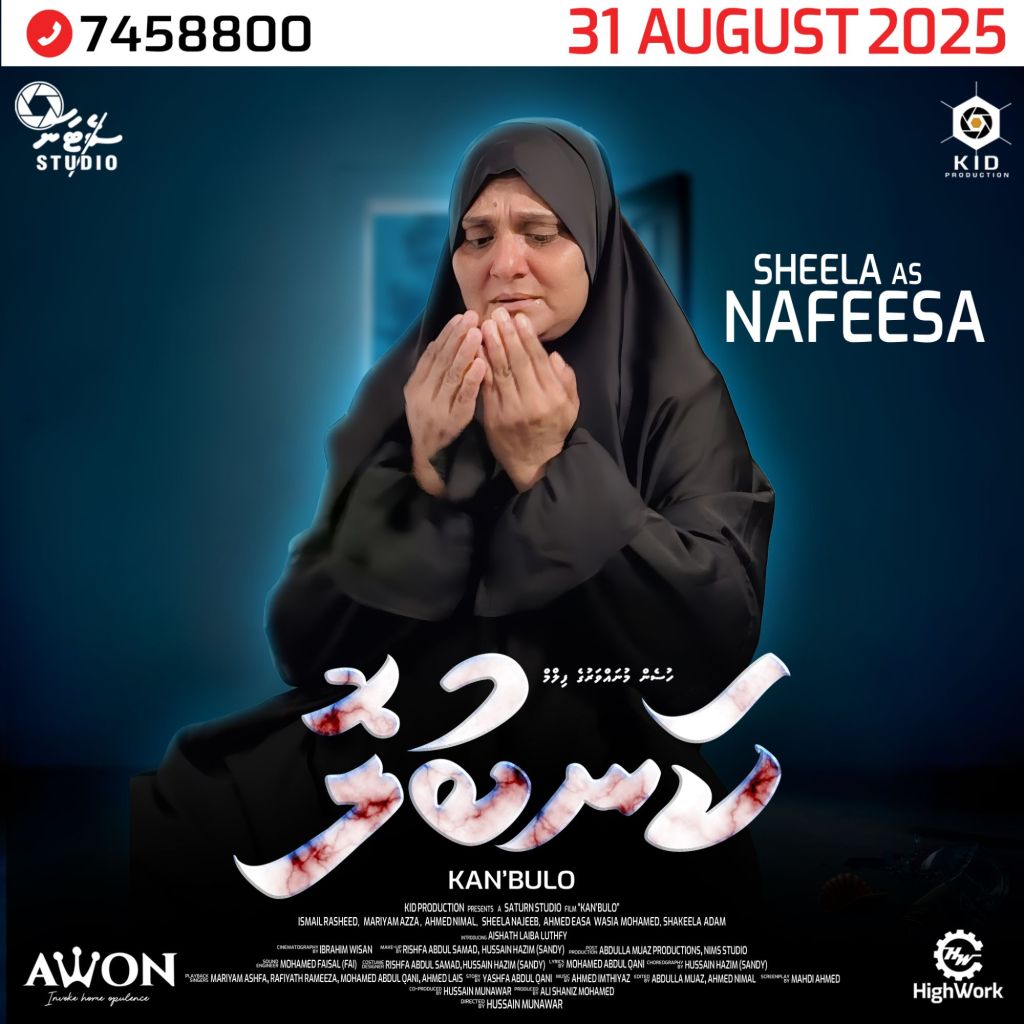
SHEELA NAJEEB: THE QUIET FORCE BEHIND NAFEESA

As a screenwriter, you often build characters knowing full well they require an actor with presence beyond words — someone who understands that not all performances are loud, but the best ones linger long after the scene ends. In Kan’bulo, Sheela Najeeb’s portrayal of Nafeesa is a textbook example of this rare craft.

Sheela doesn’t just perform — she elevates. What she brings to Nafeesa isn’t simply emotion; it’s a kind of silent authority, a dignity wrapped in layers of grief, faith, and resilience. She carries the weight of the character’s suffering with remarkable restraint, never slipping into melodrama. Her stillness, her pauses, the precision in how she delivers even the smallest reaction — these are not accidental choices. They are the marks of an actor deeply tuned into the unspoken architecture of a scene.

What’s equally remarkable is how Sheela’s performance functions like a gravity well for the ensemble. She anchors those around her, allowing other actors to find the right emotional temperature within their own roles. In scenes where the material is heavy, she brings balance. In scenes where others might falter, she raises the bar through sheer presence.

As a screenwriter, this is the kind of actor you dream of writing for — someone who understands the power of subtext, who knows the difference between playing a line and living inside it. Watching the dailies and now the rough cut, I can say this with certainty: Sheela Najeeb gives Nafeesa the quiet strength the story demands. And through her, everyone else shines brighter.

In Kan’bulo, her work isn’t just a performance. It’s a masterclass in understanding that sometimes, a mother’s grief and love can fill a screen more completely than any dialogue ever could.

Kan’bulo is set to be released on 31 August 2025.

WHEN A POSTER HURTS MORE THAN A SCENE

This morning, the official poster for Kanbulo was released.
And if it made your heart skip a beat — good.
It’s meant to.

A girl. A newborn.
Blood-soaked hands.
Eyes wide open — not with fear… but with something worse: disbelief.
And yet, she’s still standing.

The girl on this poster — portrayed heartbreakingly by Mariyam Azza — came to me first through the pages of Yuktha, the 2006 National Award-winning novel inspired by true events.
I remember the moment I finished reading it: I was frozen. Gasping. Shattered.
And I knew — without a doubt — that she would never leave me until her voice reached the screen.

The poster doesn’t sell a fantasy. It doesn’t glamorize. It doesn’t comfort.
It unsettles.
Because Kanbulo isn’t here to entertain.
She’s here to speak — for those who never could.

Writing Kanbulo wasn’t like any other screenplay.
It tore something out of me.
There were days I sat blank, unable to type a word.
And nights when writing just a single scene left me emotionally gutted.
But I kept going.
Because silence was never an option — not for her.

We renamed the film Kanbulo — a name spoken with affection, like “sweetie” or “darling.”
But don’t be fooled by its softness.
This film bites. It bleeds. It fights back.
It confronts the quiet violence so many women endure — behind closed doors, beneath polite conversations, under the weight of shame that isn’t theirs to carry.

The official poster, brilliantly designed by Abdulla Muaz, captures that very roar—unflinching, visceral, and impossible to look away from.

This isn’t fiction.
It’s a mirror.
One many will want to look away from.
But I hope you won’t.

I’m proud to be reuniting with director Hussain Munavvaru for our fourth film together. After Kamanaa, this film takes a very different turn.
Kanbulo doesn’t flirt. It doesn’t seduce.
It screams.
And for once, we’re ready to listen.

Kan’bulo opens 31 August 2025.
And when it does — I hope it stirs something in you.
Not just pity. Not just rage.
But action.
Empathy.
Reflection.
And the courage to believe those who’ve been silenced for far too long.

Until then —
Hold your daughters.
Protect the vulnerable.
And when someone finally trusts you enough to speak…
Listen. Fully. Fiercely. Without turning away.

F1 (2025): KOSINSKI’S PIT-PERFECT LAP

I revved into F1 (2025) expecting Top Gun: Pit Crew Edition — Brad Pitt, visor down, throttle open, powering through the backstretch of midlife. And sure, that turbo-charged swagger is here. But director Joseph Kosinski doesn’t just run a few hot laps for show — he gives us a full Grand Prix of emotion, grit, and grease. This isn’t just another studio pit stop — it’s a championship-level drama wrapped in racing gear.

Kosinski drives the film like someone who knows every corner of the circuit. Fresh off the Top Gun: Maverick podium, he brings the same aerodynamic precision — but this time, he downshifts when needed. F1 isn’t just spectacle; it breathes. He’s got a mechanic’s eye for detail and a racer’s instinct for timing, crafting scenes that glide, grip, and occasionally gut-punch. Under his direction, F1 becomes more than a race movie — it’s a story of wear, tear, and redemption, told in carbon fiber.

Pitt plays Sonny Hayes, a once-legendary driver pulled back to the grid to coach a rising star — Damson Idris, magnetic and refreshingly grounded. It’s the classic “one last lap” setup, but Pitt doesn’t come in hot. He eases into the role with restraint, playing Sonny like a man still haunted by the corners he missed — both on the track and off. There’s a scene where he watches Idris from the pit wall after a brutal qualifying run — no words, just a look that says, I’ve been there. It’s a quiet pass of the baton. No melodrama. Just respect.

Javier Bardem and Kerry Condon round out the team with precision casting. Bardem, as the seasoned team principal, mixes pit wall wisdom with ruthless edge — a man who can quote philosophy and still gamble on slicks in the rain. His moments with Pitt crackle, like two old engines revving in sync, each carrying scars from different races. Meanwhile, Condon plays the team’s technical director with steely calm. She’s the data whisperer, the emotional barometer, the quiet pulse beneath the roar. Together, they give the film its backbone.

And the racing? Holy downforce. F1 doesn’t rely on green screen trickery — it hugs the tarmac. Real cars, real tracks, real speed. Every turn, overtake, and braking point feels electric. Claudio Miranda’s cinematography is pure art — racing shot like high-velocity ballet. You don’t just see the speed. You feel it press into your chest.

Hans Zimmer doesn’t just score the film — he tunes it. His compositions rise and idle like an engine under pressure, syncing perfectly with the film’s emotional pulse. It’s not peak bombastic Zimmer — it’s restrained and elegant.

What really impresses is how F1 downshifts at the right moments. Between tire screeches and engine roars, it finds its quiet gears. The bond between Pitt and Idris is warm and lived-in — like two drivers who’ve seen different races but respect the same finish line. Their chemistry never fishtails into sentimentality. It stays grounded.

Sure, the plot hugs the underdog racing line a little tightly, and the final stretch may be a touch too clean. But when a film lets you feel every emotional gearshift, every mental chicane — you don’t mind a smooth corner or two.

F1 isn’t just about taking the checkered flag. It’s about staying in the race — battered, aging, but still chasing the ghost of who you once were. Brad Pitt may be burning through the latter laps of his career, but here, he’s running rich — eyes on the apex, soul on the line.

Slam the pedal. This one’s worth the full circuit.

P.S. Pitt and Idris actually drove specially modified Formula 2 cars dressed up to look like F1 monsters. With real telemetry, real rigs, and real speed. So, when you see Pitt dive into a corner at 150 mph, that’s no digital illusion. That’s a man inside a carbon-fiber bullet, grinning like a driver who still lives for the redline.

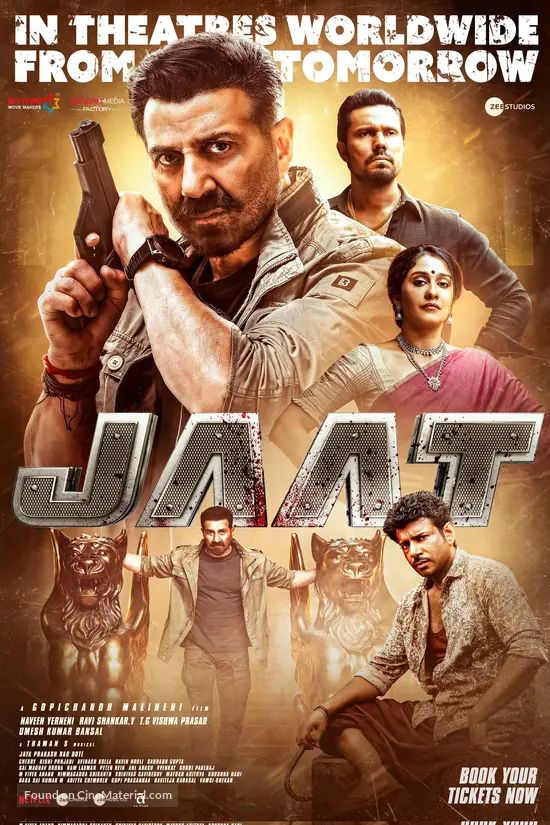
JAAT (2025): SO RIDICULOUS, IT’S GLORIOUSLY ADDICTIVE

Forget logic—Jaat kicks it off in a hot Andhra coastal village terrorized by Ranatunga (Randeep Hooda), a Sri Lankan crime lord who discovered JTF gold and went full-on despot mode. Enter Sunny Deol as a mysterious stranger/ farmer-turned-saviour who casually demands, “Sorry” for spilled idlis—because yep, that’s how action drama begins these days.

Our hero is Baldev Pratap Singh, the Jaat, who said it best: “Yeh dhaai kilo ke haath ki taakat poora  dekh chuka hai. Ab South dekhega.” (“The power of these two‑and‑a‑half‑kilo hands has already rattled the North. Now the South will feel it.”) 

That one-liner lands like a cannon. It’s Salman Khan’s Kuch Kuch Hota Hai heartbreak, meets Damini righteous rage, all wrapped in one glorious punch.

What follows is 153 minutes of physics-defying carnage—villains flying off in mid-air, idli plates turning into high-stakes catalysts, and massive hero-origin flashbacks that feel half indie documentary, half South Indian vigilante spectacle. Director Gopichand Malineni brings his Telugu flair to Bollywood with manic speed and massy swagger.

Sunny is in full “growl-and-shout” mode—less method actor, more method thunderbolt or bulldozer. Randeep Hooda? Menacing, regal, and with enough screen presence to make you forget Sunny exists—within seconds. He has a certain swagger when he smokes his bidi.

Sure, the second half sputters with slower pacing and melodrama, but who cares when there’s an item song (“Sorry Bol”) that practically dares you to stay seated?

Final Take

Plot: A stranger with a beef over idlis crashes a criminal empire.

Action: Bodies explode like Bollywood fireworks.

Dialogue: Stirring one-liners delivered with all the conviction of a guy lifting gold bricks for breakfast.

Fun Factor: Ridiculously watchable—even if you know it’s ridiculous.

Why I Rooted for It:

1. Sunny’s charisma is colossal: you believe those hands could rip through steel.

2. It’s unapologetically dumb in the best way—popcorn cinema that never apologizes.

3. That “two-and-a-half-kilo” line? Whistle-worthy moment.

If you’re in the mood for massy mayhem, nostalgic bravado, and one spectacularly silly hero sequence after another—Jaat is your guilty pleasure. It’s absurd, it’s indulgent, and yes, you’ll find yourself cheering loud enough to wake the village.

P.S. I’ll probably watch it again the next time I feel low on adrenaline. Even my wife—who treats slow-mo punches like mosquito bites on her patience—was hooked. She said, “This is nonsense.” Then sat stone-faced for 153 minutes like it was the SATs.

THUDARUM (2025): WHEN MALAYALAM CINEMA WHISPERS THUNDER AND THAT SMILE…

There’s something quietly powerful about a film that doesn’t beg for your attention. Thudarum, directed by Tharun Moorthy, isn’t trying to be loud. It doesn’t explode with plot twists or shout with background scores. Instead, it breathes. It lingers. It invites you in.

At the center of this stillness is Mohanlal, playing Shanmughan—a humble taxi driver from Ranni, known lovingly as “Benz.” Not because he owns a luxury car, but because he drives a lovingly preserved vintage Ambassador. Like the car, Shanmughan is solid, graceful, and full of unspoken stories. That small detail says everything without ever spelling it out.

And then there’s George.

If Shanmughan is a smoulder waiting to flare, George is ice in human form. Played with unnerving calm by newcomer Prakash Varma, George is the kind of villain who never yells. He doesn’t need to. His stillness is menacing. His smile? It chills the spine. Every time he appears on screen, the temperature drops just a bit.

The plot—on paper—is familiar: guilt, justice, a slow-burning sense of revenge. But in Tharun Moorthy’s hands, it becomes something far more personal. This isn’t just a story being told; it’s one being remembered.

What truly stands out is how the film weaves in nostalgia. Old Malayalam songs aren’t just there for aesthetic—they carry memory. They haunt. They heal. They act as bookmarks in Shanmughan’s emotional journey. For older audiences, these tunes will hit like waves of memory; for younger ones, they may spark curiosity.

Visually, Thudarum is pure mood. The sleepy lanes of Ranni, the warm glow of late afternoons, the shadowy corners of quiet homes—everything is framed with purpose by cinematographer Shaji Kumar. And Jakes Bejoy’s background score? It whispers, it doesn’t scream. It holds the film’s emotional weight without ever tipping the balance.

This isn’t a film for those looking for speed. Thudarum walks. Slowly. But that’s exactly the point.

You’re meant to feel the silence. To sit with the characters. To live in their moments.

Watch it for Mohanlal’s haunting restraint.
Watch it for George’s bone-deep chill.
Watch it because every old song carries a ghost.
And because Malayalam cinema, at its best, doesn’t shout. It whispers—and that whisper can be thunderous.

P.S. If this really is Prakash Varma’s debut, we’ve just met one of the most chilling new faces in Malayalam cinema. What a start.

HEVANA MALDIVES– A PRIVATE SLICE OF PARADISE

Tucked away on the serene western edge of V. Keyodhoo, Hevana Maldives is more than just a guest house—it’s a warm island embrace wrapped in comfort, charm, and outstanding service. Our two-night family escape here was filled with memorable moments and heartfelt hospitality.

From the moment we arrived at the jetty, the Hevana Maldives team made everything seamless. Friendly staff welcomed us with genuine warmth, promptly took care of our luggage, and set the tone for a stress-free vacation.

Located in a peaceful, private corner of the island, Hevana Maldives felt like our own beachfront haven. The entrance carried a homely vibe—quiet, intimate, and just steps away from a beautiful, spacious beach that felt reserved just for us.

Rooms had already been thoughtfully allocated for each family member. Spacious and family-friendly, ours featured a plush king-sized bed, and an extra bed was added upon request. The bathroom was a pleasant surprise—generously sized with a semi-open shower area that added a rustic Maldivian touch.

But the soul of Hevana Maldives lies in its open-plan main lounge. Surrounded by large windows, including one that overlooks the beach, this space became our gathering hub. It’s where we had our long family chats and even hosted a lively DJ night to celebrate my wife’s birthday.

The beach itself was equally inviting—lined with beach beds and a cozy lounging area where adults could unwind while keeping an eye on the kids enjoying the calm sea.

Dining at Hevana Maldives is an experience in itself. We asked for a local buffet, and the spread exceeded expectations—traditional Maldivian dishes, fresh tropical flavors, and the grilled reef fish? Simply divine. Caught fresh, grilled perfectly, and served with love.

Murakabar, the on-site mini café, was a hit with both the young and the young-at-heart. From local frozen juice bags and ice cream to branded coffee and crema, everything felt like a sweet little indulgence. If you visit, don’t miss their coconut ice cream—it’s unforgettable.

We also ventured out to the famous boat wreck—a short trip made incredibly easy thanks to the Hevana team. For those with an adventurous streak, snorkeling and diving are available too.

When we left, we weren’t just saying goodbye to a place—we were leaving behind a collection of memories. And with one unanimous decision, we promised ourselves: Hevana Maldives will be our yearly tradition. If you’re looking for peace, fun, and a deeply personal island experience—this is where you need to be.

THE QUIET CHECKMATE

Some stories… you don’t just write.
You survive them.

I just wrapped the final scene of a screenplay I’ve been living with for over a month. And I say living with because this wasn’t one of those breezy weekend scripts where characters flirt and plots resolve with a kiss in the rain. No. This one had sharp edges. And it knew where to cut.

It took me to dark, silent places—places where grief doesn’t shout, it watches. Where every character’s arc is forged in silence and pain. I found myself pacing my room at midnight, questioning not just the characters’ motives, but my own. I felt like I was walking barefoot on broken glass—knowing I had to cross, but dreading every step.

At one point, I had to pause and study the intricacies of a specific chess move. I thought I’d just Google a cool play and move on. But no. The scene demanded more. The stakes were higher. So I ended up neck-deep in Sicilian Defense, Zugzwang, and the beautiful cruelty of the Smothered Mate. That moment became a quiet war. No weapons. Just minds trying to outlive each other on a checkered battlefield.

What began as a simple idea—a flicker—turned into something heavier. Something real. This script tested me. And strangely, I’m grateful for that.

I’m not going to reveal the title just yet. Not the plot either.
Let’s just say… some sparks don’t just light up a room.
They burn through your soul.

More soon.

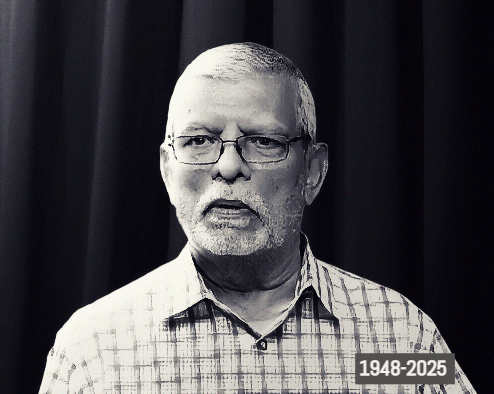
MADULU MOHAMED WAHEED: THE LAST VERSE OF A GUARDIAN

This morning—April 14, 2025—the final chapter of a remarkable book closed.

My dear friend, Madulu Mohamed Waheed, passed away at the age of 77, while seeking treatment for his illness.

He was no ordinary man—he was a living manuscript.

A towering volume in the library of Maldivian literature and journalism.

His words did more than fill pages—they stirred thought, preserved culture, and gave breath to Dhivehi language.

He was not merely a writer. He was the binding that held our language together.

In 2019, he was awarded the National Award of Honor—a bookmark in a career richly underlined by purpose.

As Special Envoy of the Dhivehi Academy, he wrote till the ink ran dry.

His dedication? Unmatched. His margin notes? Timeless.

But there’s a personal grief scribbled in the margins of my heart.

He used to call some mornings and say, “Free for breakfast?”

It was never just about eating—it was about the chapters we were both writing.

About the drafts, the rewrites, the plots half-formed in our minds.

He’d help me find the right phrase, the perfect form, the word that unlocked a scene.

And when he published something new, he placed a copy in my hands.

Weeks before illness stole his final sentences, he said to me: “Let’s meet for another breakfast soon.”

We never turned that page.

And after my father passed, I found myself in one of those breakfasts—lost.

I spilled my sorrow on the table like ink.

He didn’t edit my grief.

He told me stories— verses about my father I had never read.

He reminded me that no one truly disappears from the book of life, as long as someone remembers their chapter.

Today, I feel the same ache.

Another book I cherished has closed.

But some books never really end.

They sit on our shelves—dog-eared, beloved, often revisited.

Rest now, my dearest friend.

The nation mourns.

I mourn.

And somewhere, in the silence between sentences— your voice will still turn the page.

Thank you for every word.

Rest in peace.

DRAGON (2025): A DRAMEDY ON REDEMPTION

“Dragon” (2025) is a Tamil cinematic gem that takes you on an emotional rollercoaster, blending humor, drama, and romance into a narrative that’s both engaging and thought-provoking. Written and directed by Ashwath Marimuthu, this film showcases the journey of D. Raghavan, affectionately known as ‘Dragon,’ portrayed with remarkable depth by Pradeep Ranganathan.

Pradeep masterfully captures the essence of Raghavan, a rebellious college student burdened with 48 arrears, making his journey from academic underachiever to a man confronting his past both believable and deeply engaging. Pradeep’s performance is a harmonious blend of humor and emotional depth, allowing audiences to connect with Raghavan’s struggles and triumphs on a personal level. His nuanced acting ensures that Raghavan’s transformation is not just seen but felt, making this film a truly immersive cinematic experience.

Anupama Parameswaran shines as Keerthi, bringing a nuanced performance that adds layers to the storyline. Kayadu Lohar, as Pallavi, delivers a compelling portrayal that complements the ensemble cast, including notable performances by Mysskin, Gautham Vasudev Menon, and K. S. Ravikumar.

Leon James’ musical score is the soul of the film, perfectly capturing the essence of each scene and elevating the overall experience. The cinematography by Niketh Bommireddy paints each frame with a vibrancy that mirrors the protagonist’s tumultuous journey.

The editing by Pradeep E. Ragav crafts a rhythm that effortlessly shifts from college mischief to heartfelt drama. Each scene flows smoothly, ensuring that even the predictable beats hit just right. It’s as if the cuts know exactly when to hit the gas or slam on the brakes, keeping the film crisp and engaging—solid editing that gives Dragon its cool, modern pulse.

However, what sets “Dragon” apart is the adept screenplay by Marimuthu, blending conventional narrative structures with inventive storytelling techniques. His screenplay seamlessly integrates humor and drama, ensuring that each scene propels the story forward while deepening character development. The strategic placement of comedic elements provides relief without undermining the narrative’s emotional weight. Additionally, the screenplay’s pacing maintains audience engagement, balancing moments of levity with poignant sequences that resonate on a human level.

This film seamlessly weaves a tale of redemption without being preachy. It holds a mirror to society’s pressures and the lengths one might go to overcome personal failures. The film doesn’t shy away from showcasing the protagonist’s flaws, making his redemption arc all the more satisfying.

In essence, “Dragon” is more than just a film; it’s an experience that resonates deeply, reminding us of the power of second chances and the human spirit’s resilience. A must-watch that leaves you reflecting long after the credits roll.

P.S. The poignant scene at the end between Dragon and his father, Dhanapal, portrayed with heartfelt sincerity by George Maryan, is one of the film’s most emotionally charged moments. If that scene doesn’t open your floodgates, then maybe nothing will.